


AI isn’t slowing down and the people building outside the closed labs are feeling it. Compute is sold out. Hardware is hard to source. The frontier is being walled off by companies that increasingly decide who gets access to what.
The clearest recent example: Anthropic teased Claude Mythos and then declined to release it, citing concerns that humans couldn’t be trusted with it. OpenAI, founded as a nonprofit by Sam Altman and Elon Musk, is now closed-source and chasing a trillion-dollar valuation.
We wrote more about Claude Mythos in the article below:
Against that backdrop, Bittensor’s bet is simple: closed always starts faster, but open always wins. Linux did it. The internet did it. AI is next.
Why Open Wins In Practice
Bittensor is 128 subnets competing for a slice of TAO, each running its own incentive market. The mechanism is the moat: if you can solve the task best, you get paid. That’s it. No gatekeeping, no application process, no jurisdictional limits.
The results are already showing up:
- Resi (real estate appraisal) backed by Stillcore and DSV, has trained an appraisal model hitting 98.69% accuracy, beating Zillow’s ~95%. Their long-term goal is settlement and intelligence layer for tokenized real estate.
- Targon (Subnet 4) co-authored a paper with Intel on encrypted decentralized compute. Hedge funds and governments can now access GPUs without leaking sensitive data.
- Templar (Subnet 3) pulled off a 72-billion-parameter LLM training run on permissionless compute. Anthropic’s CEO acknowledged it. Jensen Huang publicly endorsed the approach.
These are the real results we’re already experiencing on Bittensor, produced by strangers competing for token (TAO) rewards.
The Bigger Idea
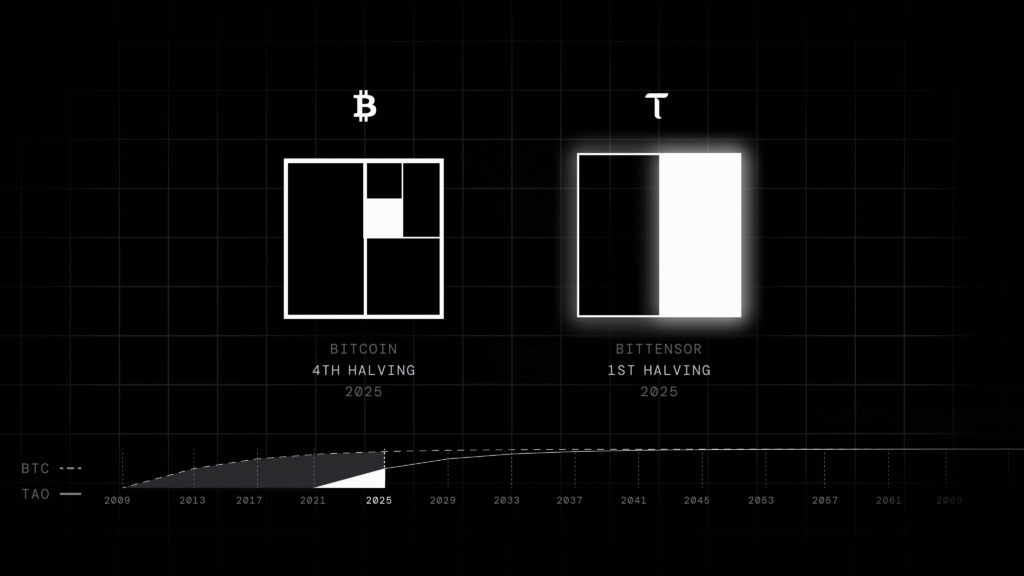
Bitcoin’s mining network consumes more electricity than Poland and after the block is mined, that compute goes nowhere. Bittensor’s thesis is that the same incentive structure, pointed at AI, captures stranded talent and stranded compute globally and turns it into open-source intelligence.
That’s why the model isn’t limited to AI. Vanta is using Bittensor incentives to build a prop firm. Other subnets reward influence, data storage, inference, video compression. The incentive mechanism is the product. AI just happens to be the most lucrative thing to point it at.
The Valuation Gap
Nvidia trades at $5 trillion. Google, Microsoft, and Apple are all in the same neighborhood. Every Mag 7 company is now an AI company.
Bittensor, the entire open-source AI network competing with all of them, sits at a $3 billion market cap.
It’s why Barry Silbert is publicly calling for 100–500x from here. Closed AI starts faster. Open AI catches up. And the gap between $3B and $5T is the trade.
Watch the full video below:
Enjoyed this article? Join our newsletter
Get the latest TAO & Bittensor news straight to your inbox.
We respect your privacy. Unsubscribe anytime.
Enjoyed this article?
Join our newsletter
Get the latest TAO & Bittensor news straight to your inbox — every morning before markets open.

No comments yet — be the first.