

Anyone arriving at Bittensor for the first time runs into the same problem. There are 128 active subnets, each running its own competition, and almost no obvious entry point for someone who wants to start mining without spending a week reading documentation.
Poker44 (SN126) is one of the cleaner places to begin, both because the task is well-defined and because the infrastructure is set up to onboard new miners quickly. This guide walks through what the subnet does, what miners contribute, and how to get a miner running end-to-end.
What Poker44 is Solving
Online poker has a structural bot problem that has gotten worse as automated tools become more capable. Bots play hands, exploit human decision patterns, and erode trust at the table.
Poker44 is building an open, competitive evaluation layer for anti-bot detection models, structured around three roles:
a. Validators send real game data to miners across the network,
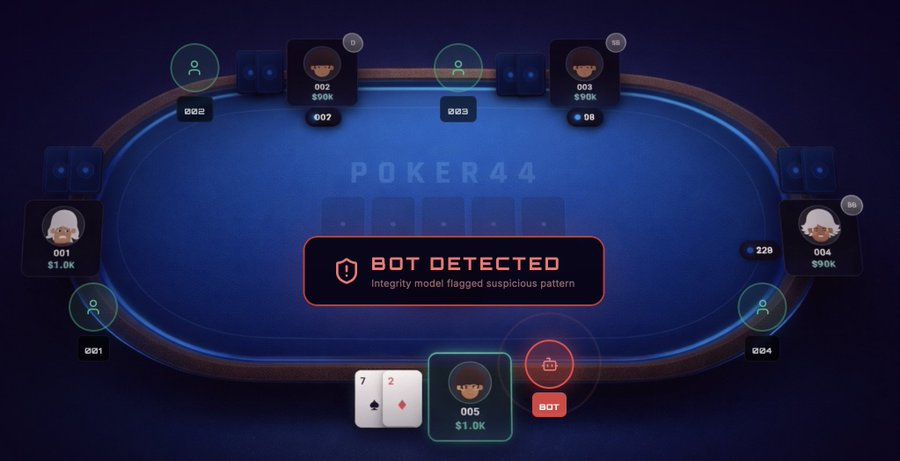
b. Miners run detection models and return a bot-risk score for each chunk of hands, and
c. Reward distribution flows toward models that most accurately distinguish human behavior from bot behavior.
The goal is to detect them accurately, without wrongly flagging legitimate players. That balance is what the incentive structure rewards.
What a Miner Actually Does
A miner on Poker44 is not running a poker room or playing hands. The job is narrow and well-defined:
a. Receive chunks of ‘hands’ from validators,
b. Return a bot-risk score for each chunk through your detection model, and
c. Compete against other miners on accuracy and consistency.
If your model performs well across continuous daily evaluations, validators reward you with higher emissions. If it does not, your share of the subnet’s rewards drops accordingly.
What You Need Before Starting
The setup requirements are minimal:
a. A Linux server,
b. Python 3.10 or higher,
c. A Bittensor wallet with both a coldkey (main wallet for funds and registration) and a hotkey (the operating key your miner uses),
d. A hotkey registered on Subnet 126, and
e. The Poker44 repository cloned locally.
Registration on the subnet requires a small amount of TAO, so wallet funding should be handled before running the registration command.
The Five-Step Setup
The full path from zero to a running miner takes five commands:
a. Create your wallet: btcli wallet new-coldkey –wallet-name mi_wallet_poker44 followed by btcli wallet new-hotkey –wallet-name mi_wallet_poker44 –wallet-hotkey mi_miner_hotkey
b. Register on Subnet 126: btcli subnets register –netuid 126 –wallet.name mi_wallet_poker44 –wallet.hotkey mi_miner_hotkey –subtensor.network finney
This step requires miners to hold some amount of $TAO.
c. Clone the repository: git clone https://github.com/Poker44/Poker44-subnet.git and move into the directory
d. Run the setup script: ./scripts/miner/setup.sh, which installs dependencies and prepares the environment
e. Launch the miner: WALLET_NAME=mi_wallet_poker44 HOTKEY=mi_miner_hotkey AXON_PORT=8091 ./scripts/miner/run/run_miner.sh
At that point, your miner is live and ready to receive evaluation chunks.
How Evaluation and Rewards Work
Validators on Poker44 follow a continuous daily cycle rather than a one-shot scoring process:
a. Fetch the active evaluation batch,
b. Send chunks to all active miners,
c. Compare returned scores against internal labels, and
d. Calculate rewards and update on-chain weights.
The competition runs around the clock, with multiple rounds throughout the day, and miners are not judged on a single request or a lucky round.
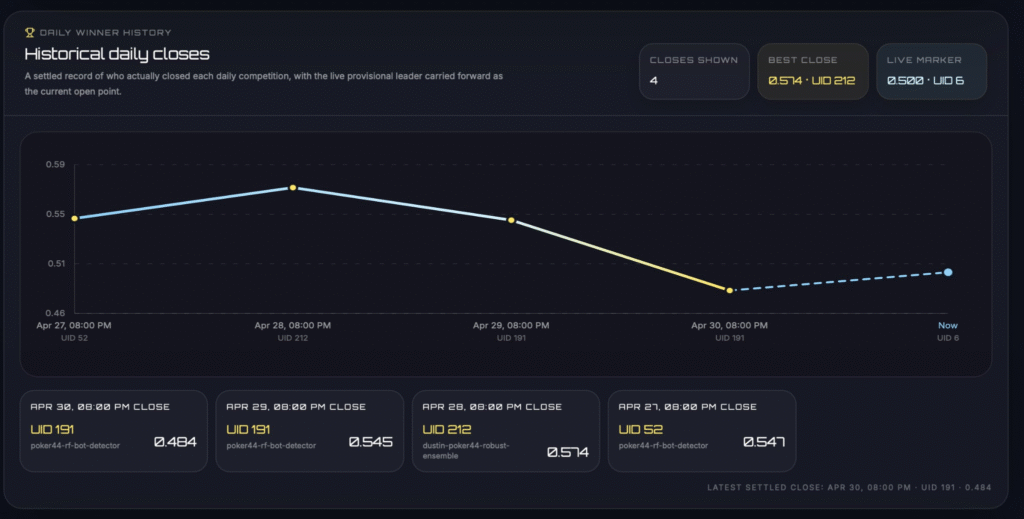
Final standing depends on consistent performance across the full day, which means the strongest models are the ones that detect bots reliably while avoiding false positives on human hands and remain stable whenever validators query them.
Only the best-performing models capture meaningful emissions. Being online is not enough. Performance has to be competitive relative to the rest of the subnet.
Monitoring Your Miner
Once deployed, two things need to be verified separately: The first is that the miner process is running correctly and responding without errors, and the second is that the model is actually producing competitive scores. Both are visible through the Poker44 dashboards:
a. Dashboard: poker44.net/dashboard
b. Miners view: poker44.net/miners
c. Network view: poker44.net/network
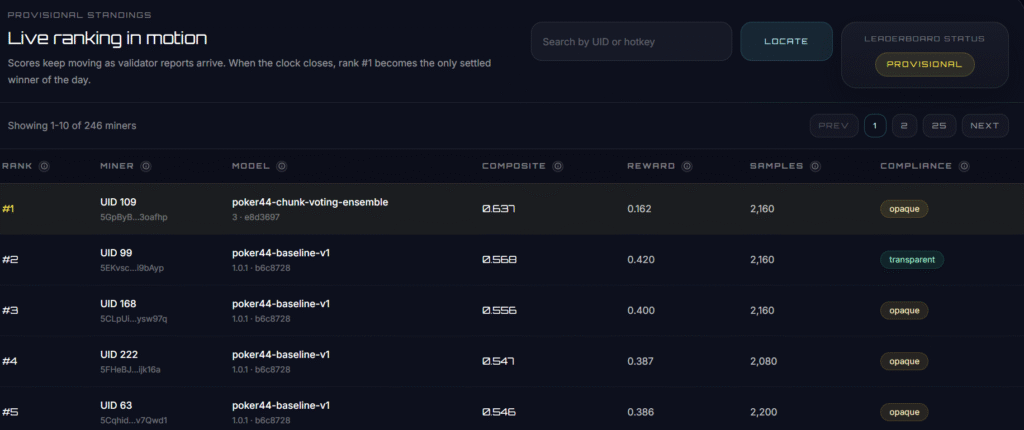
These dashboards show whether a UID is active, how the model is being evaluated, current ranking inside the subnet, and how performance is evolving over time.
A Clean Entry Point Into Bittensor
Poker44 sits at a useful intersection for new miners. The task is clearly scoped, the infrastructure is well-documented, and the competitive surface rewards model quality rather than raw compute.
For anyone who wants to start mining on Bittensor without committing to weeks of orientation, Subnet 126 is one of the more practical first steps available. The community runs an active Discord channel for miners (both new and existing) encountering setup issues, and the iteration loop, ship a model, watch the dashboard, refine, is short enough to learn quickly.
Enjoyed this article? Join our newsletter
Get the latest TAO & Bittensor news straight to your inbox.
We respect your privacy. Unsubscribe anytime.
Enjoyed this article?
Join our newsletter
Get the latest TAO & Bittensor news straight to your inbox — every morning before markets open.

No comments yet — be the first.