

Contribution credit: School of Crypto
There’s one common misconception about Bittensor — it’s only an AI blockchain project. That couldn’t be further from the truth. Bitcast brought marketing into the fold. Hippius took storage onto Bittensor. Lium and Targon are offering compute for a fraction of competitors’ prices. DeFi is the next sector being tackled by this ecosystem.
Minotaur is looking to become a universal intent layer not only for Bittensor, but for all of DeFi and AI agents alike. To understand how big this could be, it’s best to take a trip down memory lane to see where DeFi came from, and where it’s destined to go.
How DeFi Started
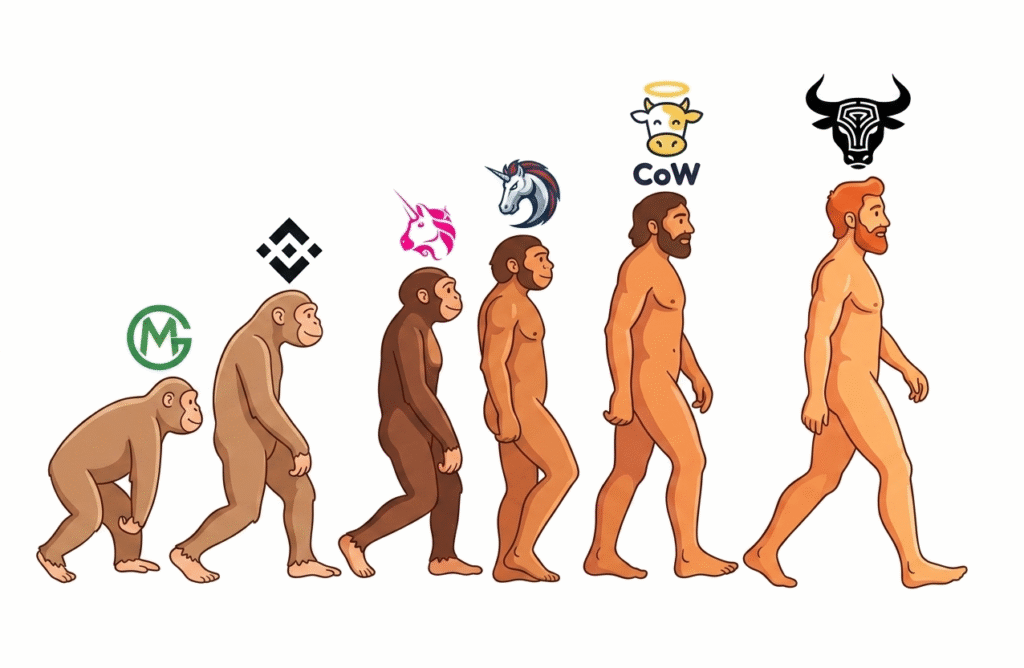
There used to only be one way to trade crypto, and that was through centralized exchanges. Traders needed to trust the safety and security of the Binances of the world in order to make transactions. Liquidity was overflowing; however, the ownership of assets wasn’t a reality.
Then came the advent of decentralized exchanges. First came dApps like Bancor and Kyberswap. Then Uniswap changed the game with automated market makers and liquidity pools (LP), which allowed users to earn fees based on providing crypto to these respective LPs. While this served as a favorable alternative to centralized exchanges, there were still a few issues. Liquidity was fragmented because traders could only swap on each respective DEX.
The solution was the DEX aggregator, popularized by 1inch and Paraswap. Now, users could make a swap and get the best possible price across several DEXs and multiple different chains. While the aggregation of quotes improved selection for traders, there were still lingering issues. Since the routing was on-chain, trades were prone to being sandwich attacked or getting front-run by bots, making transactions more costly. Gas fees occurred whether the trade went through or not, and slippage was inconsistent.
The Intent-Based Revolution
In 2021, CoW Protocol introduced the intent-based infrastructure that has since become the de facto strategy for modern aggregators. Individual “solvers” searched for the best trades off-chain and were rewarded for getting the best price quote for the user. The MEV problem was diminished because signed intents are collected off-chain and settled in batches, preventing them from being exploited in public mempools.
As Paradigm Research explains: “The adoption of intents represents a shift from an imperative to a declarative paradigm, which promises to improve UX and efficiency loss due to MEV leakage significantly.”
The competition between solvers increased the likelihood of better prices, and this architecture still reigns as the bedrock for DEX Aggregators today.
The Gap in the Market
While the intent based solver technology has been a net positive for swapping engines, there isn’t a universal layer to find the best routing for other forms of DeFi such as borrowing, lending, bridging, and other actions.
Intent-based architecture has proven itself powerful for swapping, but the technology has remained largely confined to that use case. For example, if someone wanted to take out a loan for 100K USDC at the best rate, he would have to manually check Aave, Compound, Fluid, and other lending protocols to compare rates and collateral requirements. With universal intent infrastructure, you could submit a single intent stating “borrow 100K USDC at under 5% APR with my ETH as collateral,” and solvers would compete to find you the best match across all lending venues.
The same principle applies to bridging, staking, liquidation protection, and complex yield strategies. Yet today, no single infrastructure optimizes execution across all of these intent types simultaneously. Solvers in a universal network would need to understand lending mechanics, understand bridging protocols, understand yield farming, and stay attuned to how these DeFi primitives evolve. This fragmentation across DeFi use cases is the bottleneck that needs solving.
Minotaur’s Solution Is The Universal Intent Platform
This is where Minotaur comes in.
Minotaur (SN112) is bringing this innovation onto Bittensor, the world’s most innovative incentivization blockchain. However, the DeFi subnet is not building another solver-based DEX aggregator for swapping purposes. Its ambition is to leverage a decentralized intent-based solver engine to coordinate all actions in DeFi.
Minotaur is building this as an open-source decentralized platform in which people can build dApps off it and tap into the technology. Developers and teams will be able to create their own custom intent-based applications on top of the solver engine. Developers can build advanced yield strategies, liquidation protection bots, or agent-native tools.
How Minotaur Works: The Miner-Driven Improvement Model
In the Bittensor ecosystem, there are several subnets like Ridges, Affine, Bitmind, and others that employ their miners to iterate on their models, with the top ones earning emissions for improving it the most. The same can be said for Minotaur.
Miners compete to improve the subnet’s universal intent solver engine model. Every successful iteration and improvement will lead to better routing for any transaction in all of DeFi.
Miners improve the engine by adding support for new DeFi primitives. This includes lending protocols, emerging bridges, staking mechanisms, or yield farming strategies. They optimize routing algorithms for changing market conditions, continuously monitor on-chain data and market signals, and keep execution strategies competitive as the DeFi landscape evolves. The top performers earning the most emissions are those who can anticipate what users will need next and ensure the solver is ready.
The miner’s job is to continuously monitor chains across DeFi and assess all sorts of market data, while staying attuned to execution demand. As new markets and rates emerge, miners will keep the intent solver model amplified and up to date. The whole ethos of Bittensor is to incentivize miners to produce the best results. This inherent DNA of the network perfectly aligns with intent-based model architecture.
While miners improve the solver engine, validators are responsible for ensuring execution quality and integrity. When users submit intents, validators simulate the orders on forked chains to test outcomes before they go live on-chain. They score miners based on execution quality, while rewarding those who provide better results for users.
Validators then reach quorum to confirm that orders meet minimum thresholds before they’re passed to settlement. The dynamic between the miners competing to find the best intent action and the validators scoring them keeps the network honest and aligned with user outcomes.
The Agentic Opportunity
Bittensor has recently been infused with AI agents galore. In fact, we are seeing agents currently running entire subnets on their own, such as the activity between SN97 and SN66. As more autonomous agents join the fold, there is a growing need for a local DeFi execution layer to facilitate transactions on behalf of subnets and miners.
This is where the transition from human trading to Agentic DeFi happens. Agents don’t want to manage slippage or gas wars; they need to declare an intent and have it executed. Minotaur has the potential to be the go-to source for these agents.
As Minotaur’s official X account stated in their March 2026 “Agent Revolution” panel thread: “SN112’s CTO goes into what Minotaur is and how the subnet is designed to operate and facilitate agentic DeFi through ‘intents’.”
Their bio further brands the project as the Agent DeFi Intent Engine. Minotaur plans to integrate with Model Context Protocol (MCP), which will allow AI agents running in environments like Claude and other agentic systems to natively submit intents and execute DeFi transactions without manually navigating multiple protocols.
Current Progress and Roadmap
Minotaur’s roadmap spans 31 weeks from December 2025 to July 2026, with 8 distinct phases that progressively move the subnet from closed testing to full public operation and decentralization.
Phase 0 (Dec ’25 – Apr 14) involved building the intent platform, pivoting from a DEX aggregator model to a generic intent execution platform where the DEX aggregator became the first app, not the platform itself. The team built the miner pipeline, validator consensus, platform fees, frontend, and MCP server, with same-chain swaps tested end-to-end on Ethereum and Base.
Phase 1: Closed Beta — Mainnet (Apr 14 – Apr 28) is where Minotaur currently operates. The DEX aggregator is live on Base and executing real swaps on mainnet. The system is focused on same-chain execution across Ethereum, Base, and Bittensor EVM with team-operated validators and miners.
Currently, most of the core pieces are working: same-chain swaps, simulation, scoring, quorum signing, and the full submission pipeline are all live. The team is actively testing miner-driven solver improvements directly on mainnet and stress testing validator coordination under real conditions.
All intents are already designed to support cross-chain execution at the data level, so APIs won’t need to change when cross-chain is enabled later.
Over the coming days leading into April 28, the focus is on validating miner-driven solver improvements and stress testing validator coordination. After that, the project moves into open-sourcing the codebase, audits, and preparing for Phase 2.
Phase 2: Code Release + Onboarding (Apr 28 – May 5) will open-source the solver SDK, validator, and miner code, allowing miners to use frontier AI models to write solver code as first participants onboard and sync.
Phase 3: Subnet Goes Live (May 5 – May 19) will connect the subnet to Bittensor, where validators and miners register on Subnet 112 and weight setting begins. Bootstrap test miners will be retired as independent miners compete for champion status.
Phase 4: Public DEX Launch (May 19 – Jun 9) will allow anyone to swap on Ethereum, Base, and Bittensor EVM. Initially, only same-chain swaps will be available with no cross-chain bridging yet, and app deployment will remain restricted to the Minotaur team. An audit competition will occur before this launch.
Phase 5: Cross-Chain (Jun 9 – Jun 23) will integrate bridges, implement escrow systems, enable multi-leg intent execution, and harden post-bridge validation with a provider-agnostic bridge adapter architecture.
Phase 6: Fee Calibration + Third-Party Apps (Jun 23 – Jun 30) will calibrate platform fees based on usage data, implement treasury auto-buy mechanisms (WETH → TAO → stake), and allow third-party developers to deploy their own Apps with complete developer documentation for Solidity and JS scoring.
Phase 7: Progressive Decentralization (Jun 30 – Jul 7) will begin decentralizing validator operations
Minotaur as Universal DeFi Infrastructure
The advent of advanced digital commodities has arrived on Bittensor. Subnets, users, and AI agents will need a DeFi layer to make transactions locally on-chain and beyond.
Minotaur displays the makings of a real destination to accommodate each of these parties, bringing Bittensor that much closer to a self-sustaining economy and a universal DeFi layer for the greater DeFi space.
The plans to expand to many chains with dedicated MEV protection to prevent sandwich attacks position Minotaur as foundational infrastructure for the next era of decentralized finance. It will be a place where intents are primitive, and where solvers continuously improve the universal intent solver model, which in turn, gives better strategies and DeFi outcomes to serve users, agents, and the ecosystem as a whole.
Enjoyed this article? Join our newsletter
Get the latest TAO & Bittensor news straight to your inbox.
We respect your privacy. Unsubscribe anytime.
Enjoyed this article?
Join our newsletter
Get the latest TAO & Bittensor news straight to your inbox — every morning before markets open.



No comments yet — be the first.