


Innerworks’ last appearance on the Revenue Search podcast traces the origin story of RedTeam (SN61), one of the strong commercial subnets emerging from Bittensor this year.
The parent company is only three years old, while RedTeam launched just six months ago, yet Innerworks has already reached serious enterprise cybersecurity territory.
The company is generating seven-figure annualized revenue, maintaining 90%+ gross margins, splitting revenue roughly 50/50 between fiat and crypto, and serving major crypto exchanges and Web2 payments platforms.
The Foundation Behind RedTeam’s Rapid Rise
The conversation moved through Innerworks’ origin, the pivot that produced RedTeam, the team structure, the commercial numbers, and the specific adversarial model that separates the subnet from every incumbent in cybersecurity.
1. Innerworks started three years ago as a behavioral sciences firm: The original idea was building the most accurate behavioral profile possible about a real human being, and none of the founders came from a cybersecurity or payments background.
2. The pivot into security came from a device-usage discovery: As the team studied how people interacted with their devices, they realized the behavioral profiles they were building were both instant and unique, with major security implications the original thesis never anticipated. That discovery reshaped the company.
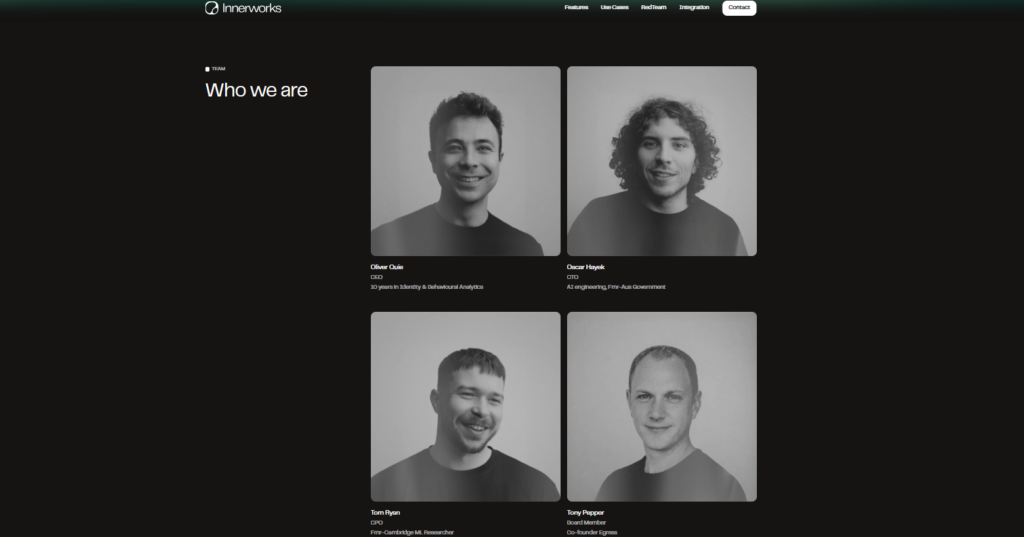
3. The team is now roughly 20 people, engineering-heavy: Almost every seat is a data scientist or a developer, and most carry a machine learning background. Oliver Quie (the CEO) runs Innerworks from Mexico while Oscar Hayek (the CTO) and the rest of the engineering team operate out of London.
4. The adversarial R&D loop predates Bittensor entirely: Long before RedTeam existed, Oscar’s team was spinning up test websites, installing their own detection systems alongside competitors, and attacking all of them daily to reverse-engineer bypasses. Bittensor ($TAO) scaled that same behavior into a global network of hackers.
5. RedTeam (SN61) only really got moving six months ago: The subnet was registered in late December of 2025, but meaningful momentum began in Q1 of this year. Everything Innerworks is producing through RedTeam happened in that six-month window.
6. First seven figures are annualized already on the books: Innerworks confirmed on air they crossed the seven-figure annualized threshold with usage-based B2B SaaS pricing scaling with authentication volume across their client base.
7. Gross margins sit above 90% per deal: Because RedTeam handles R&D through miner competition rather than in-house inference infrastructure, unit economics stay clean even as attack sophistication climbs upward.
8. Revenue splits fifty-fifty between fiat payments and crypto: They get revenue from big crypto exchanges on one side. Web2 platforms with Stripe-style and Buy Now Pay Later functionality on the other. Both categories buy the same three signals: is the user human, is this the right device, and are they in a permitted jurisdiction.
9. Backed by GTV, Yuma, and DCG: All three invested early and helped with incubation into Bittensor. Innerworks openly credited both for bringing the commercial work into the ecosystem in a way the internal team could not have done alone.
10. Two concrete proof points showing RedTeam works: Attacks received through the RedTeam mechanism have shown up on real client sites three months later, meaning miners are producing genuinely novel attack vectors before they reach the open market.
Separately, when Innerworks benchmarked a supposedly cleansed client traffic stream, they found 60% of the “human” users were bots the client had no idea existed.
Six Months of RedTeam, Three Years of Groundwork
RedTeam is the result of three years of behavioral science research meeting six months of Bittensor incentive design.
Innerworks did not enter Bittensor as a crypto team searching for a use case, but as an established cybersecurity company with a proven adversarial R&D loop that RedTeam can scale from a small group of in-house engineers into a global network of continuously incentivized ethical hackers.
The commercial numbers reinforce that advantage, with seven-figure annualized revenue in six months, 90%+ gross margins, and enterprise clients split evenly between crypto and traditional payments.
RedTeam serves as the R&D engine while Innerworks remains the commercial arm, giving the team an advantage built on years of experience before Bittensor existed and a clear understanding of how to use it now.
Enjoyed this article? Join our newsletter
Get the latest TAO & Bittensor news straight to your inbox.
We respect your privacy. Unsubscribe anytime.
Enjoyed this article?
Join our newsletter
Get the latest TAO & Bittensor news straight to your inbox — every morning before markets open.

No comments yet — be the first.