

Synth (SN50), Bittensor’s probabilistic financial forecasting subnet, has added a new layer to its miner scoring system.
On October 1, 2026, Synthdata announced that Volatility CRPS is now live in the Crypto 1h competition, allowing validators to measure how well each miner’s 1,000 simulated price paths capture volatility throughout the forecast rather than focusing only on the final price.
The change addresses an important limitation of judging forecasts by their endpoints alone, where two models can predict the same final price but very different journeys to get there. One might expect a calm market before a sudden move, while the other expects volatility throughout the hour.
For a trader, that difference is important because it can change how they size positions, set orders, provide liquidity, or hedge risk.
Why the path matters
Synth already uses the Continuous Ranked Probability Score, or CRPS, to evaluate the distribution of predicted prices. Since miners submit 1,000 simulated price paths, the network can evaluate a range of possible outcomes instead of asking only whether one predicted price was correct.
In simple terms, CRPS measures how good a forecast is by looking at both accuracy and calibration. A forecast gets a better score when it puts more probability around outcomes that actually occur, while avoiding too much confidence in outcomes that do not. This makes it useful for judging a full probability distribution, not just a single predicted price.
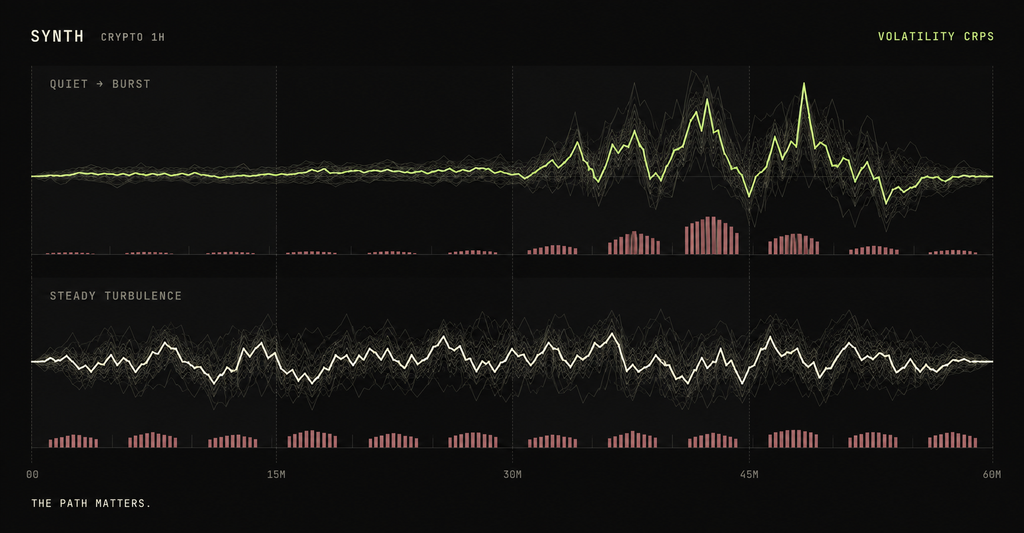
Volatility CRPS extends that approach by examining the volatility contained within those simulated paths. The goal is to reward models that can capture both the expected price distribution and the way market risk develops during the forecast.
This is particularly relevant to Synth because its forecasts are designed for financial applications where volatility can influence decisions before the final price is known.
How the new score works
Miners continue to submit 1,000 simulated price paths for each Crypto 1h forecast. Validators calculate the volatility implied by those paths and compare its distribution with realized volatility.
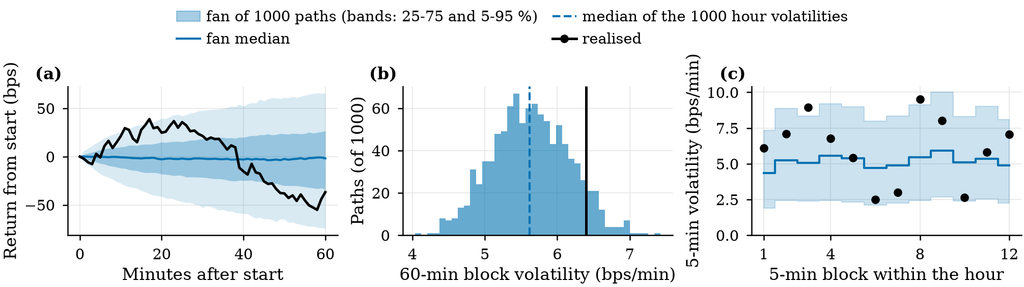
The one-hour forecast is evaluated at three time scales:
- 1 × 60-minute block
- 4 × 15-minute blocks
- 12 × 5-minute blocks
For each block, validators calculate the standard deviation of one-minute price changes across the simulated paths and compare it with the realized volatility. This lets the score account for both the amount of volatility a model expects and when that volatility occurs.
The volatility component is then combined with the existing price CRPS using a 5.25 multiplier, so the final score evaluates both price and volatility accuracy.
What this means for trading
The practical value of the change comes from how Synth’s forecasts are used beyond the subnet. Its API provides financial tools that include volatility analysis, options pricing, liquidation probabilities, and liquidity-provider range optimisation.
More accurate volatility forecasts can therefore help with several parts of trading, including:
- Market making: where expected volatility can influence how spreads are set.
- Position sizing: where changing risk affects how much capital can be deployed.
- Execution timing: where expected volatility can help identify periods of higher market activity.
- Options pricing: where the expected distribution of future price movements is important.
- Liquidation-risk estimates: where volatility can change the likelihood of positions reaching liquidation levels.
- Hedging: where traders need to account for how risk may change during the forecast period.
Synth has also publicly tested its probabilistic forecasts in prediction-market trading by comparing probabilities derived from its simulated paths with market odds.

Volatility CRPS does not guarantee that these applications will produce better trading results, but it gives miners a stronger incentive to produce forecasts that contain more useful information about changing market risk.
The next test for SN50
Synth has gradually expanded its forecasting system by moving from 100 to 1,000 simulated paths, introducing the Crypto 1h competition, expanding its asset coverage, and testing different forecasting models against live subnet data.
Volatility CRPS builds on that progression by making the risk contained within each simulated path part of the scoring process.
The first scoring cycles under the new system should show how well miners can adapt to the added requirement and whether models that capture both price behaviour and volatility dynamics can produce stronger forecasts for the applications built on top of Synth.
➛ Learn more about Synth (SN50) below:
Enjoyed this article? Join our newsletter
Get the latest TAO & Bittensor news straight to your inbox.
We respect your privacy. Unsubscribe anytime.
Enjoyed this article?
Join our newsletter
Get the latest TAO & Bittensor news straight to your inbox — every morning before markets open.



No comments yet — be the first.