


AI agents are moving beyond assistance. They can now initiate payments, execute trades, interact with smart contracts, and act on behalf of users across increasingly autonomous systems.
That creates a growing trust problem. As agents gain more authority, failures become more consequential. A stolen credential, prompt injection, or misinterpreted instruction can result in an irreversible financial or operational action.
Yanez (SN54), a Bittensor-based privacy-preserving identity infrastructure, is approaching this problem from the authorization layer. Its new products, Pulse and Gate, are designed to let agents act autonomously while keeping sensitive actions under the explicit control of a verified human.
Built on Yanez YID
Pulse and Gate build on Yanez YID, the project’s Proof of Humanhood and Proof of Uniqueness system, which verifies a real, unique person without sending biometric or personal data off-device.
Yanez has developed these privacy-preserving identity primitives through its work in the Bittensor ecosystem, including liveness verification and adversarial identity testing.
Pulse extends YID from identity verification into authorization, while Gate carries that approval into execution by keeping funds locked until the required authorization is verified.
Pulse Introduces Human Authorization at the Point of Action
Pulse is Yanez’s authorization layer for sensitive agent activity. Users decide which actions can happen autonomously and which require confirmation.
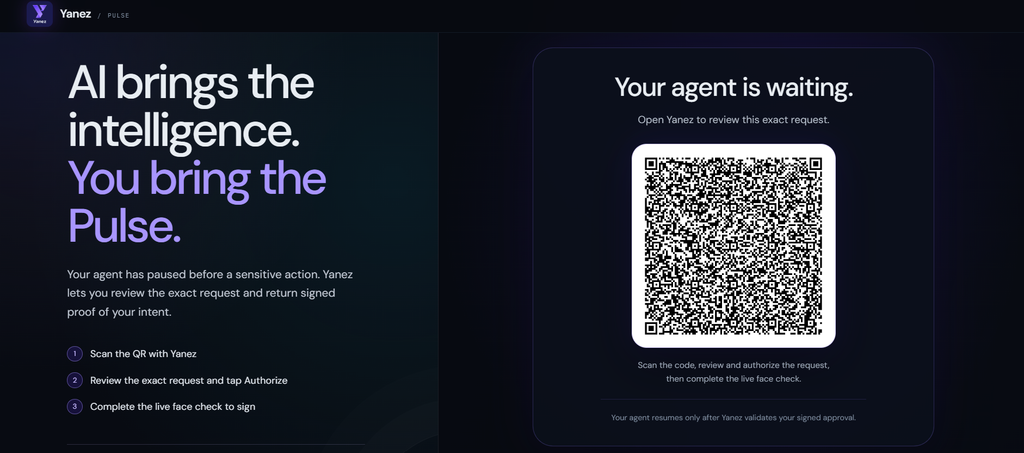
An agent can continue researching markets, preparing transactions, or handling low-risk operations, while larger payments, trades, permission changes, and other sensitive actions trigger human approval.
When approval is required, the process works like this:
1. A request is sent to the user through the Yanez YID application with the exact action the agent wants to perform.
2. The user reviews the request and confirms it with a live face verification.
3. A cryptographic signature is generated on-device and tied specifically to that action.
4. The signature is returned to the system as proof that the authorized human approved the request.
5. Biometric data remains on the user’s device, according to Yanez, and is not stored externally.
Because each approval is created for a specific action at the moment it is requested, there is no reusable authorization token that can later be stolen and replayed.
This gives the agent room to operate independently without giving it unlimited authority over the user’s most sensitive actions.
Gate Separates the Agent From the Funds
Gate applies the same principle to payments. Instead of giving an agent direct control over a wallet or spending credential, funds remain behind a smart contract governed by rules set by the owner.
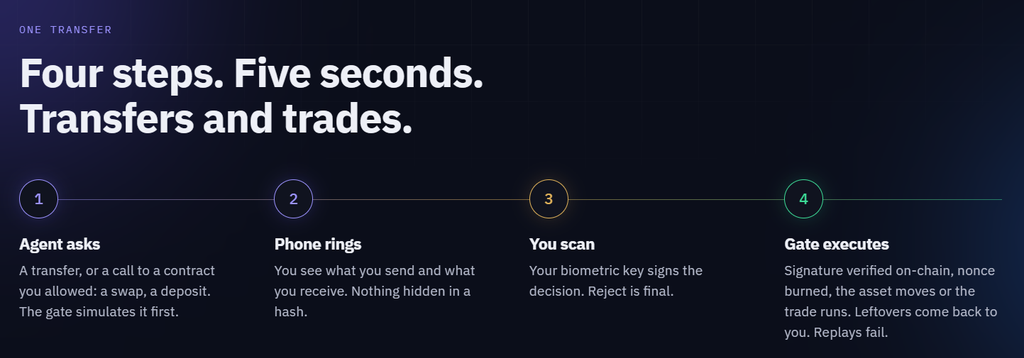
Those rules can define spending limits, approved contracts, allowed counterparties, and other transaction conditions. The agent can prepare and submit a transaction request, but it does not hold the key required to release the funds.
Once the user approves an action through Pulse:
1. The approval is cryptographically tied to that specific transaction.
2. The Gate contract verifies the authorization before releasing funds.
3. Nonces prevent the approval from being reused or replayed.
This creates a clear separation between intent and control. The agent can propose a transaction, but the funds only move once the contract verifies that the human owner approved that exact action.
Designing Around Agent Failure
Pulse and Gate are built around a simple assumption. Agent failures may be impossible to eliminate entirely, but the damage they can cause can still be contained. A compromised agent might attempt a malicious transaction, but because it does not directly control the funds, execution still depends on the required human authorization.
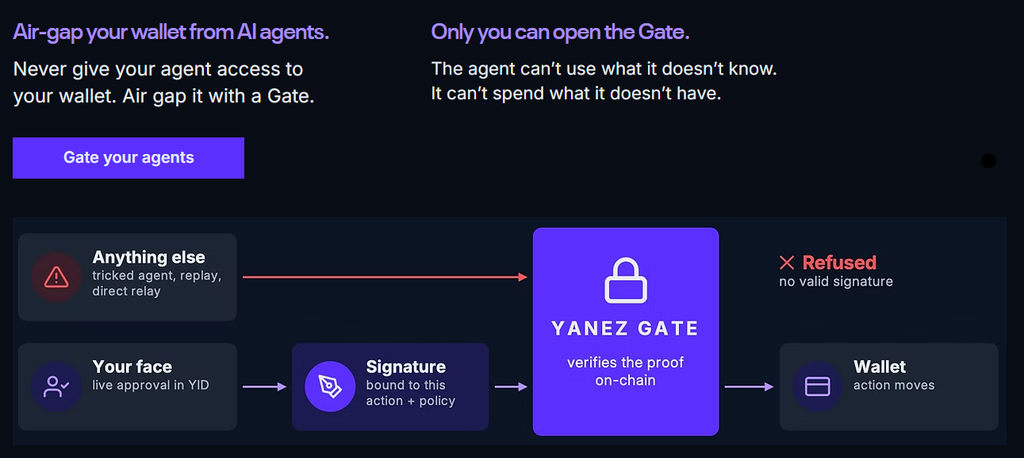
That separation is particularly relevant for enterprise use cases such as procurement, treasury operations, customer accounts, and other financial workflows. Developers can let routine actions proceed within defined limits while reserving higher-risk actions for explicit human approval. The result is a model that expands agent autonomy without giving agents unrestricted control over sensitive assets.
Human Control Becomes More Important as Agents Gain Authority
As agents take on more financial and operational responsibility, digital permissions will need to become more precise. It is no longer enough to know that an agent has access. Systems also need to know whether the person behind it approved a specific action.
That is the boundary Pulse and Gate are designed to enforce. Agents can operate within predefined limits, while higher-risk actions return control to the human. As agent capabilities expand, Yanez is betting that authorization will need to become more explicit, not less.
Useful Resources
1. Yanez Main Site: https://www.yanez.ai
2. Official Pulse Product Page: https://www.yanez.ai/pulse
3. Gate Product Page: https://gate.yanez.ai
Enjoyed this article? Join our newsletter
Get the latest TAO & Bittensor news straight to your inbox.
We respect your privacy. Unsubscribe anytime.
Enjoyed this article?
Join our newsletter
Get the latest TAO & Bittensor news straight to your inbox — every morning before markets open.


No comments yet — be the first.