

The math behind Bittensor’s next leg up is simpler than most people assume. One subnet crossing into breakout territory could drag the entire TAO valuation to four figures, and the ecosystem is now stacked with candidates sitting right on that edge.
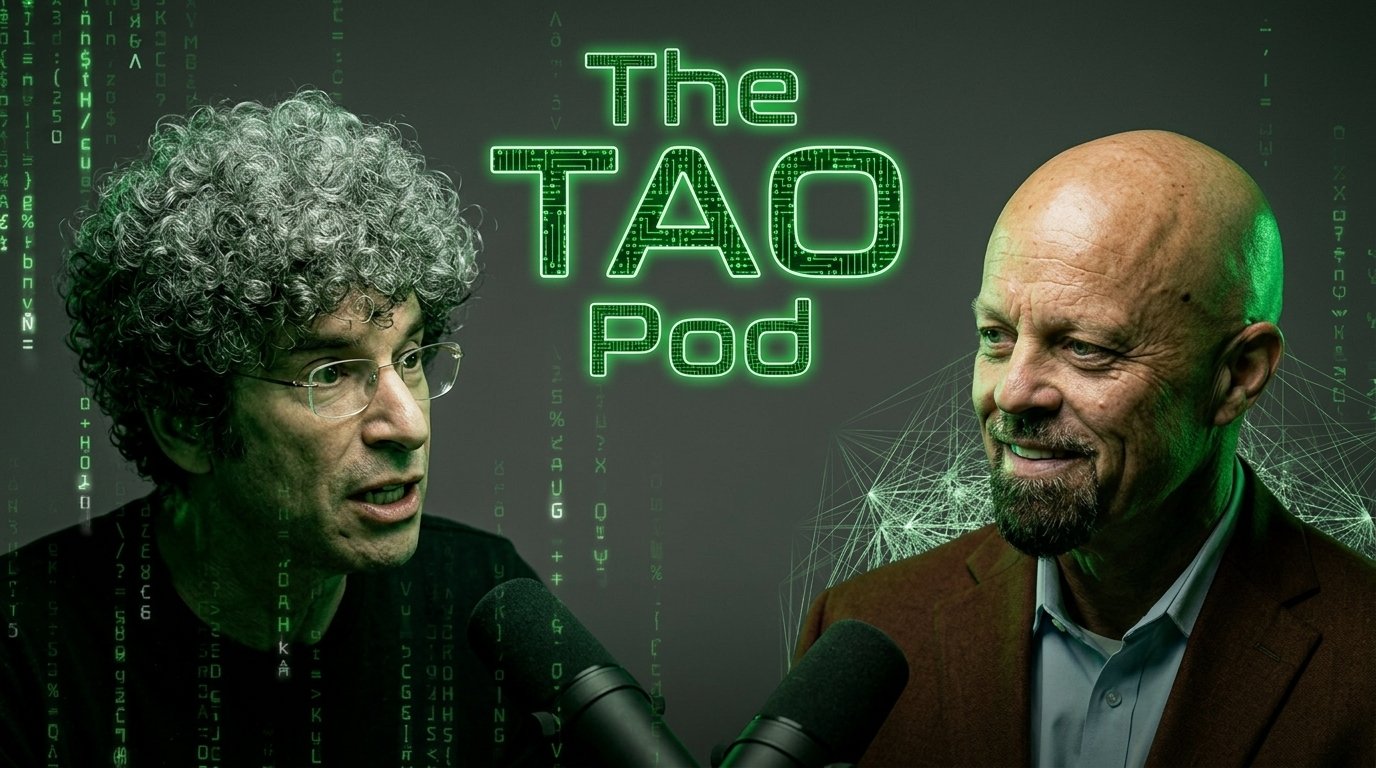
A recent conversation between James Altucher and Mark Jeffrey of The TAO Pod ran through why that single event matters more than anything else happening in decentralized AI.
Let’s go through the conversation.
The One Subnet That Changes Everything
The central claim is that Bittensor doesn’t need dozens of wins to reprice. It needs one. Independent analysis from Yuma and from Sami Kassab both arrived at the same conclusion, that a single breakout subnet with a billion-dollar-plus market cap sends TAO toward $1,000, with some estimates stretching to $3,000 to $5,000 depending on the scale of the win.
There are 128 subnets, and a striking number of them feel like they are one push away from a breakout. The subnets named as candidates included:
- Chutes (SN64)
- Score (SN44)
- Ridges (SN62)
- Targon (SN4)
- Minos (SN107)
- Engy (SN53)
- Actual Computer (SN95)
For these subnets, quality is a quantity game. Picasso produced roughly 117,000 works, and fewer than 1% ever made him money, and the same logic applies to Bittensor subnets.
More subnets means more attempts, and each new registration also drives TAO demand since you need TAO to register. One success kicks off a virtuous cycle that pulls entrepreneurs, capital, and more subnets in behind it.
Why JJ Left Bittensor
This was one of the most anticipated topics on the show, and the honest answer is that nobody really knows why.
Joseph Jacks, who previously co-hosted The TAO Pod, has withdrawn personally from Bittensor, though he remains involved in the ecosystem through companies such as Latent Holdings and OSS Capital.
Here’s what was said:
- JJ has largely stopped posting about Bittensor
- His attention has shifted toward microtubules, quantum consciousness, etc.
- Both speakers stressed he remains invested in the ecosystem and hasn’t publicly turned against it
Root Reborn and Why the Chain Stopped Betting Against You
The most consequential recent protocol change is Root Reborn, and it fixes something that was quietly working against every holder.
Before the update, emissions produced by the chain were being used to sell subnet tokens every block, dumping roughly 1,000 TAO worth of tokens onto the market continuously. It was like trading in a market where the Federal Reserve prints money specifically to bet against you.
Root Reborn flips that dynamic completely:
- Newly printed emissions now actively invest in subnets rather than dump on them
- The best-performing subnets receive the most emissions and the most buys
- The chain force-multiplies existing market signals instead of centrally planning outcomes
- Daily selling pressure from validators on TAO effectively disappears
For the average institutional buyer who just wants to hold TAO and stake to Root, the update removes a persistent drag they were absorbing without realizing it.
The Trillion-Parameter Prize
The biggest valuation unlock sits with decentralized training, and several subnets are hunting it. Chutes (SN64) is currently the largest subnet on Bittensor and the biggest provider of open-source models to OpenRouter, which Stripe is reportedly valuing near $10 billion.
Chutes is chasing a one-to-two-trillion-parameter mixture-of-experts model spread across miners in a new product called Parallax.
The subnets working this problem from different angles include:
- Chutes and Parallax, using mixture-of-experts with a routing layer
- IOTA (SN9), solving the drop-in drop-out reliability problem of decentralized training rigs
- Connito (SN102), led by a six-year Opentensor Foundation veteran, pursuing its own MoE architecture
How That Value Reaches TAO
The final piece is why any of this accrues to TAO rather than staying locked in individual subnets. Subnet tokens are in a sense rehypothecated TAO, since you must stake TAO to acquire them. When a subnet token rises and drags its paired pool with it, TAO rises alongside it.
The comparison:
- Owning TAO works like holding the S&P 500 of every subnet
- A single hot subnet ballooning to 40% of the ecosystem proportionally lifts TAO by its weight
- Subnet token value tends to capture roughly 60 to 70% of the underlying company’s value, enough to keep miners incentivized
- One proven success triggers speculation that the next one is coming, compounding inflows into TAO
If Chutes succeeds at a two-trillion-parameter decentralized model and mirrors Kimi’s $30 billion, and subnet tokens capture 60% of that, the subnet token alone approaches $24 billion. Accrued down to TAO, that implies at least a 10x from current levels, roughly $2,000, on the strength of one subnet out of 128.
You can watch the full conversation below:
Enjoyed this article? Join our newsletter
Get the latest TAO & Bittensor news straight to your inbox.
We respect your privacy. Unsubscribe anytime.
Enjoyed this article?
Join our newsletter
Get the latest TAO & Bittensor news straight to your inbox — every morning before markets open.


Be the first to comment