


Mark Jeffrey of and Stillcore Capital sat with Gordon Frayne for a conversation on the case for Bittensor ($TAO) as the third great coin after Bitcoin ($BTC) and Ethereum ($ETH). Jeffrey has lived through 5 inflection points in his career, and the throughline of the hour was that every signal he is reading on Bittensor today matches the patterns he saw before each previous wave broke.
Subnet ‘$ALPHA’ tokens are insanely undervalued relative to what is being built underneath them, with the gap between price and product wider than at any comparable early stage of a major crypto cycle. The next six to twelve months is the window for a breakout subnet to cross a billion in market cap, which Jeffrey treats as the moment Bittensor’s thesis stops being early-believer territory.
Solid Takes From The Conversation
The hour produced enough material for a half-dozen separate articles, but the points below cluster around the case for Bittensor, the price-versus-product gap, and what Jeffrey thinks needs to happen next.
1. Bittensor is the third great coin after Bitcoin and Ethereum. Ethereum took Bitcoin’s smart contract side and blew it out into DeFi. Bittensor took Bitcoin’s mining side and made it programmable into a new asset class.
Solana and others were improvements on Ethereum; Bittensor is a fundamentally new category.
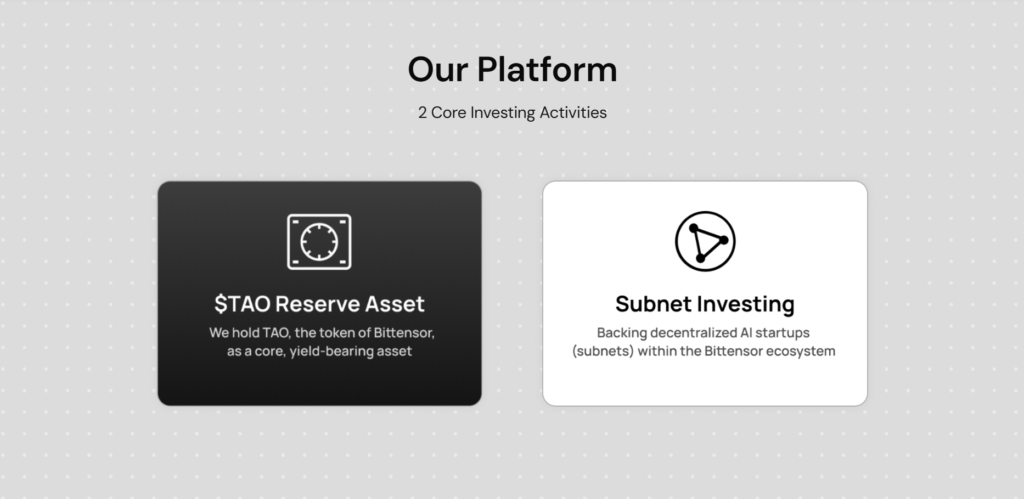
2. Stillcore targets 3x ROI (Return on Investment) versus $TAO over a three-year lock. The fund is currently ~50% over $TAO eight to nine months in, which is on track.
The compressed timeframe versus traditional VC (venture capital) reflects the speed of crypto cycles and the maturity of the infrastructure already in place.
3. The investment filter is the same as early-stage angel investing. Quality team, depth of experience in both tech and the target market, defensible price or quality advantage, a real reason the subnet structure is required, and a credible path to revenue.
4. The fund started revenue-only and has opened up to research subnets. Templar (ex, SN3) proved the market would reward genuine technical achievement even before revenue, which opened the door for bets on NOVA (SN68), Minos (SN107), and similar earlier-stage subnets with credible science underneath.
5. Subnets produce at roughly one-tenth the cost of VC-funded alternatives. 256 rotating contributors competing globally for the top spot produce higher quality output cheaper than any hireable team, and the price advantage compounds at the product layer.
6. A breakout subnet means an $ALPHA at a billion-plus market cap. Most quality subnets currently sit between 5 to 30 million USD in market cap, with the largest near a hundred million.
Two or three subnets crossing a billion is the trend that proves the thesis publicly.
7. Bittensor has a six-to-twelve-month window to produce a breakout. The thesis does not die if it misses that window, but the network risks drifting into Cardano territory: technically interesting, commercially stillborn, never producing flywheels.
8. ‘Const’ operates Bittensor like a startup CEO, and that is the right model. The recent pace of changes reads as chaos to institutional investors used to Ethereum’s stability.
When walking through the reasoning, those same investors recognize it as decisive startup management of the kind required to outpace centralized AI labs.
9. Centralized AI labs are heading into a commoditization wave. Anthropic, OpenAI, and others sustain trillion-dollar valuations on venture and public-market subsidies, with cost-to-revenue ratios that cannot hold.
Combined with the S-curve in model capability flattening and smaller specialized models outperforming larger ones on narrow tasks, the AI space is heading toward rapid commoditization within a few years.
10. Bittensor sits in exactly the right place when commoditization arrives. If the network produces AI commodities at one-tenth the cost with quality competitive with centralized labs, market forces drive the work toward the cheaper, higher-quality alternative.
The analogy is Linux beating OS/2, IBM, and Solaris because it was free and good enough.
The Magical Early Window
The throughline of Jeffrey’s argument is that Bittensor is sitting in the magical early window that comes around every five to six years and only lasts as long as the broader market stays confused about what is being built underneath. Bitcoin had it, Ethereum had it, the early internet had it twice, and the pattern each time was that nothing happens until everything happens at once.
$ALPHA are insanely undervalued relative to the venture-grade companies sitting underneath them, with anybody able to buy them rather than waiting for a Y Combinator invite. None of that is financial advice, but it is the same pattern Jeffrey has watched produce category-defining returns four times in his career, and the bet is that this is the fifth.
Enjoyed this article? Join our newsletter
Get the latest TAO & Bittensor news straight to your inbox.
We respect your privacy. Unsubscribe anytime.
Enjoyed this article?
Join our newsletter
Get the latest TAO & Bittensor news straight to your inbox — every morning before markets open.



No comments yet — be the first.