


The Google Ads industry moves $300B a year and almost none of it runs on benchmarks, with most decisions made on instinct and contradictory opinions from self-styled experts. The only group with enough data to publish real benchmarks is Google itself, and Google has no commercial reason to do so.
The leadership of AdTAO (SN21) was featured at Subnet Summer AMA to navigate how SN21 is attacking that gap with a prediction layer for Google Ads, an existing business on track for a million-dollar revenue year, and a Google Ads MCP (Model Context Protocol) server already being called by the agentic ecosystem. This is one of the cleanest examples of a real commercial business sitting on top of a Bittensor subnet, with miners solving a math problem the founders could never have hired for directly.
What AdTAO Brought Into Bittensor
AdTAO did not start on Bittensor as the team arrived with a working tech stack, paying customers, and a dataset that would be operationally impossible to assemble from scratch.
1. 50,000+ Google Ads accounts in the ecosystem. Acquired legitimately over years through agency relationships and customer connections.
2. A weekly account scanning and codification engine. Every account gets mapped to a structured framework that surfaces problems and suggests next-best actions.
3. An agency dog-fooding the tooling. Runs at 80%+ margins instead of the 10–20% traditional agencies sit at, because the tool replaces the team.
4. A beta group of 50 paying users. Opening publicly to PPC (Pay-Per-Click) professionals next month, with each new sale bringing hundreds of new accounts into the dataset.
The compounding loop is the moat. One recent customer brought over a thousand accounts into the ecosystem from a single sale. Each sale makes the tooling sharper, the predictions better, and the gap against any competitor wider.
The Mining Problem
The mining setup is unusual because the miner output is not the product. The product already exists, and miners are the rocket booster strapped to it.
How a weekly epoch works:
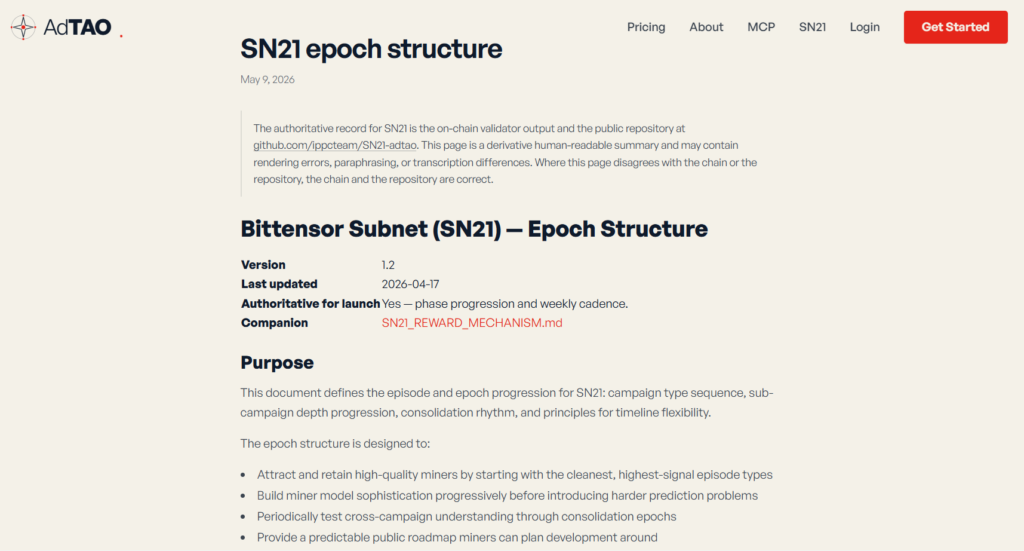
1. AdTAO packages a basket of Google Ads accounts and the changes made to them one month ago. Anonymized and structured as JSON with supporting account data.
2. Miners predict 7-day, 14-day, and 28-day performance outcomes based on the inputs.
3. Validators unlock what actually happened after the 28-day window closes and compare predictions against reality.
4. Miners are ranked by prediction accuracy. Top 5 earn ~40% of emissions in the elite tier, the competitive tier earns ~30%, and below-baseline submissions earn nothing.
Miners do not need to be Google Ads experts at all. Underneath the framework, this is a time-series prediction problem with a Google Ads skin. The strongest performers in week 4 came from outside the PPC industry entirely.
Of ~100 miners submitting, the top 5 were exceptionally good and the rest varied. The founder’s observation: hiring is binary and risky, but Bittensor surfaces the top performers naturally and only pays the ones who clear the bar.
Why Now, And Why On A Subnet
The structural facts that make this the moment:
1. No published benchmark exists for a $300B industry. Google has the data and no commercial reason to publish. Everyone else operates on tiny slivers and confuses opinion with evidence.
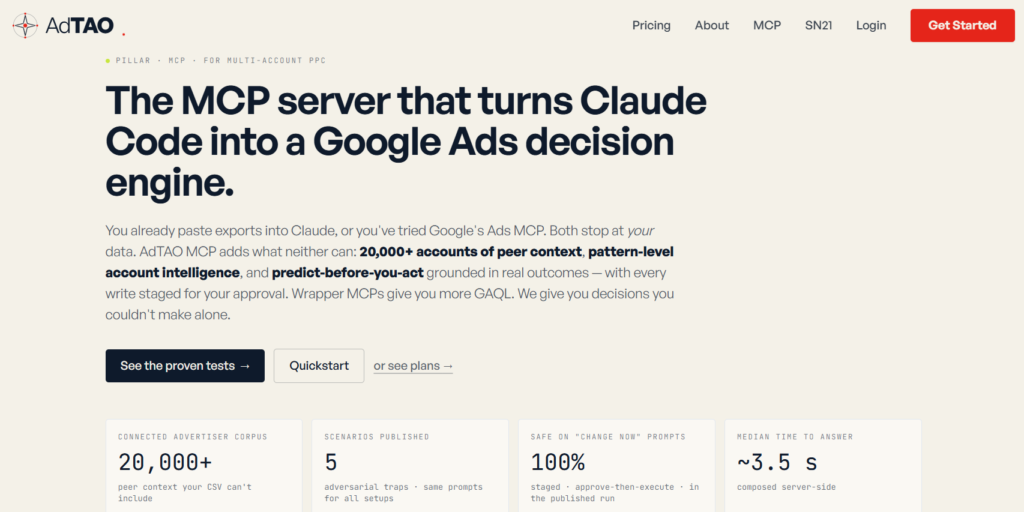
2. AI has commoditized basic execution. Anyone can drop a .CSV into Claude. The intelligence layer (real data, real benchmarks, real prediction models) is where the differentiated value now sits.
3. Academic research is too slow. The founder estimated the academic route would produce papers but no working product in the timeframe the problem demands.
Why Bittensor specifically:
1. Access to talent the team could never have hired directly. The miners scoring highest are people the founder admits he could not have judged, could not have found, and could not have afforded.
2. A validation scoring system that makes the work legible. Without on-chain scoring, judging the output of statisticians and ML researchers as a non-technical founder is functionally impossible.
3. The problem keeps morphing. Google is a rapidly changing business, so the mining problem is not static. The subnet is a long-term engine for solving a problem that does not stop evolving.
The Google Ads MCP server is the other half of the play. PPC professionals are already building Claude-based workflows, and the MCP positions
AdTAO as the intelligence layer between those workflows and the underlying data. The goal is preferred-partner status on Anthropic, Google Gemini, and other major LLM ecosystems.
Why $SN21 Is Backed By Something Real
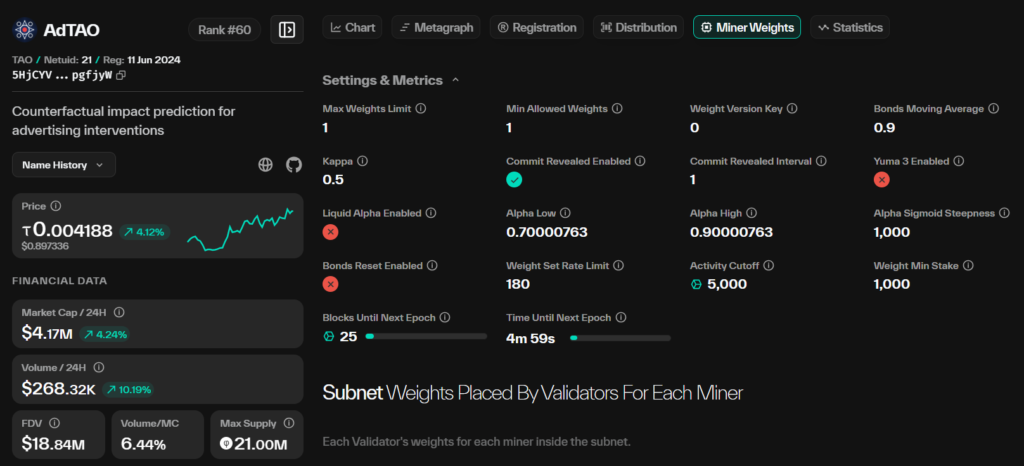
The case for AdTAO’s $SN21 is one of the clearer ones on Bittensor right now because the demand is structural rather than speculative.
What underwrites the value:
1. A real business with proven revenue. On track for a million-dollar year on the agency model alone, with the SaaS opening publicly next month.
2. A compounding dataset. Every customer adds accounts to the pool, sharpens the tooling, and improves miner accuracy.
3. A market that pays for performance. Customers either improve their account performance by ~20% or they do not, and AdTAO can already deliver that uplift in multiple parts of the ecosystem.
4. Google’s incentive alignment. Better-performing accounts mean longer customer lifetime value and higher auction fill rates, which makes Google a quiet beneficiary rather than a competitor.
The scale: if AdTAO can improve 1% of Google Ads spend by 20%, that is a $600M annual value proposition. The agency business is positioned for 3–5x growth, and the SaaS and MCP layers are where the upside expands beyond traditional agency economics.
What This Subnet Actually Solves
AdTAO is one of the cleaner examples of a Bittensor subnet attached to a real business that would not reach its 80% mark without the network. The remaining 20%, the prediction layer at the heart of the product, is what the subnet solves, and the team has been honest that they could not have built that piece any other way.
Academia is too slow, hiring is too risky, and the alternative paths produce mediocre intelligence wrapped in PowerPoint. The miners on SN21 are doing the math problem that turns a working Google Ads tool into a category-defining one, and the data flywheel underneath ensures every customer makes the next prediction sharper. For an industry running on folklore, that is the version of progress worth taking seriously.
➛ Check Out AdTAO Here
Enjoyed this article? Join our newsletter
Get the latest TAO & Bittensor news straight to your inbox.
We respect your privacy. Unsubscribe anytime.
Enjoyed this article?
Join our newsletter
Get the latest TAO & Bittensor news straight to your inbox — every morning before markets open.


No comments yet — be the first.