

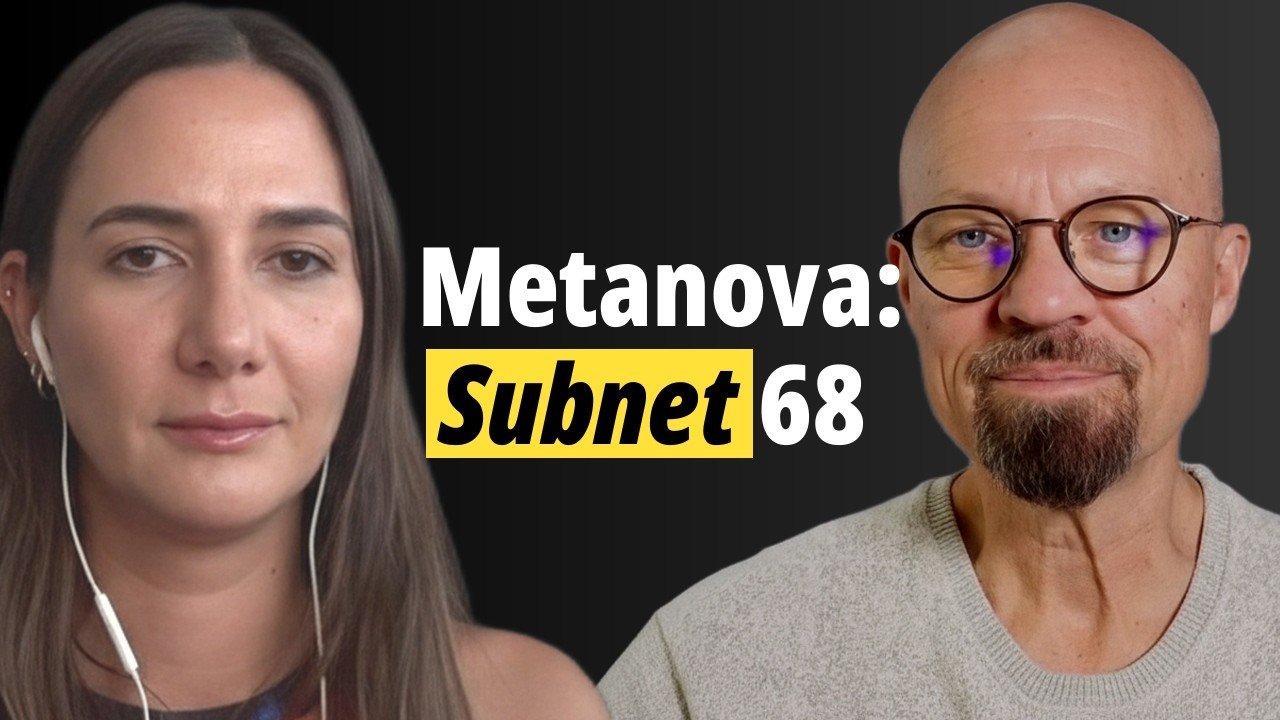
Speaking on Hashrate with Mark Jeffrey, Metanova CEO Micaela described the project as a crypto biotech company building on the Bittensor network, with a focus on AI-driven drug discovery.
More on Metanova (SN68):
Metanova launched with a mandate to identify novel therapeutics and advance the tools required to discover them. According to Micaela, the team entered the space after identifying structural limitations in traditional AI drug discovery, particularly within closed research environments.
She said the subnet was initially designed as a proof of concept, testing whether decentralized participants could successfully conduct virtual drug screening, a process not previously attempted in this format.
Drug Discovery Framed as a Search Problem
Micaela explained that Metanova reduces drug discovery into a search and optimization problem.
At launch, miners were given access to a dataset of roughly one billion synthesizable molecules. Rather than requiring expertise in chemistry, participants were tasked with optimizing how to shortlist candidates for evaluation by machine learning models.
Validators then score submissions and reach consensus on top-performing entries.
This approach allows individuals without a background in medicinal chemistry to compete effectively, shifting the challenge toward algorithmic efficiency rather than domain knowledge.
Subnet Expands to Three Incentive Mechanisms
Metanova now operates three distinct incentive tracks:
- Small molecule discovery
- Chemical search algorithms
- Nanobody discovery (launched this week)
The introduction of nanobodies expands the system beyond small molecules into multiple therapeutic modalities.
Micaela noted that, going forward, miners will submit both small molecules and nanobodies within each challenge. Top nanobody submissions will be validated through a wet lab partnership.
From Submissions to Wet Lab Validation
Michaela outlined a multi-step pipeline between miner outputs and real-world drug development.
Submissions first pass through additional filters beyond the subnet’s scoring system. These include checks for:
- Toxicity
- Solubility
- Ability to reach target sites (e.g. crossing the blood-brain barrier)
Selected candidates are then sent to third-party labs for validation. Metanova currently works with a Shanghai-based partner for this stage.
She described the company’s operating model as a “virtual biotech,” outsourcing physical experimentation while coordinating discovery through decentralized infrastructure.
Patent Strategy and Commercial Pathways
When promising results emerge from wet lab testing, Metanova files provisional patents.
These patents allow the company to either:
- License the intellectual property
- Or continue development internally
Micaela said outcomes at this stage vary widely, noting that even early-stage assets can lead to deals in the range of tens to hundreds of millions of dollars, depending on results.
She emphasized that drug discovery involves “unknown unknowns,” and that flexibility in development strategy is critical.
Evidence of Cross-Disciplinary Breakthroughs
During the discussion, Micaela pointed to a specific example of a winning submission that applied an optimization strategy from energy systems to drug discovery.
According to her, the approach outperformed a widely used method (Thompson sampling), including on a difficult oncology target.
She presented this as evidence that Metanova’s structure enables contributions from outside traditional scientific domains, where participants are not constrained by established assumptions.
Building Toward an “AI Co-Scientist”
Micaela said Metanova’s long-term goal is to develop an AI co-scientist, combining three types of intelligence:
- Human experts and researchers
- Decentralized miners
- Autonomous AI agents
She cautioned against claims that AI agents can fully replace human input, stating that current systems still require guidance and verification.
Instead, she described agents as tools that increase productivity, with humans increasingly acting as “prompters and verifiers.”
Use of Agents and Internal Tooling
The team has experimented with AI agents internally, including:
- Analyzing chemical similarity between submissions and existing drugs
- Running retrospective analysis on molecule datasets
- Conducting prior art searches against known pharmaceutical patents
One implementation involved comparing subnet-generated molecules against a dataset of ADHD medications to determine patent overlap.
Michaela noted that a key challenge remains the lack of standardized benchmarks in scientific research, due to siloed data across the industry.
Miner Participation and Network Dynamics
Micaela said it is difficult to determine the exact number of participants in the subnet.
She noted that:
- Some miners operate in teams rather than individually
- Others run multiple keys to submit varied entries
- Some participants test solutions without submitting them
She added that mining operations are becoming increasingly industrialized, with a mix of individuals, teams, and automated systems contributing.
Token Behavior and Incentive Design
The discussion also touched on token dynamics within the subnet.
Michaela said that while miners have historically sold rewards immediately, there are early signs of a shift:
- Some contributors are choosing token compensation over fiat
- Some miners are holding tokens rather than selling
She described this as an encouraging signal, particularly for a project operating on long-term timelines like drug discovery.
Approach to Regulation and Global Strategy
Rather than attempting to change regulatory frameworks, Metanova is pursuing what Micaela described as a “geographic arbitrage” strategy.
This involves selecting jurisdictions based on:
- Cost efficiency
- Regulatory feasibility
- Speed of execution
She said the team aims to balance this approach with maintaining rigorous testing standards required for drug approval.
Comments on Bittensor Governance and Recent Events
Micaela also addressed ongoing discussions around proposed changes to Bittensor’s subnet governance model (Locked Stake) following a recent incident.
She declined to take a definitive position, stating that:
- The proposal requires further review
- There is a need to consider second- and third-order effects
- Different subnets operate under different constraints
She emphasized the importance of avoiding unintended consequences, particularly those that could affect:
- Token stability
- New subnet participation
- Long-term incentive structures
Micaela said she intends to review the proposal in detail before forming a position and highlighted the importance of community input across stakeholders.
Framing the Mission
Throughout the conversation, Micaela characterized Metanova’s work as focused on real-world outcomes, particularly in healthcare.
She stated that while financial returns are significant, the primary objective is the development of treatments that can impact human health.
According to her, the combination of decentralized networks, AI systems, and global participation creates a new model for tackling complex scientific problems.
NOTE: This article is a condensed report derived from Mark Jeffrey’s HASH RATE interview with NOVA team. Watch the full video below:
Enjoyed this article? Join our newsletter
Get the latest TAO & Bittensor news straight to your inbox.
We respect your privacy. Unsubscribe anytime.
Enjoyed this article?
Join our newsletter
Get the latest TAO & Bittensor news straight to your inbox — every morning before markets open.



Be the first to comment