


A live 100-gigabyte bucket transfer finished in 1:10 minutes during Beam (SN105)‘s Novelty Search appearance. The team said scaling that same job to 1 terabyte could finish under 2 minutes because transfers run in parallel.
That demonstration gave context to Beam’s goal of making existing bandwidth easier to use for large-scale data movement.
SN105 went live on March 10 under Yuma incubation, with Beam spending months testing whether the network could handle traffic.
The reason Beam matters starts with bandwidth, which simply describes how much data can move between two places. As AI and robotics grow, the team expects demand for moving increasingly large amounts of data to keep rising.
Physical cables limit available capacity, while bandwidth remains fragmented compared with compute and storage, which can consolidate into server farms. Beam, therefore, does not buy and resell bandwidth, but coordinates existing network capacity and makes it easier to use.
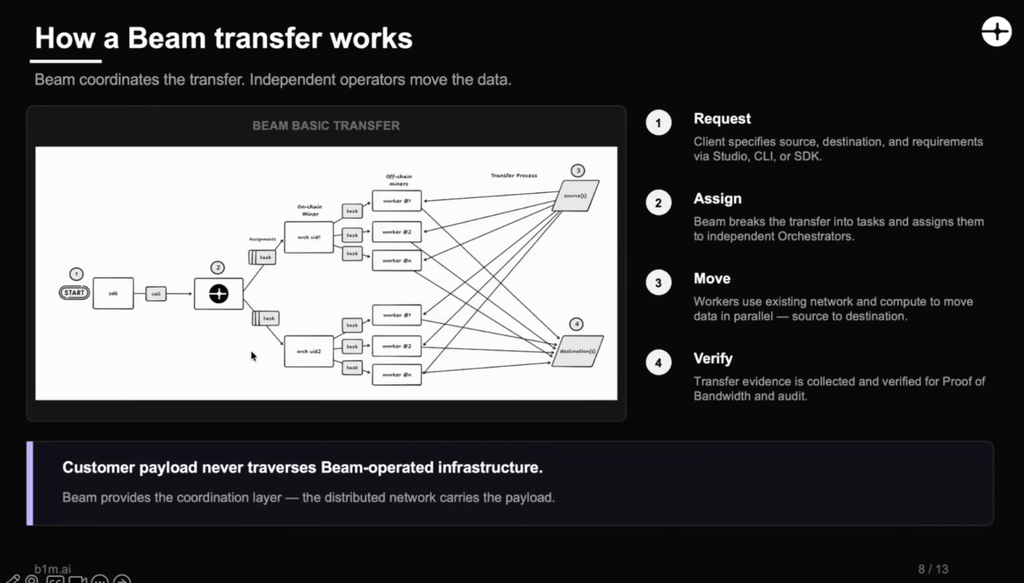
When a customer wants to move data, Beam breaks the file into smaller pieces and sends them through different routes.
Orchestrators coordinate those transfers, while off-chain workers handle collecting and delivering each individual piece to its destination.
Beam Core checks that pieces arrive on time and remain unchanged, adding another layer of protection during transfers. New orchestrators first complete test transfers, then enter one of five performance tiers after meeting Beam’s requirements.
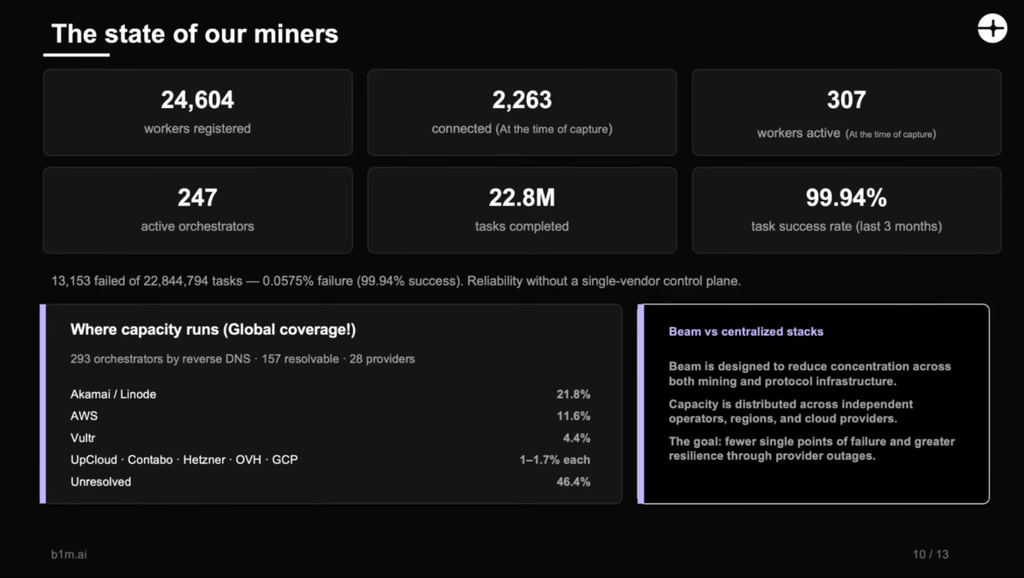
The network had roughly 24,000 registered worker keys, with 2,200 connected and 307 actively moving data.
Beam reported more than 99% transfer success over 3 months, while moving over 1 terabyte every 30 minutes.
Its dashboard tracks transfers, failures, schedules, providers, and workers, while Studio adds workflows and connections to familiar services.
Those connections include S3, Salesforce, Databricks, and other tools, while reusable skills are stored through Beam’s Registry.
The episode then demonstrated Rooms, where invited members can share data with people, buckets, and services through Beam. A live stream moved between a MacBook and Windows laptop, showing data traveling through Beam, not directly between devices.
The team said this becomes useful when hundreds or thousands of participants need to receive large files simultaneously.
With encryption, model sharing, robotics, distributed processing, and lower egress costs among future uses, Beam is building around data movement.
➛ Read More About Beam (SN105)’s Rooms and Tunnels:
Enjoyed this article? Join our newsletter
Get the latest TAO & Bittensor news straight to your inbox.
We respect your privacy. Unsubscribe anytime.
Enjoyed this article?
Join our newsletter
Get the latest TAO & Bittensor news straight to your inbox — every morning before markets open.


No comments yet — be the first.