

Some six months ago, Enigma (SN63) went dark with the team telling the community it would be offline for about six weeks. That went exactly as planned.
Enigma went live this week as the rebuilt version of SN63, structured around a public challenge to break RSA cryptography, the algorithm that quietly secures most of the internet’s financial, government, and healthcare communications.
The first milestone is already published with $10,000 on the line, total prize pools across the program will exceed $400,000, and the underlying mission is to produce the world’s first empirical, publicly verifiable measurement of how close we actually are to Q-Day.
For context, Q-Day, short for Quantum Day, is the hypothetical moment when quantum computers will become powerful enough to break the now-widely used cryptographic algorithms. This milestone will have profound implications for cybersecurity, as current encryption methods like RSA and ECC will be rendered obsolete.
What Just Launched
Enigma is positioned as a decentralized pressure-testing network for cryptography, with the opening challenge structured as follows:
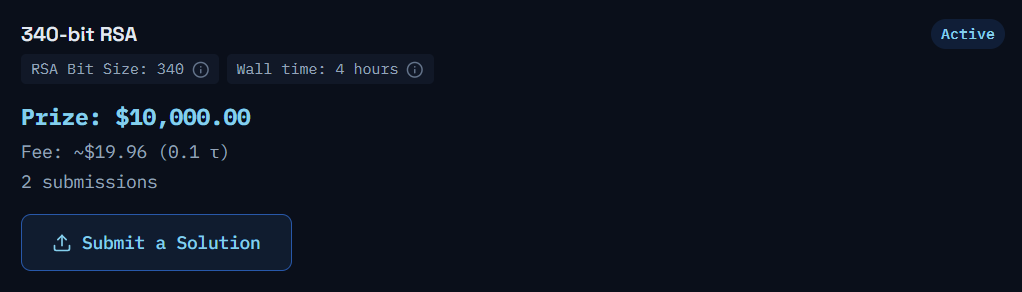
a. First milestone is RSA-340, with participants competing to factor a 340-bit RSA modulus inside a 4-hour wall time.
b. $10,000 USD active prize pool on the opening milestone, with prize pools scaling as modulus sizes grow.
c. Total prize pool across the program exceeds $400,000, distributed across escalating milestones.
d. SN63 is the first subnet ever to incorporate treasury wallets, with payouts handled through smart-contract-encoded rules and a roughly 5-day settlement window.
e. Submissions run inside a sealed Docker environment with no network access, an NVIDIA RTX PRO 6000 with 96 GB VRAM, 26 CPU cores, and 96 GB RAM allocated per attempt.
The structure forces classical-method solutions for now, with quantum-specific phases planned for future milestones.
Why Breaking RSA Is Important
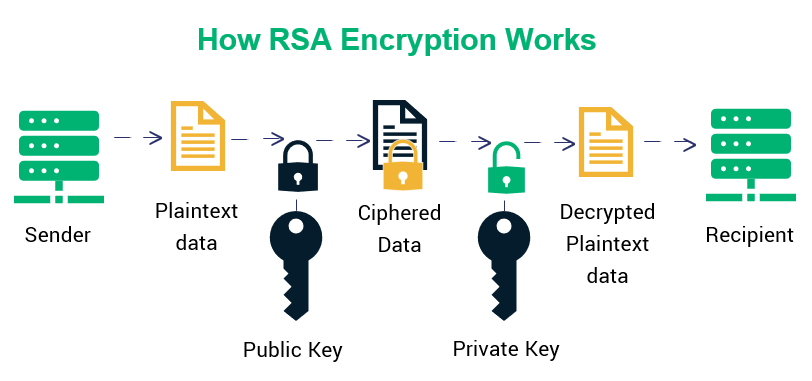
RSA secures effectively every encrypted connection that runs the modern internet. The challenge exists to measure how close quantum or classical advances are to breaking that assumption:
a. RSA protects TLS connections, code-signing certificates, VPN tunnels, SSH sessions, and the certificate authority infrastructure that browsers use to verify legitimacy.
b. The largest RSA modulus factored to date is RSA-250, achieved in 2020 using roughly 2,700 core-years of computation via the General Number Field Sieve.
c. Recent estimates suggest 1,200 to 1,400 logical qubits could factor RSA-2048, with IonQ publicly targeting 1,600 logical qubits by 2028.
d. Even partial progress would matter commercially, since demonstrating that factoring is easier than believed at any key size would force the industry to revisit minimum key length recommendations.
The challenge produces a continuous public record of where the actual frontier sits, which is something the cryptography industry has not had access to in calibrated form.
How the Phases Will Roll Out
The challenge is structured in three stages, each measuring a different layer of capability:
a. Classical milestones first, where participants attack RSA moduli using established algorithms and any optimizations they can engineer. This establishes the public baseline.
b. Quantum simulation milestones next, where participants run quantum circuit simulators on classical hardware to test whether quantum algorithms like Shor’s can be implemented efficiently enough to outperform classical methods.
c. Real quantum hardware milestones after that, where participants submit solutions executed on actual quantum processors, including superconducting, trapped-ion, photonic, or other architectures.
When a quantum submission factors a modulus that no classical submission could crack, the result becomes a publicly verified signal of quantum advantage in cryptographically relevant computation rather than a vendor marketing claim.
The Terra Quantum Partnership
The challenge is being run in partnership with Terra Quantum, a Swiss deep-tech company specializing in quantum security across three product categories:
a. Post-quantum cryptography for enterprises preparing for the post-quantum era.
b. Quantum key distribution (QKD) for hardware-secured encrypted communication.
c. Quantum random number generation (QRNG) for cryptographically strong randomness.
Terra Quantum’s business depends on understanding exactly when current cryptography will fail, which is why a calibrated public record of factoring progress matters to them commercially as much as it matters to Enigma scientifically.
What This Measures
Enigma’s return is the kind of subnet relaunch that rewrites what a Bittensor subnet can structurally be.
The treasury wallet implementation is a first for the network, the corporate collaborator model brings outside expertise directly into the incentive layer, and the underlying mission produces a continuous, publicly auditable measurement of how close the world actually is to Q-Day.
The classical phase is the calibration layer, the quantum phases are the measurement against it, and the entire program turns a question the cryptography industry has been guessing at into an empirical one. The first milestone is live now, and the answer the network builds over the next 12 to 24 months will matter far beyond Bittensor.
➛ Read More About the Challenge Here and View the Subnet Code Here
Enjoyed this article? Join our newsletter
Get the latest TAO & Bittensor news straight to your inbox.
We respect your privacy. Unsubscribe anytime.
Enjoyed this article?
Join our newsletter
Get the latest TAO & Bittensor news straight to your inbox — every morning before markets open.
No comments yet — be the first.