

Miners have pushed a Pareton (SN10) optimization upstream, delivering measurable throughput gains for Qwen inference workloads.
The improvement was discovered through Pareton’s competitive optimization process and subsequently contributed to the mainstream open-source vLLM inference engine.
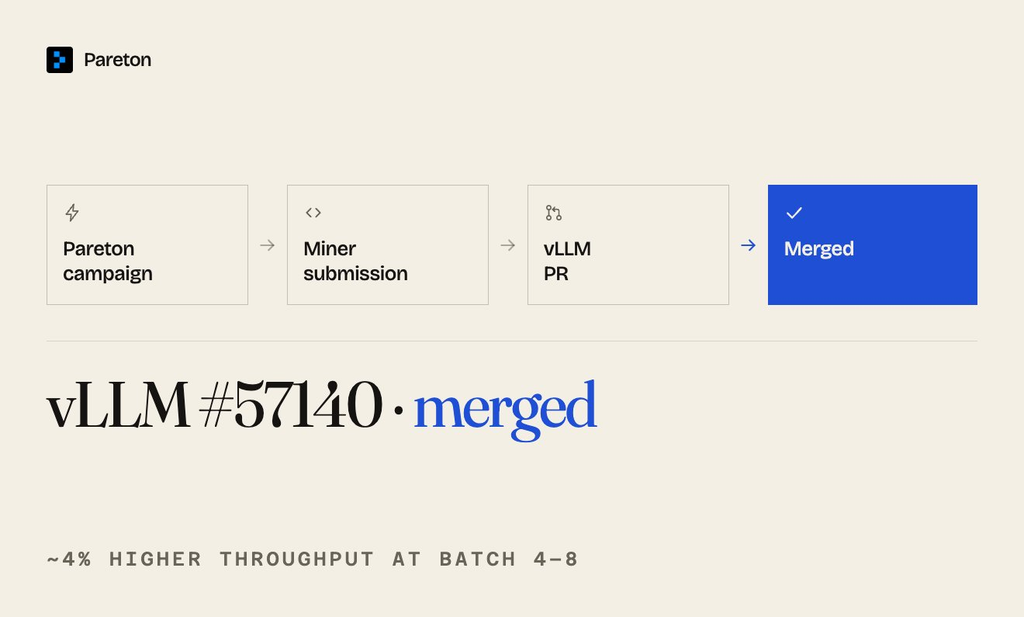
Pareton (SN10) continuously discovers, validates, and deploys optimal serving configurations across models, hardware, and serving stacks for specific workloads.
The contribution improves throughput by roughly 4% for Qwen workloads using multi-token prediction speculative decoding.
The Headline Optimization
The PR (Pull Request) addresses inefficiency in vLLM when Qwen’s Gated Delta Network layers process mixed speculative batches together.

Previously, vLLM allocated a temporary tensor, scattered output groups into it, then copied everything into the final buffer.
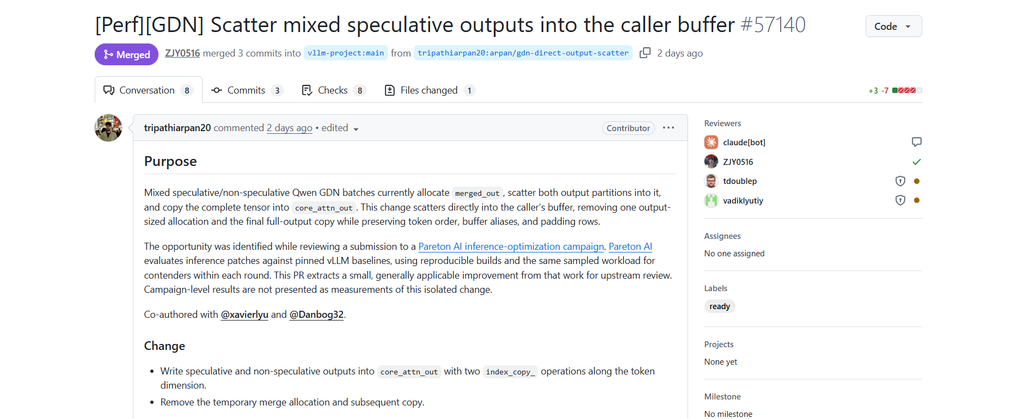
The new implementation writes directly into the caller’s buffer, eliminating temporary allocation and unnecessary copying along this performance-critical path.
1. Approximately 3.9% higher output tokens per second at batch size 4 on one H100 GPU during testing.
2. Approximately 4.1% higher output tokens per second at batch size 8 on one H100 GPU during testing.
3. No meaningful throughput gains appeared at batch sizes 1, 16, or 32, matching the exercised code path here.
Draft acceptance rates remained unchanged, indicating the speedup comes from reduced overhead instead of altered speculative decoding behavior.
How It Reached Upstream
Pareton (SN10) runs optimization campaigns where contributors compete by submitting focused patches against pinned vLLM or SGLang baselines. Submissions pass reproducible builds, benchmark rounds, correctness checks, and service-level constraints using frozen customer workloads.
A campaign leader is seated only when a challenger beats the incumbent against the same prompt set under identical conditions. For this contribution, Pareton (SN10) extracted a generalizable improvement, validated it independently, and submitted the patch to vLLM maintainers.
Why the Contribution Matters
The contribution demonstrates a practical connection between decentralized incentives and performance improvements in widely used inference infrastructure. For operators running supported Qwen workloads with multi-token prediction, the optimization provides additional throughput without changing speculative decoding behavior.
The value lies in systematically discovering small engine improvements that can survive rigorous testing and benefit open-source users. This first ‘Pareton-to-upstream’ contribution is an early example of decentralized optimization feeding improvements back into mainstream infrastructure.
Enjoyed this article? Join our newsletter
Get the latest TAO & Bittensor news straight to your inbox.
We respect your privacy. Unsubscribe anytime.
Enjoyed this article?
Join our newsletter
Get the latest TAO & Bittensor news straight to your inbox — every morning before markets open.



No comments yet — be the first.