

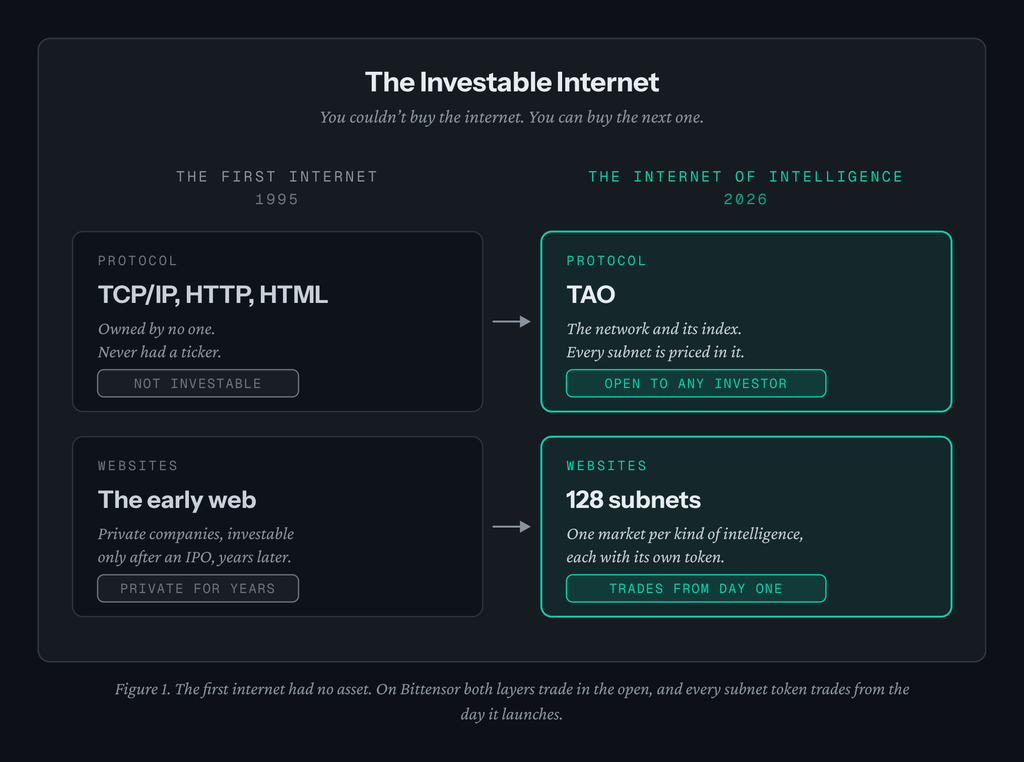
The internet became the most valuable network in history, but investors could never own TCP/IP or HTTP. The value flowed mainly to companies built on top of those protocols.
Bittensor changes that for the intelligence era. It is an open protocol for producing and trading intelligence, but unlike the early internet, the protocol itself has an asset. TAO is the network currency, while every subnet represents a specialized market for intelligence that trades against TAO.
In April, Stillcore Capital argued that TAO could anchor an economy worth more than $1 trillion by 2030. Six months later, their view has not changed. What has changed is the amount of evidence supporting it. Four developments in 2026 strengthened the thesis.
First, intelligence is rapidly becoming a commodity. Epoch AI estimates that the cost of reaching a given level of model performance has fallen roughly 13-fold per year since 2023. On Vercel’s AI Gateway, open-weight models handled 56% of tokens in August, up from just 7% in December, while accounting for only 14% of spending.
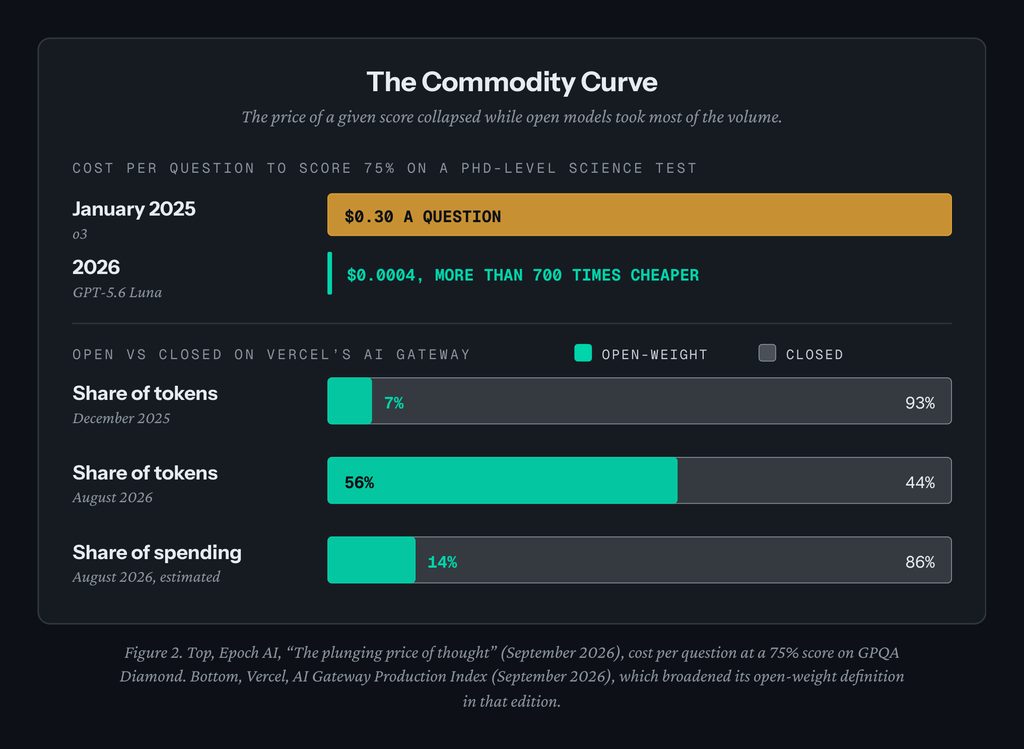
The implication was that as model quality converges and prices fall, buyers increasingly choose intelligence based on capability, cost and control, and not which lab produced it. That changes where value accumulates.
Commodity producers tend to compete margins down over time. The more durable value sits with scarce inputs and the market that grades, prices and clears the commodity. Intelligence still lacks a universal market for measuring quality, and this is the problem Bittensor is designed to solve.
Through Yuma Consensus, validators score the work produced by miners, stake-weighted consensus determines which contributions deserve rewards, and persistent disagreement is penalized. Bittensor is effectively building a market where intelligence can be evaluated and traded.
The second major shift is toward open AI. Companies including Airbnb, Uber, Pinterest and AT&T have already moved meaningful workloads toward open models because of lower costs and comparable performance. Control has also become more important. In June, customers of a major U.S. AI lab temporarily lost access to its newest models following an export-control directive.
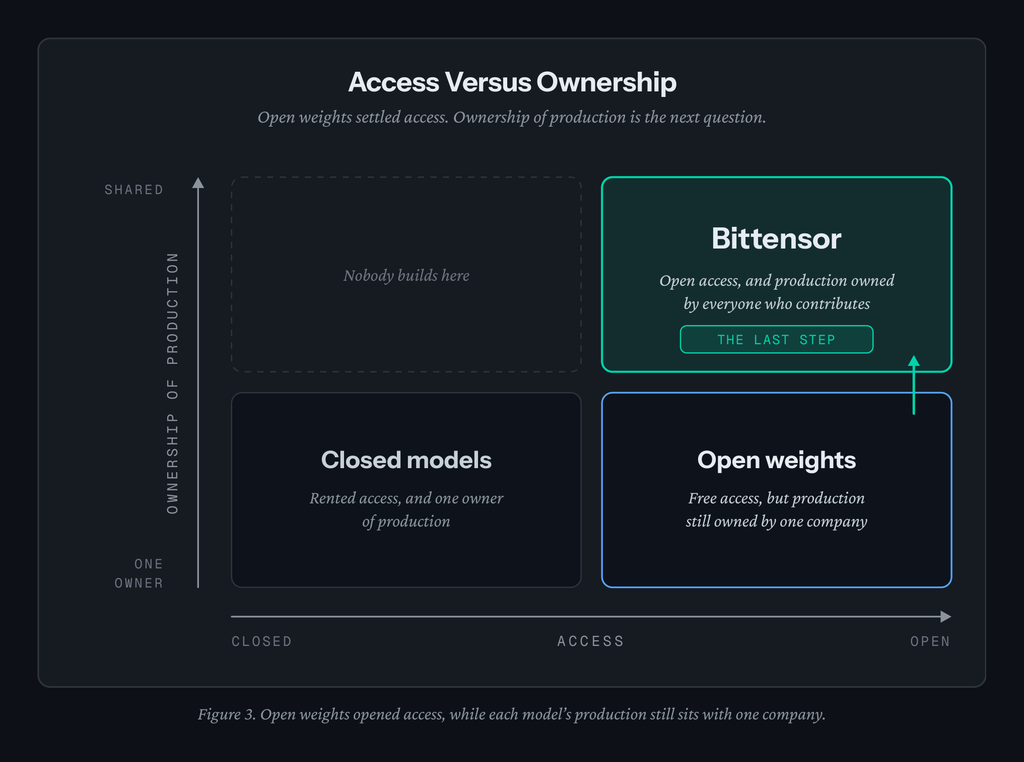
Open models reduce that dependency. Bittensor goes further by opening not only access to models, but their production. Anyone can contribute compute, models, data or code and earn ownership in the markets they help build.
Third, Bittensor has started generating meaningful external revenue. Outside customers are now estimated to pay Bittensor subnets between $50 million and $65 million annually. Twenty-three of 128 subnets have paying customers, while two already generate enough external revenue to cover miner emissions.
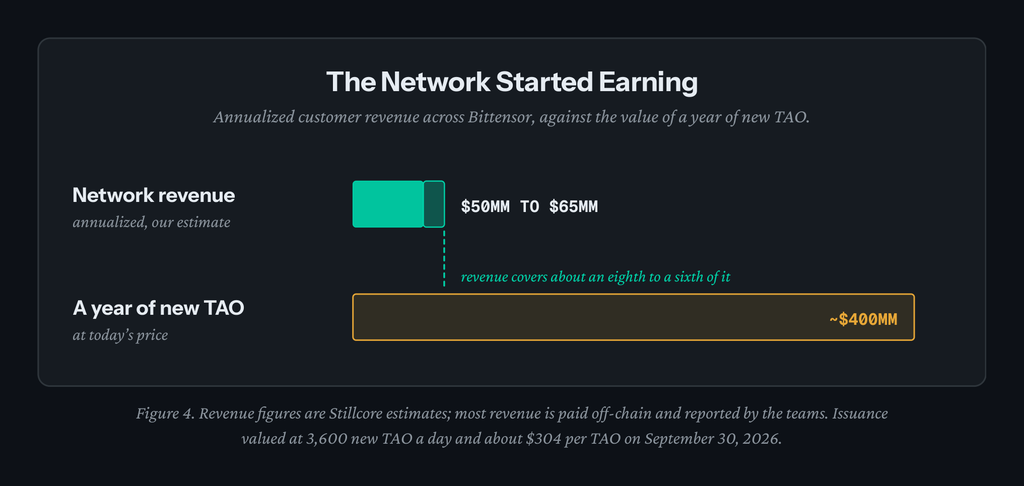
Revenue still represents only a fraction of TAO issuance, but that is the point of the current phase. The protocol is subsidizing supply while the network develops demand. TAO issuance declines on a fixed schedule. Revenue does not.
The incentive system is also evolving. Mature subnet ownership is increasingly tied to locked stake, emissions now incorporate market prices, and future mechanisms are expected to give external revenue a greater role in determining TAO allocation.
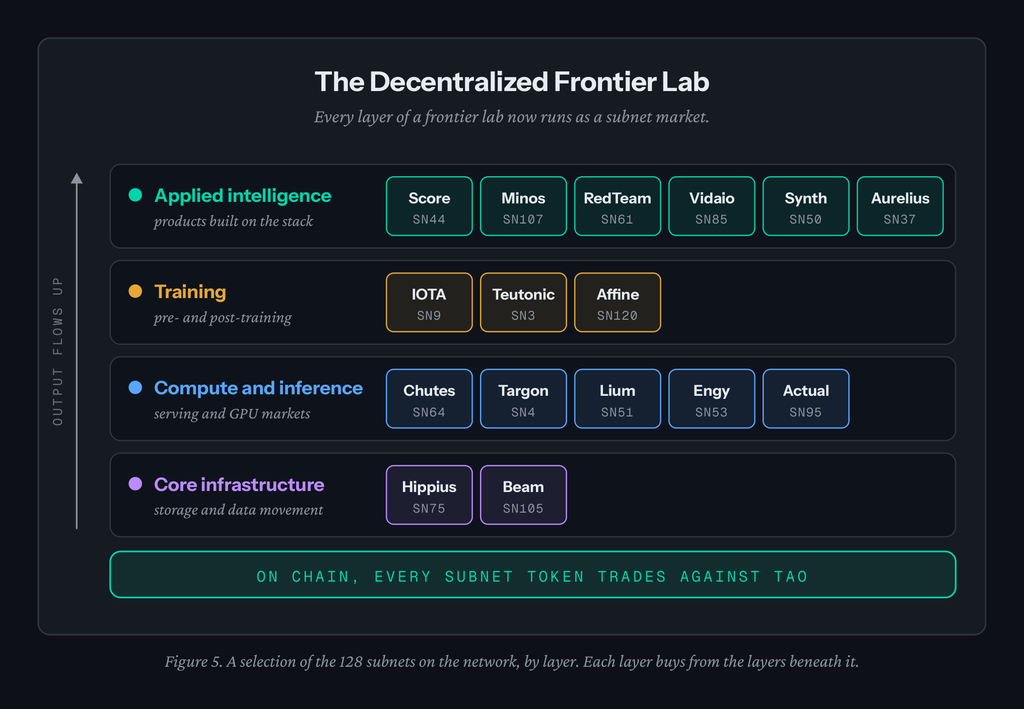
Fourth, Bittensor is increasingly operating like a decentralized frontier AI lab. A full AI stack requires data, compute, training, inference, model improvement and applications. Bittensor now has subnets operating across each of these layers, with some already buying services from one another.
The network has also begun producing competitive models. That includes a 72-billion-parameter model trained by dozens of independent contributors and another effort that reached 2025 frontier-level quality at a fraction of the size and cost using Bittensor infrastructure.
Decentralized training still trails centralized clusters, but continued improvement here is upside to the theory, not something it depends on.
By 2030, Bittensor is projected to consist of hundreds or potentially thousands of specialized intelligence markets selling compute, inference, data, models and other services to humans, companies and increasingly AI agents.
At the valuations considered in the report by Stillcore Capital, TAO issuance alone could support compute equivalent to more than one million of today’s high-end GPUs, creating an enormous decentralized fleet without a single owner. Planned mechanisms such as Gamma could make payments between these markets easier, allowing subnets and AI agents to purchase services from one another directly.
This creates a powerful feedback loop. Better compute lowers training costs, better training improves models, and better models improve applications. More demand produces more revenue, which strengthens the markets supporting the network.
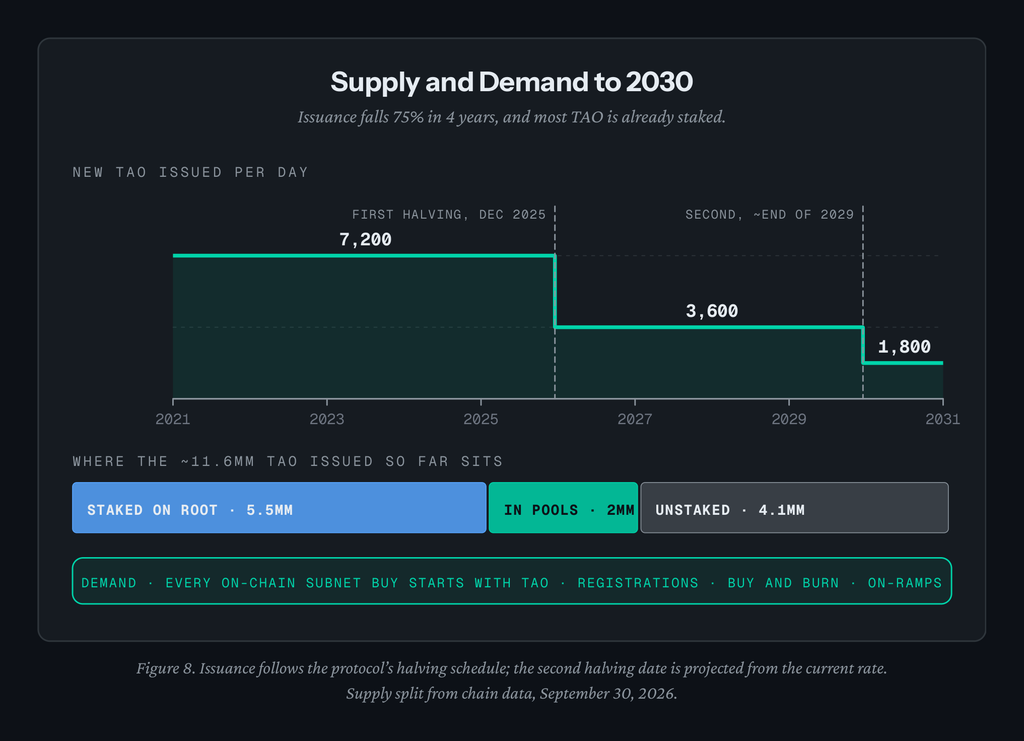
TAO exists underneath the entire system. Its supply is capped at 21 million. Subnet purchases, staking, registration and revenue recycling all ultimately interact with TAO. As economic activity across Bittensor expands, value generated across many separate intelligence markets connects back to the same base asset.
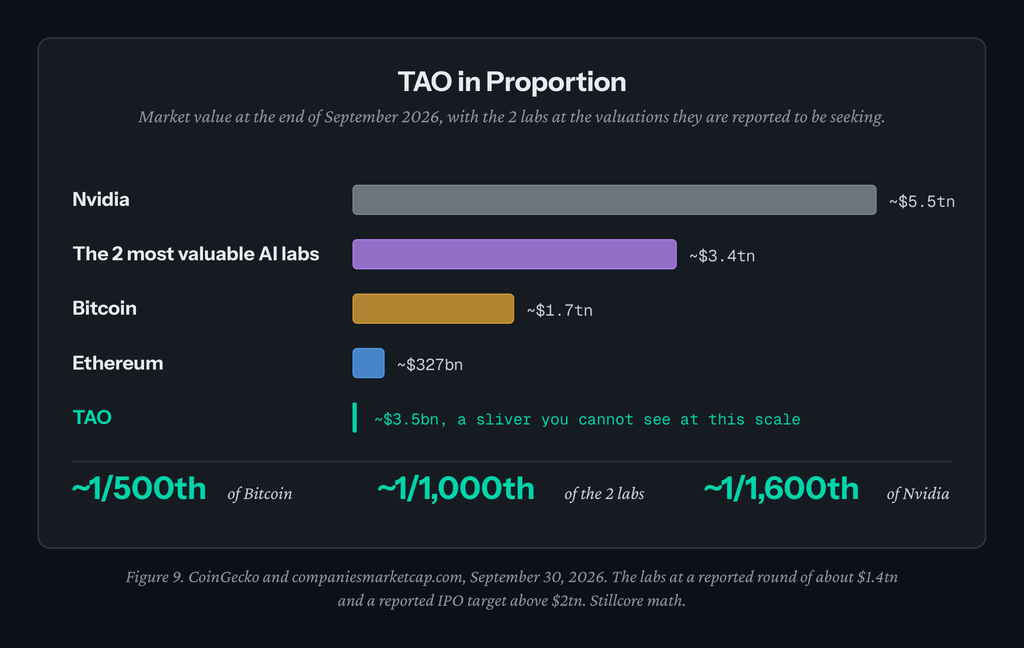
If intelligence becomes abundant, cheap and increasingly open, the scarce asset may not be the model itself. It may be the network that determines what intelligence is valuable, coordinates its production and provides the market where it trades.
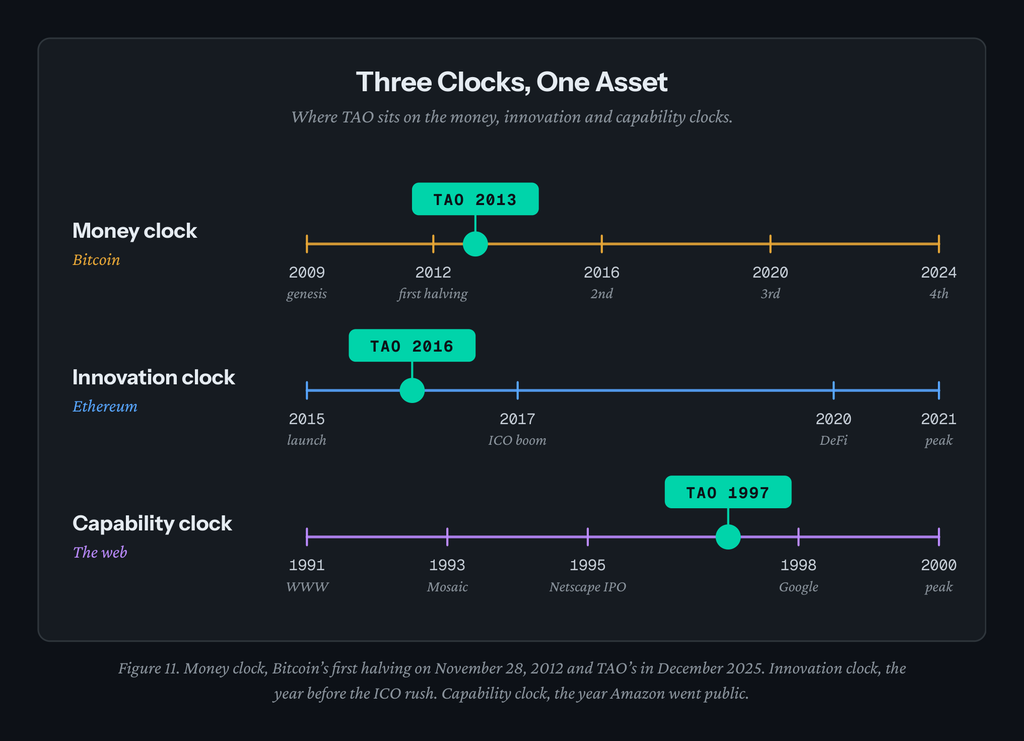
This is exactly the network Bittensor is building.
Enjoyed this article? Join our newsletter
Get the latest TAO & Bittensor news straight to your inbox.
We respect your privacy. Unsubscribe anytime.
Enjoyed this article?
Join our newsletter
Get the latest TAO & Bittensor news straight to your inbox — every morning before markets open.



No comments yet — be the first.