


TAO has moved quickly from around $220 in mid-September to above $300, with CoinGecko data showing a move from $221.93 on September 16 to above $300 by the end of the month. After a run like that, it is reasonable to wonder whether buying now means arriving late.
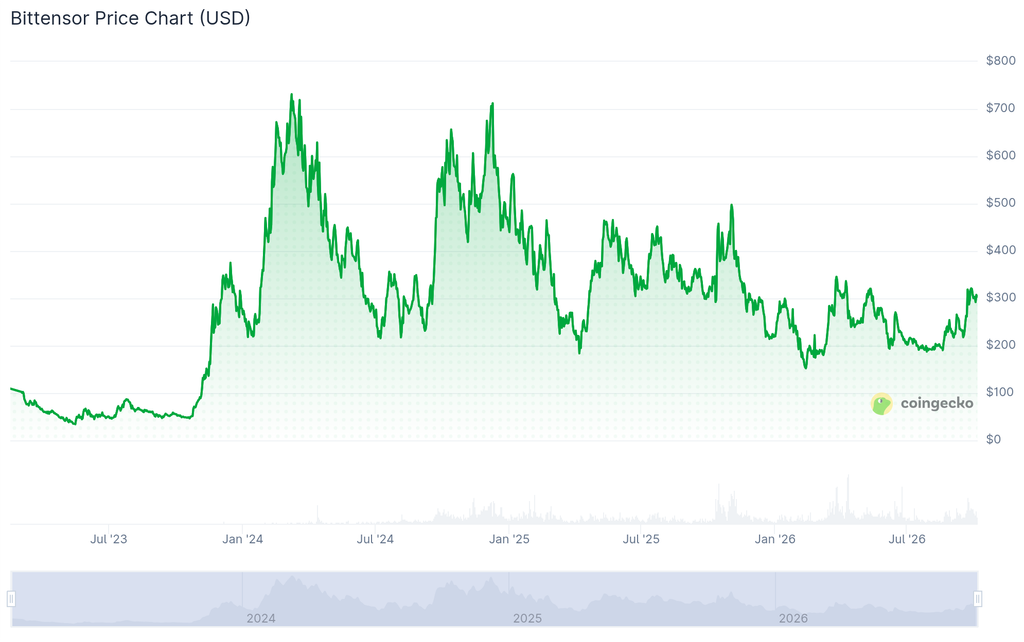
The stronger argument is that Bittensor itself looks considerably better today than it did when TAO traded at similar prices before. The network now has 128 subnets spanning inference, compute, data, model training, agents, robotics and other AI markets. Commercial activity is beginning to appear outside the token economy, the first TAO halving has already reduced new issuance, and new ideas such as Gamma are trying to connect the different parts of Bittensor into an economy where subnets buy services from one another.
That combination is why $300 TAO still looks interesting.
Gamma Could Be Much Bigger Than Another Token Mechanism
Gamma was one of the more important announcements from Exploit Summit because it tries to solve a basic problem inside Bittensor. The network has many specialized subnets producing useful services, but those markets still operate largely as separate economies. Gamma proposes standardized usage credits that could represent access to things such as inference, compute and storage, making it easier for one subnet to become a paying customer of another.
A robotics subnet, for example, does not need to build its own GPU infrastructure or inference stack. It could use part of its emissions to buy those services from infrastructure subnets already doing them well. Gamma credits are also being designed to be transferable and potentially usable across chains, opening the possibility of AI agents purchasing Bittensor services directly without the normal account, subscription or fiat-payment process. Our earlier breakdown of Gamma explains the proposal in more detail.
The economic part is even more interesting. The proposed route involves buying and burning a subnet’s alpha to create dollar-denominated Gamma credits, while subnets could also redirect portions of emissions toward buying Gamma from other networks. If that becomes widely used, consumption of an AI service could create direct demand for the alpha behind that service instead of the token economy depending almost entirely on speculative demand and emissions. Gamma is still a proposal and does not yet have a confirmed final implementation, but the direction is important.
The Subnets Are Starting to Find Paying Customers
That market would not mean much without real demand, which is why the recent growth in subnet revenue deserves attention. According to the latest SubConnect Revenue Index covered by The TAO Daily, Bittensor’s revenue-generating subnets have now passed $50 million in annualized external revenue, compared with roughly $32 million to $35 million about one month earlier.
These are customers paying for products and services outside Bittensor’s incentive system, which means at least some subnets are beginning to answer the question that eventually matters for every crypto network: does anybody want to buy what is being produced?
The next step could become even more interesting because several subnets are already using revenue to buy back their own alpha. If commercial revenue continues growing and more of it returns to subnet tokens through buybacks, while Gamma creates another source of demand tied to service consumption, then Bittensor starts building an economic loop that is much healthier than most other crypto projects.
OpenRoboto Shows How Wide the Opportunity Can Become
OpenRoboto is a good example of why the Bittensor opportunity should not be viewed only through the lens of LLMs. The subnet has been building a robotics pipeline covering model improvement, benchmarking, physical robot testing and now real-world data collection through Shift.
Workers can wear first-person recording devices while carrying out normal tasks in factories, warehouses and other environments, producing the kind of egocentric data robots need to understand how humans interact with the physical world. The TAO Daily recently covered the full OpenRoboto pipeline here.
The interesting part is that this is not some obscure problem invented for crypto. NVIDIA’s EgoScale research trained a vision-language-action model using more than 20,000 hours of action-labelled egocentric human video, arguing that human behaviour can become a highly scalable source of training data for dexterous robots. OpenRoboto is trying to build an open, incentive-driven market around the same broad bottleneck.
This is what makes Bittensor particularly interesting as an AI bet. Investors do not have to predict whether the biggest opportunity will ultimately be inference, GPU compute, agents, robotics data, model training or something that has not yet emerged. Different subnets can compete across all of those markets while TAO remains the common asset sitting underneath the broader network.
The Market Is Growing While New TAO Issuance Has Already Fallen
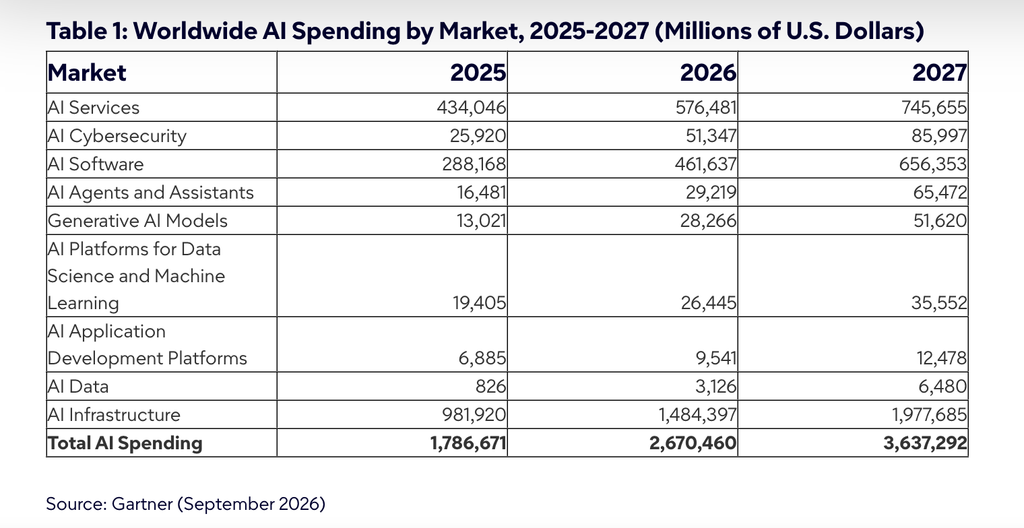
The size of the opportunity outside Bittensor is also difficult to ignore. Gartner now expects worldwide AI spending to reach $2.7 trillion in 2026, an increase of 49.5% year over year, with AI infrastructure among the largest areas of spending. Bittensor does not need to take a huge share of that market for the economics of the network to look very different from where they are today. Capturing just 5% of that would make TAO’s valuation go parabolic.
At the same time, TAO’s supply side has become tighter. Bittensor’s first halving happened in December 2025, reducing network emissions from 1 TAO to 0.5 TAO per block, or roughly 3,600 new TAO per day. The network still has inflation and will continue issuing TAO toward its 21 million maximum supply, but new daily issuance is now half what it was before the halving.
That creates a simple part of the bull case. Bittensor is trying to create more reasons for people, companies, agents and subnets to demand its economy at the same time that the flow of newly issued TAO has already been cut substantially.
Institutional attention is also slowly becoming less theoretical. Grayscale has operated a Bittensor Trust since 2024, and in a new research report on the crypto AI sector published on October 1, it described Bittensor as a decentralized AI marketplace and one of the representative assets in the category. Perhaps more interestingly, Grayscale noted that artificial intelligence remains the smallest crypto sector by market capitalization, despite AI becoming one of the biggest investment themes in technology.
Why $300 Still Does Not Look Late
The case for buying TAO around $300 comes down to how much Bittensor has changed while the market is still valuing it well below its previous highs. The network is beginning to generate meaningful commercial revenue, its subnets are attacking increasingly valuable AI markets, and Gamma could create more direct economic activity between those subnets.
All of this is happening while the wider AI market continues expanding at an extraordinary rate. Compute, inference, agents, robotics and AI data are attracting enormous amounts of capital, and Bittensor is building markets across several of them at the same time.
That is why $300 does not look particularly expensive when viewed against what Bittensor could become. TAO has already traded above $750 when the ecosystem was far less developed than it is today. Now there is real revenue, a larger subnet economy, tighter issuance, growing institutional attention, and a clearer path toward connecting Bittensor’s AI services into one economic system.
Enjoyed this article? Join our newsletter
Get the latest TAO & Bittensor news straight to your inbox.
We respect your privacy. Unsubscribe anytime.
Enjoyed this article?
Join our newsletter
Get the latest TAO & Bittensor news straight to your inbox — every morning before markets open.


No comments yet — be the first.