

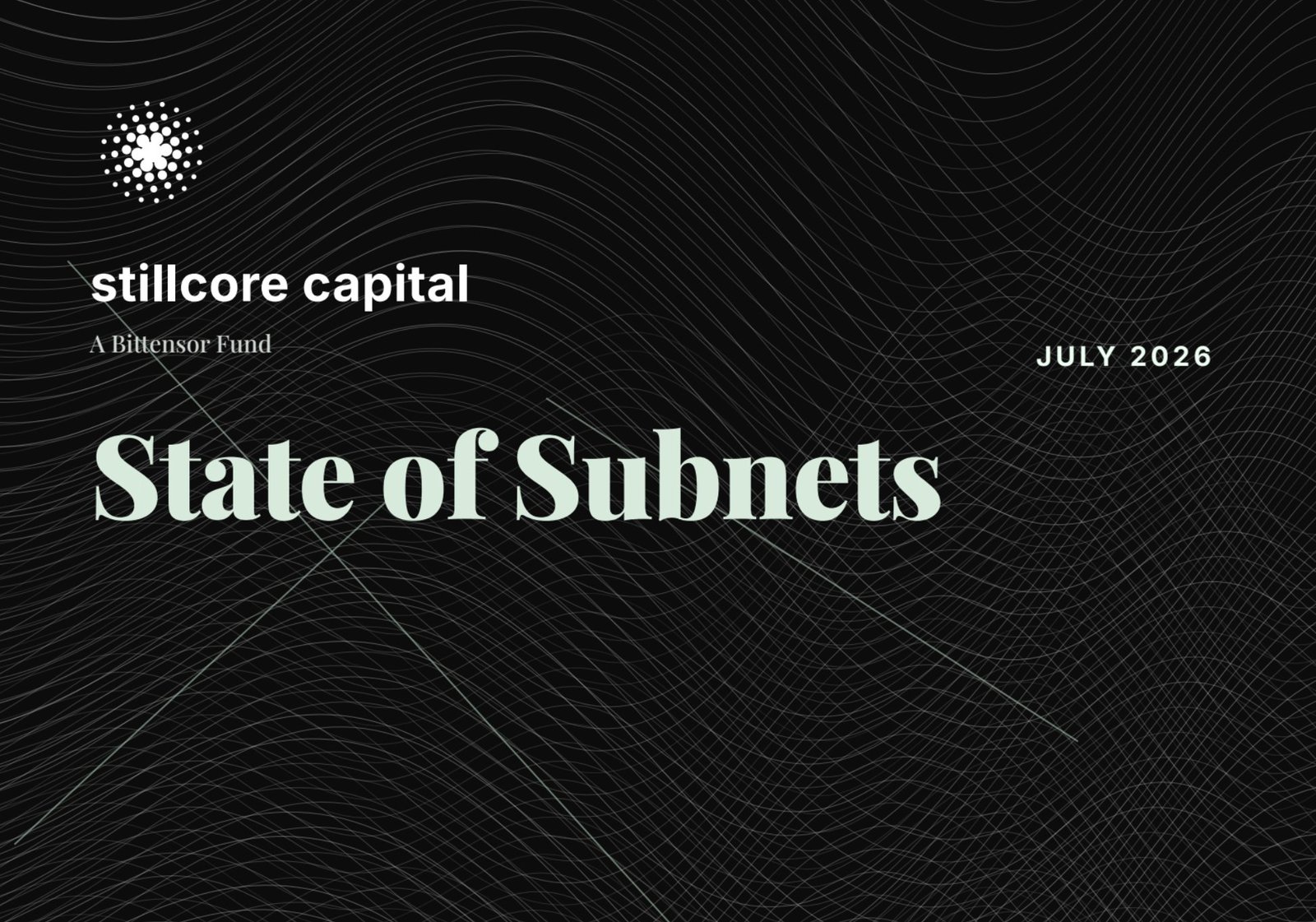
Stillcore Capital has released its State of Subnets: July 2026 Report, a data-driven assessment of Bittensor’s subnet ecosystem covering performance, economic models, valuations, and investment flows.
Partner Mark Jeffrey announced the release on July 8, and reaction across the ecosystem has been strong, with builders, validators, and investors circulating it as one of the more substantive public analyses of the network to date.
The Growth Cycle Hasn’t Started
The report’s central argument is that the subnet economy remains small, deliberately framed as the “calm before the storm.” Teams are shipping, revenue is beginning to appear, and the infrastructure required to absorb serious capital is coming together piece by piece. But the actual growth cycle, Stillcore suggests, is still ahead.
Year 1 Proved the Model. Year 2 Has to Prove the Businesses.
The report draws a sharp line between Bittensor’s first and second years.
Year 1 validated the subnet economic model; the incentive mechanisms work, emissions flow, miners and validators coordinate.
Year 2 is the harder problem: actual revenue, actual customers, sustainable flywheels, and functioning buy-and-burn mechanics. The next breakout subnets will be decided on execution and problem-solving, not on narrative strength.
For a network that has spent much of its life explaining itself and the tech behind it, that’s a meaningful shift in the evaluation criteria.
The Valuation Gap
The report also addresses arbitrage between current subnet valuations and comparable centralized AI companies. The report characterizes the gap as substantial, and raises an implicit question that has followed Bittensor for some time: why has traditional capital largely ignored decentralized AI infrastructure during one of the most aggressive AI funding cycles on record?
The report doesn’t fully answer it. But it documents the disparity in enough detail to make the omission difficult to dismiss.
SN23 (Trishool) Highlighted
Among the subnets called out explicitly is SN23 (Trishool), Bittensor’s decentralized AI alignment subnet. Trishool focuses on production-grade safety infrastructure through continuous adversarial red teaming, including its HaloGuard model family. The team has confirmed it is now in Phase 3 of its roadmap.
This inclusion drives attention toward subnets solving concrete, commercially legible problems rather than those competing on abstraction.
Other highlighted subnets are Bitsec (SN60), Vidaio (SN85), Score (SN44), and many others.
Read more about Trishool’s achievement on TaoDaily:
What Else Is Covered
- Investment flows into subnets
- Emerging high performers across the ecosystem
- The evolution of decentralized AI infrastructure
- Economic model insights and Bittensor’s long-term trajectory
Read It
The full report is available via DocSend: https://docsend.com/view/562fmtieyi2yrqn5
It is the latest release in Stillcore Capital’s ongoing Bittensor research series.
Enjoyed this article? Join our newsletter
Get the latest TAO & Bittensor news straight to your inbox.
We respect your privacy. Unsubscribe anytime.
Enjoyed this article?
Join our newsletter
Get the latest TAO & Bittensor news straight to your inbox — every morning before markets open.


[…] Jeffrey of Stillcore Capital, one of the largest funds inside the ecosystem, believes the first breakthrough will arrive within […]
[…] April, Stillcore Capital argued that TAO could anchor an economy worth more than $1 trillion by 2030. Six months later, […]