


DSV Fund‘s Mark Creaser and Siam Kidd returned from summer holidays to find Bittensor transformed after just three weeks of rapid protocol changes.
Root Reborn launched, the Emission Gate activated, Conviction reshaped alpha locking, and deregistration continued removing the lowest-priced subnet.
Building on Mark’s writeup from the previous day, their latest Revenue Search podcast unpacked how these changes are reshaping the network.
They argued the current pace is driving capital away, criticized deregistration as a weak quality filter, and proposed alternatives they believe deserve serious debate.
What the Discussion Covered
The conversation moved through change cadence, the deregistration mechanism, sales cycles, real institutional impact, and the specific alternative solutions worth discussing.
1. The pace of protocol change is exhausting even seasoned participants: Following Bittensor right now takes full-time attention. Subnet owners spend so many hours keeping up with new rules that running their businesses becomes a side project.
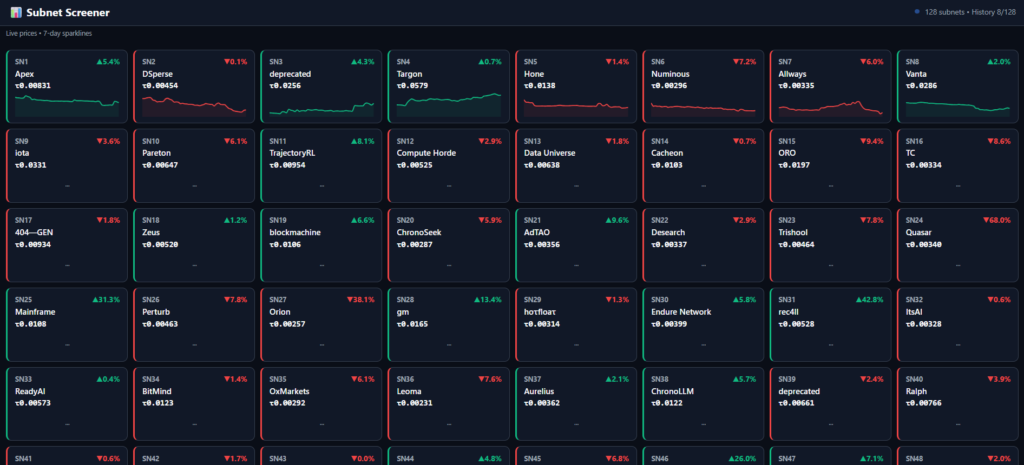
2. Deregistration filters for popularity, not quality: The lowest-priced subnet dies first. Alpha holders may not be the best judge of which teams deserve to survive, especially in an ecosystem still figuring out how to price value.
3. Enterprise sales cycles run 16 to 24 months: Tenders take a year, delivery follows on 90-day terms, and payment lags on top of that. Subnets courting hedge funds, banks, or governments cannot survive the runway the current mechanism gives them.
4. Tesla and Apple would both have been deregistered from Bittensor: Both companies spent extended periods out of favor with their own shareholders. Under the current popularity-driven cull, neither would have survived long enough to ship the products that defined them.
5. A well-funded institutional team just paused their Bittensor entry: A project had been actively planning a subnet launch with real capital behind it. They will still raise, but they will not enter Bittensor now. The protocol changes are too fast for a new business to plan around.
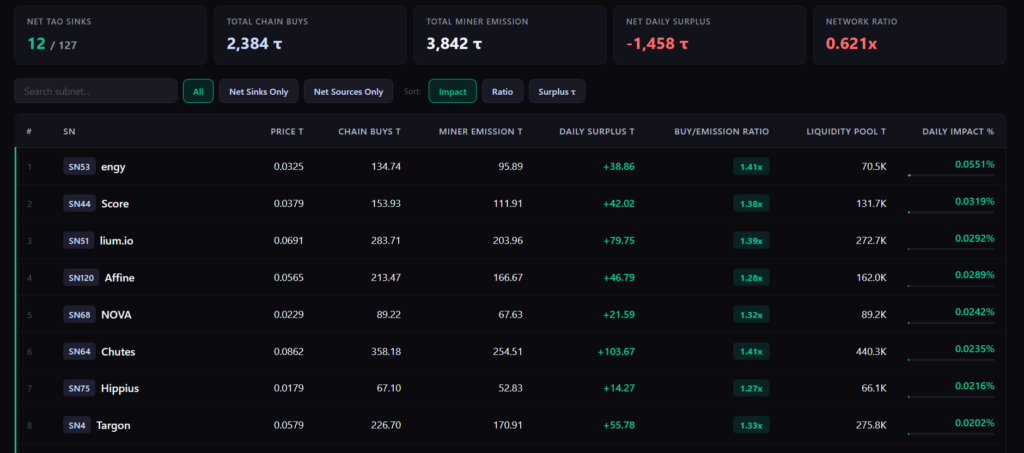
6. Chain buybacks already exceed miner emissions on 12 subnets: A live dashboard tracking net chain buying against daily miner sell pressure shows twelve subnets running a surplus, meaning the protocol buys back more alpha per day than miners emit. This is the reflexivity mechanic the ecosystem has been theorizing about.
7. Root Reborn moves the risk onto root stakers: Root staking stops being risk-free. Stakers now indirectly hold their validator’s curated basket, and rewards drop when the picks underperform. Passive root staking becomes an active choice about which validator earns more yield.
8. Conviction gets dismissed as a “sugar cube of virtue signaling”: The only problem Conviction genuinely solves is defending a subnet from hostile takeover by an outside party locking up more alpha than the owner. Every other stated purpose either does not need solving or does not get solved by locking alpha up.
9. The gap between technical and financial expertise sits at the root of the problem: Tech minds build economic systems like Bittensor assuming they understand economics, and money minds build tech assuming they understand engineering.
10. Unlimited registration is proposed as the alternative to deregistration: Bottom-ranked subnets would keep their slot but earn nothing from the chain. Teams pivoting through a rough quarter stay alive without losing everything to a temporary popularity dip.
Not a Complaint, a Diagnosis
The DSV guys closed by stressing that the discussion was not a complaint about change, but a call for Bittensor’s network-wide incentives to be engineered with the same care as those inside individual subnets.
They argued every protocol change creates second-order effects, every incentive also creates a disincentive, and a clear North Star is needed to judge whether upgrades are truly succeeding.
Their proposed path forward is to announce changes earlier, give participants time to adapt, and group major upgrades into predictable rollout windows.
They concluded that Bittensor already has the talent to succeed, but aligning technical ambition with the financial realities of institutional capital requires a stronger and more deliberate process.
Enjoyed this article? Join our newsletter
Get the latest TAO & Bittensor news straight to your inbox.
We respect your privacy. Unsubscribe anytime.
Enjoyed this article?
Join our newsletter
Get the latest TAO & Bittensor news straight to your inbox — every morning before markets open.



No comments yet — be the first.