

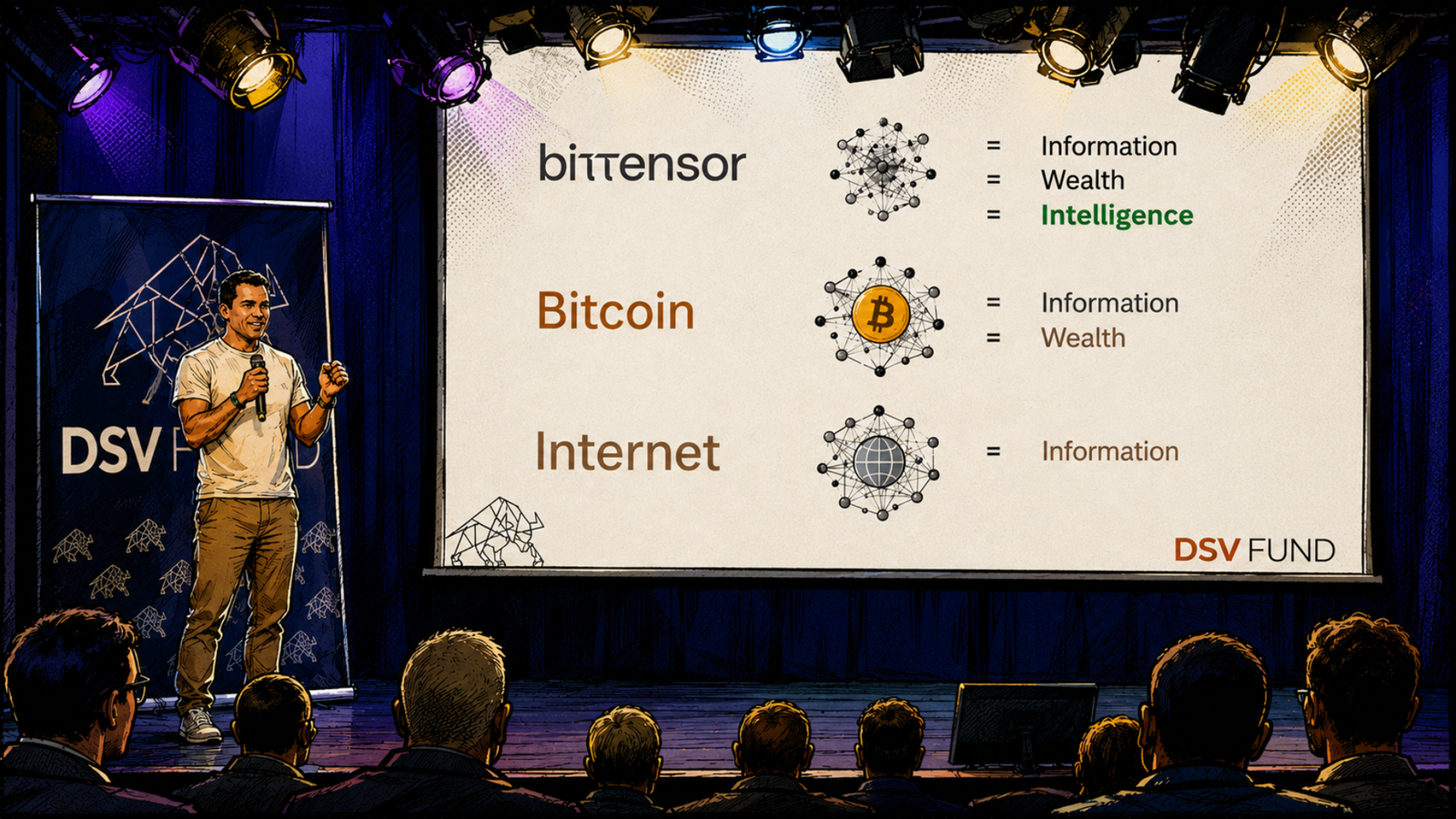
DSV Fund’s Inside Bittensor event opened with a presentation by Siam Kidd covering money as crystallized work energy, AI acceleration beyond human intuition, and the argument for Bittensor ($TAO) as the third great global network after the internet and Bitcoin. Bittensor’s tokenomics mirror Bitcoin’s (21 million cap, four-year halving), and the network reached a $1 billion market cap in eleven months against Bitcoin’s four-plus years.
At first halving, $TAO sat at $269 and $2.83 billion market cap against $BTC’s $12.35 and $129.7 million at the same milestone. The full session made the case that the current phase resembles Bitcoin in 2013, with a compressed acceleration curve pointing toward the same destination faster.
The Framework Behind the Thesis
The presentation built its framework through monetary history and AI acceleration, but the payload was where Bittensor fits in that framework and why the tokenomics point higher than most participants realize.
1. The modern market cheat code is coordinating untapped resources. Bitcoin coordinates stranded compute, Airbnb hotel rooms, Uber unused vehicles, Upwork idle talent. Bittensor extends the same pattern to AI, harnessing stranded intelligence, data, and infrastructure globally into a single marketplace.
2. AI is doubling faster than exponential, which changes the market for what Bittensor produces. AI agent task duration doubled every seven months from 2019 to 2024, now doubling every four months. The gap between what humans intuitively expect and what is actually shipping widens every quarter, and Bittensor is one of the few networks positioned to absorb that demand at scale.
3. Bittensor is the third great global network. The internet enabled information transfer, Bitcoin enabled value transfer, and Bittensor enables intelligence creation. It stands alongside those two as a globally scaled network primitive rather than a crypto project competing on features.
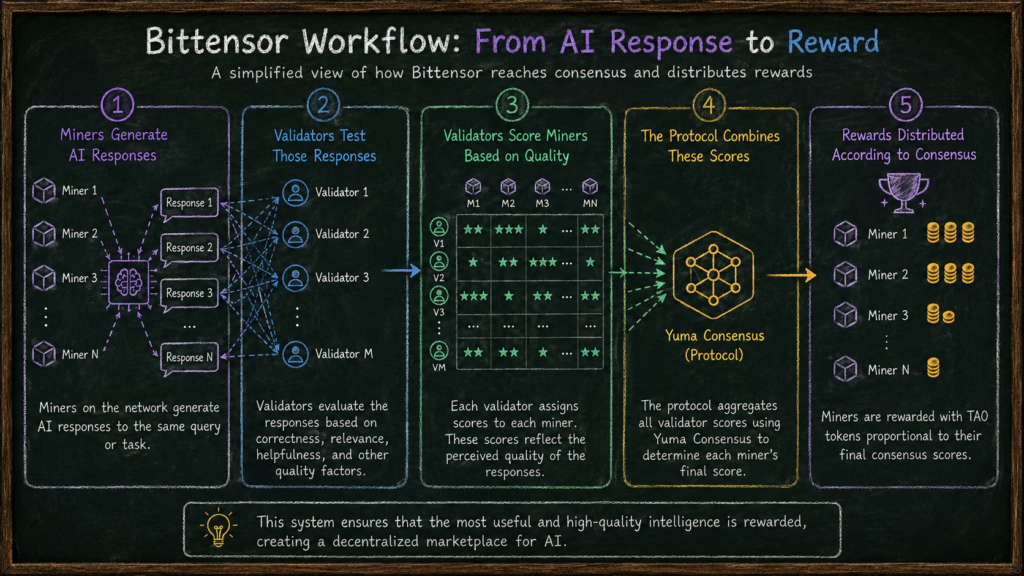
4. In technical terms, Bittensor is a decentralized framework for a marketplace of incentive mechanisms. In simpler terms, it functions like the S&P 500 or NASDAQ 100 of independent distributed AI startups. $TAO is the aggregate token that captures the ecosystem’s value, similar to how $GOOG captures Alphabet’s spread of businesses.
5. The 128 subnets are 128 independent AI startups. Each focuses intensely on one niche rather than trying to build the next general-purpose LLM. That focus is what lets them beat centralized labs in specific domains where deep specialization beats scale.
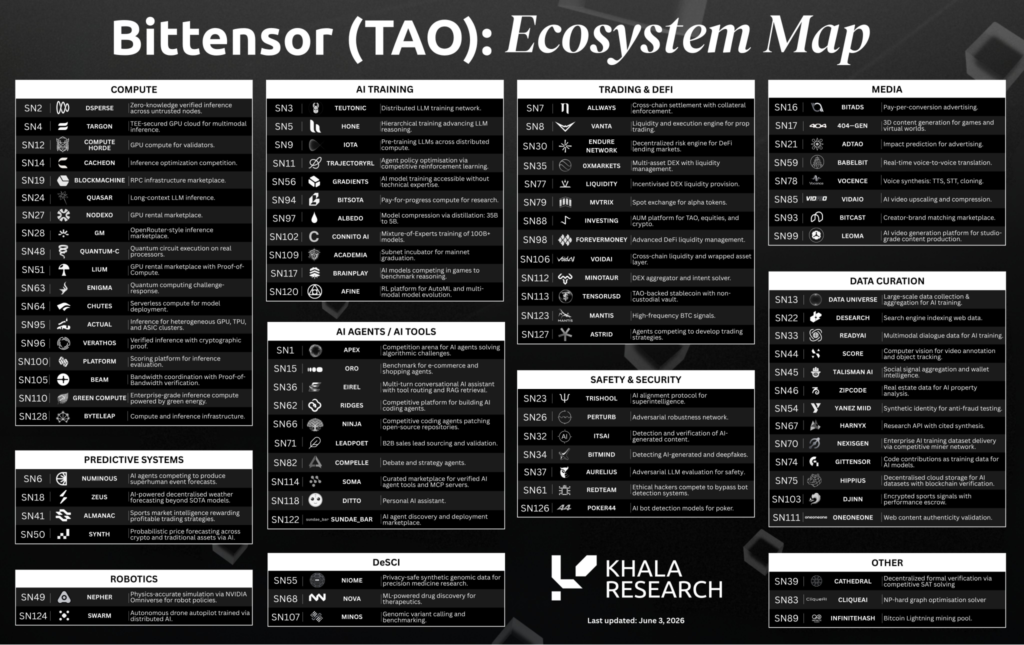
6. Subnet output already competes commercially with incumbents. Score (SN44) builds the best open-source computer vision, NOVA (SN68) collapsed drug discovery from a decade to a year for behavioral drugs, and Hippius (SN75) offers 1,000 terabytes of storage for $3,000 a month against six-figure enterprise pricing at Google or Amazon. Vidaio compresses video files by 96% with no perceptual quality loss.
Data Universe (SN13) scrapes the entirety of Reddit, Twitter, and YouTube daily, Zeus (SN18) produces the most accurate weather forecasting for energy trading hedge funds, and Targon (SN4) just signed a JV (joint venture) with Intel for AI deployment infrastructure.
7. Reed’s Law is starting to show in subnet economics. Subnets are combining to use each other’s services. A team building a Netflix competitor could use Vidaio (SN85) to compress video files, then use Hippius (SN75) to store them, driving operating costs below any centralized incumbent. That compounding surface is what makes the aggregate more valuable than any single subnet.
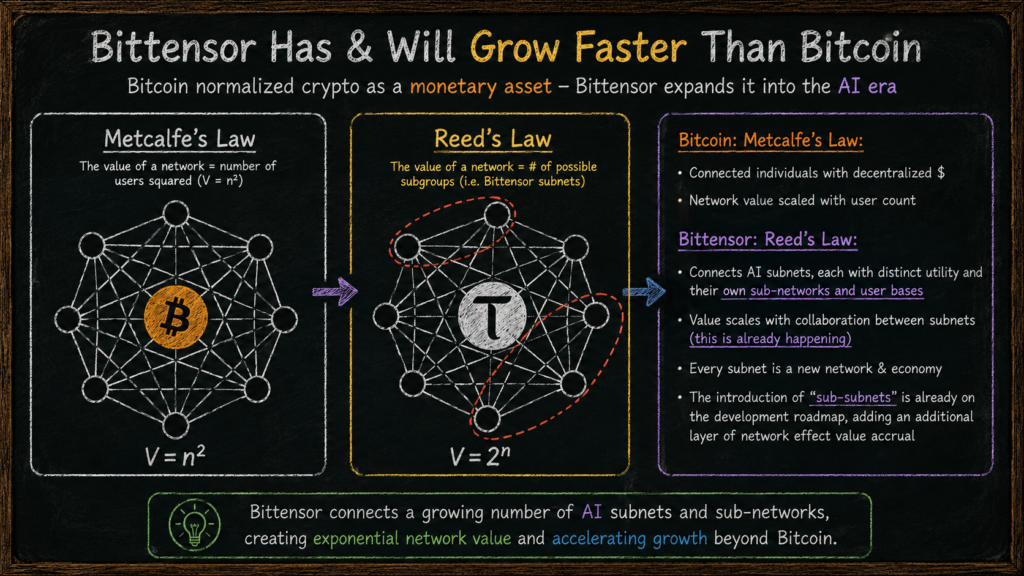
8. Bittensor tokenomics are identical to Bitcoin’s. 21 million supply cap, four-year halving schedule. The network functions on the same monetary architecture that made Bitcoin the reserve asset of the digital economy.
9. The curve is running faster than Bitcoin’s did. Bitcoin took four-plus years to reach a $1 billion market cap. Bittensor did it in eleven months. At first halving, Bittensor sat at $269 and $2.83 billion market cap against Bitcoin’s $12.35 and $129.7 million at the same milestone.
10. The price math points to substantially higher levels. If total crypto market cap reaches $7 trillion in the next bull cycle and Bittensor captures just 0.5% of that, $TAO reaches roughly $3,000. The network has already touched 0.2% before. Higher market cap shares produce $9,000 at $100 billion and roughly $60,000 at $1 trillion.
Twenty Thirteen, Compressed
The presentation closed on the argument that the current moment for Bittensor mirrors Bitcoin’s 2013 window with a compressed timeline and broader technological tailwind. The subnet economy is already demonstrating what network compounding looks like in practice across computer vision, drug discovery, storage, weather forecasting, and video compression.
Those subnets and roughly 120 others form the ecosystem that $TAO aggregates, with the tokenomics running the same Bitcoin playbook at a faster pace. For anyone who has said in retrospect they wish they had bought $BTC at $10 or $100, the closing line was that this is the same window, opening for the third great network.
Enjoyed this article? Join our newsletter
Get the latest TAO & Bittensor news straight to your inbox.
We respect your privacy. Unsubscribe anytime.
Enjoyed this article?
Join our newsletter
Get the latest TAO & Bittensor news straight to your inbox — every morning before markets open.


No comments yet — be the first.