


Most people who hold $TAO eventually ask the same question: what does staking actually pay? The answer is not a single number posted on a dashboard.
It shifts depending on which subnet you stake into, which validator you choose, and where emissions are flowing on any given day.
Bittensor’s staking rewards are the output of a live competitive system, and understanding how that system works is the difference between staking intelligently and simply parking tokens.
How Staking Works
When a $TAO holder stakes into a subnet, they delegate to a validator who evaluates miner performance and secures a position in the network. Emissions flow to subnets based on net $TAO inflows, and stakers earn a proportional share of those emissions.
Since the Dynamic $TAO upgrade in February 2025, staking also purchases that subnet’s ‘$TAO’ token, meaning stakers gain exposure to both network emissions and the subnet-specific economy simultaneously.
Yields across the network have generally ranged between 16% and 19% annualized for well-positioned validators, though top subnets have outperformed that range during periods of strong momentum.
With around 70% of circulating $TAO currently staked and 128 active subnets competing for emissions, validator selection matters more than most new stakers realize.
Where Tao Yield Comes In
Tracking this manually across dozens of subnets and validators is not realistic. Hence, Tao Yield as a tool that consolidates everything into one clean interface, is a very good resource for tracking yields.
The platform lets stakers:
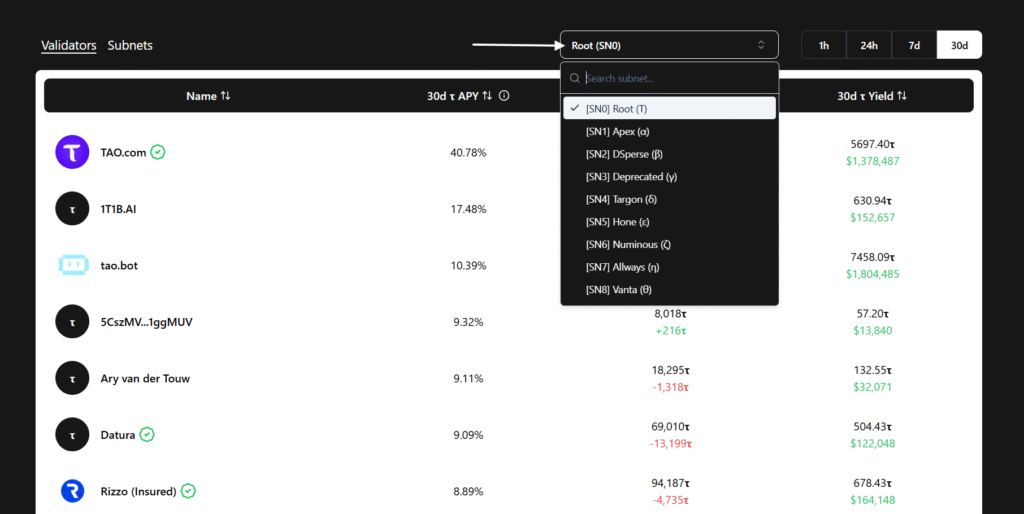
a. Browse all active subnets and compare validators side by side,
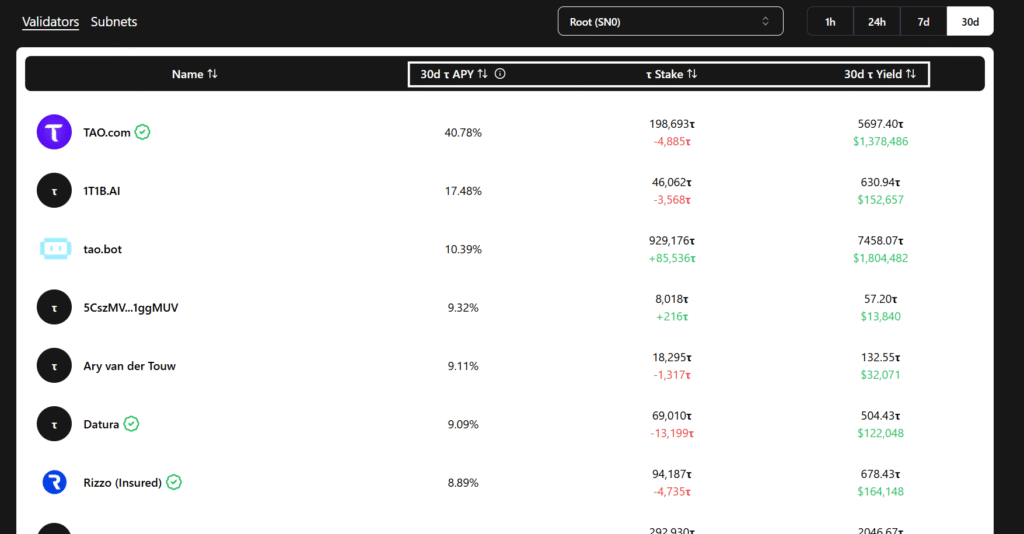
b. View each validator’s APY (Annual Percentage Yield), total $TAO staked, and actual yield performance, and
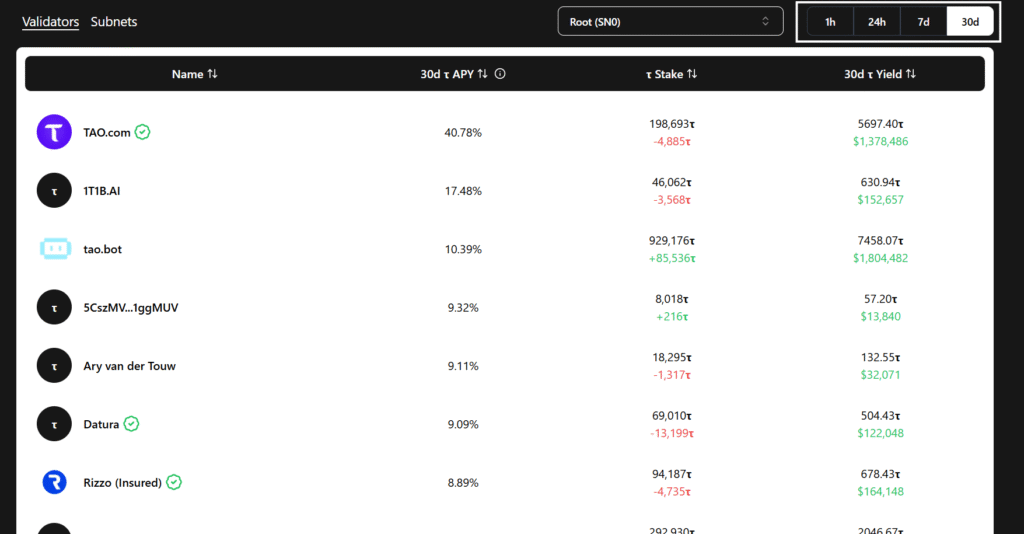
c. Filter results across 1-hour, 24-hour, 7-day, and 30-day windows to assess both recent momentum and longer-term consistency.
The timeline filter is especially useful in a network where emissions and subnet weights shift continuously.
A validator that looked strong last month may have lost inflow momentum, and that only becomes visible when short and long-term performance sit side by side in the same view.
Know Where Your $TAO Is Working
Bittensor rewards stakers who stay informed. The network is competitive by design, subnets rise and fall in the emissions rankings, and the returns between a well-chosen validator and a passive one can differ significantly.
Tools like Tao Yield removes the friction from making that call, giving stakers the data they need without the manual research. If you are holding $TAO and have not looked seriously at where it is staked, the difference in yield is real and worth finding.
Enjoyed this article? Join our newsletter
Get the latest TAO & Bittensor news straight to your inbox.
We respect your privacy. Unsubscribe anytime.
Enjoyed this article?
Join our newsletter
Get the latest TAO & Bittensor news straight to your inbox — every morning before markets open.



No comments yet — be the first.