

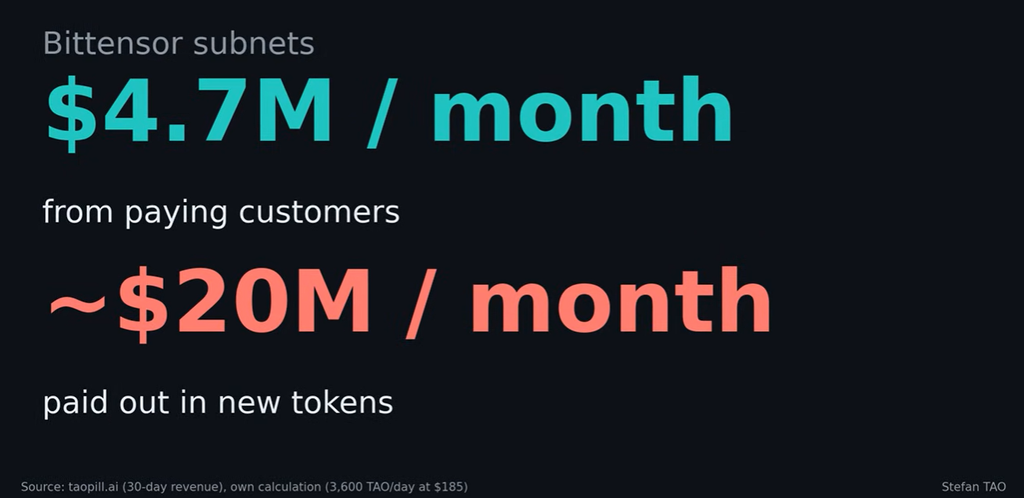
Bittensor subnets bring in ~$4.7 million a month from customers, while the network issues ~$20 million in new tokens.
Some recipients sell those rewards to cover operating costs. Customer payments can ease that pressure when they fund open-market alpha purchases. Taopill estimates $57 million in annualized sales across 17 subnets, while Subconnect puts the figure near $70 million.
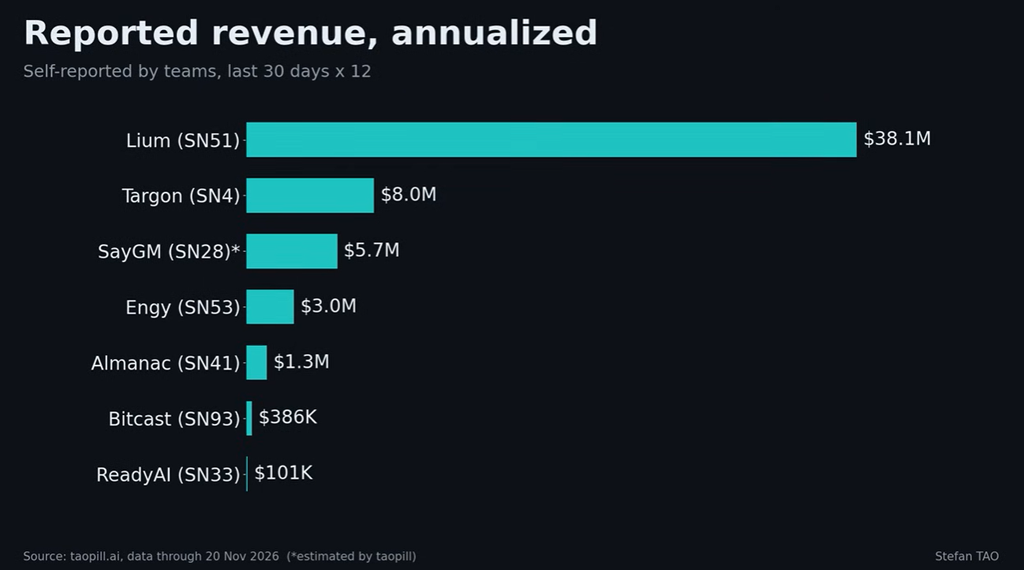
Card payments happen off-chain, so revenue trackers rely on disclosures and cover different subnets and periods.
In a 30-day snapshot, Lium (SN51) leads with $38 million in annualized GPU rental revenue. Targon (SN4) follows at $8 million from confidential compute, SayGM (SN28) at an estimated $5.7 million from AI model routing, and Engy (SN53) at $3 million from serverless inference.
On-chain records show which subnets followed through with purchases. Annualizing the same window puts Lium at $24.6 million, Targon at $5.5 million, Vanta at $2.1 million, Engy at $1.7 million and Almanac (SN41) at $1.4 million.
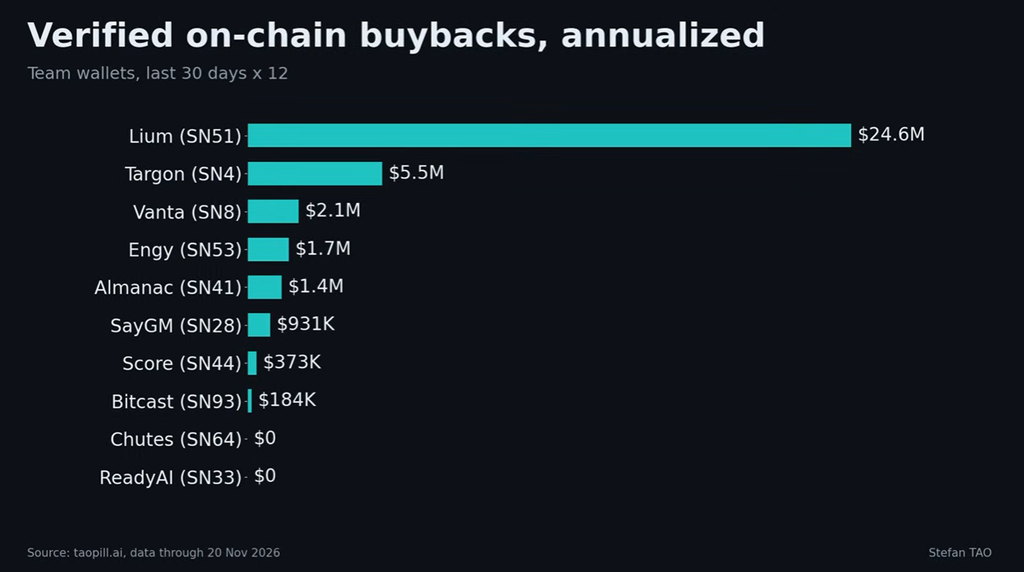
Chutes made no buybacks in the last 30-day period despite doing this previously. Ready AI also recorded zero despite having a stated buyback policy in its public disclosures.
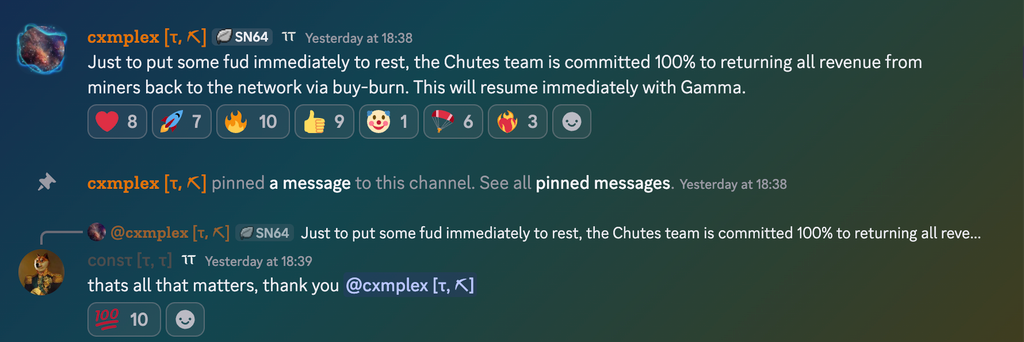
After several recent community pushbacks, the Chutes team promised to resume buybacks using 100% of the profit generated by the subnet.
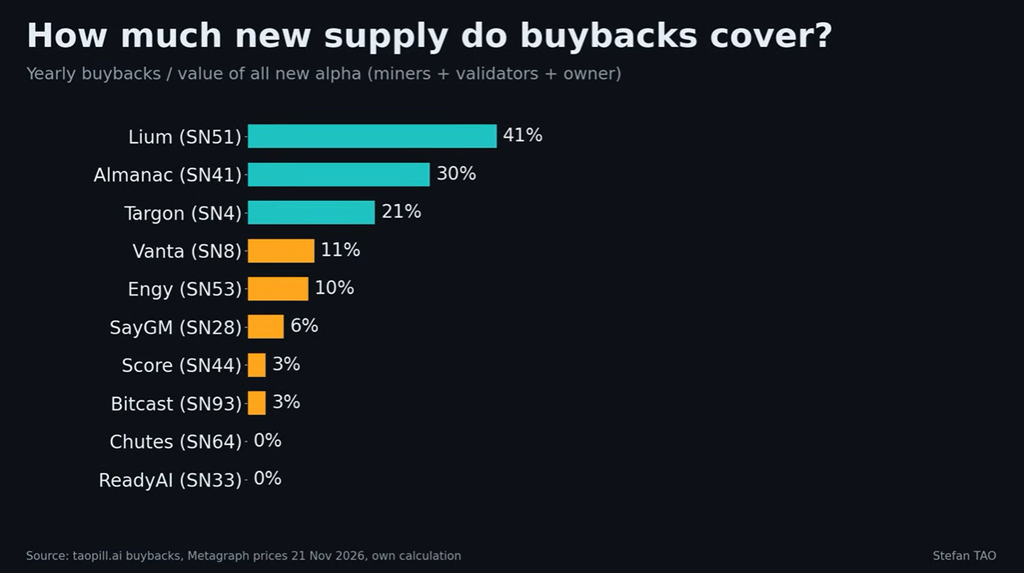
At current prices, buybacks absorb 41% of new alpha supply for Lium, 30% for Almanac and 21% for Targon.
Vanta and Engy cover about 10%, while Score and Bitcast sit near 3%. Lium trades at 4.7 times annualized buybacks, compared with 6 for Almanac and 11 for Targon.
Those multiples depend on whether the recent pace holds in subsequent months.
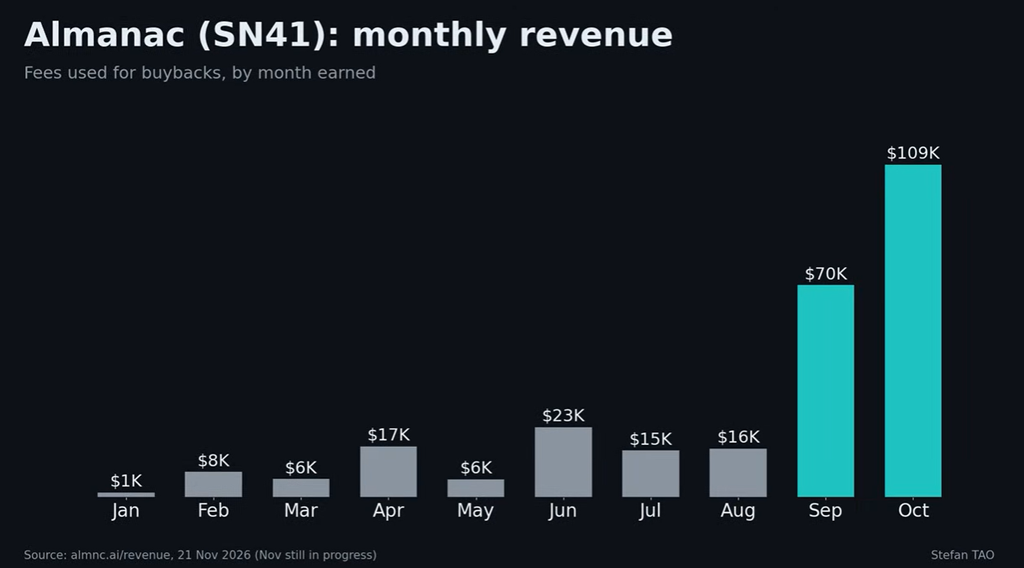
Almanac charges 1% on winning Polymarket trades. Its buybacks rose to $109,000 in October. Lium uses customer TAO to buy and burn alpha, but an independent review found that providers receive much of their compensation via subnet emissions.
Score (SN44) runs computer vision at 20 AVIA stations and counts PwC France and Reading Football Club as clients.
Bitcast (SN93) earns about $30,000 monthly from campaigns that charge for verified views.
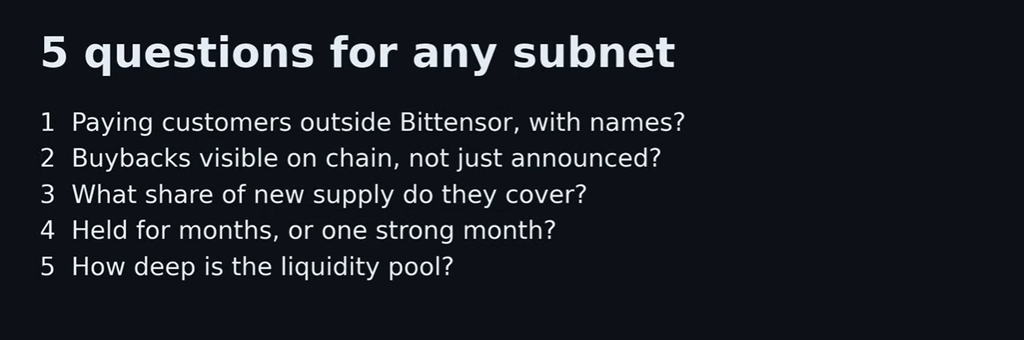
You can use five tests to assess any subnet. Look for named external customers, visible purchases, the share of emissions absorbed, consistency over several months, and enough liquidity to handle selling.
Lium comes closest to clearing all five tests. The next update will track whether it sustains its rental and buyback pace, whether Almanac holds near October levels, whether Targon maintains its purchase pace, and whether Chutes resumes buying.
Subconnect projects $100 million in annualized network revenue by year-end. That would equal more than 40% of annual emissions at current prices. Only time will tell if this holds.
➛ This Article Was Culled From Stefan TAO:
Enjoyed this article? Join our newsletter
Get the latest TAO & Bittensor news straight to your inbox.
We respect your privacy. Unsubscribe anytime.
Enjoyed this article?
Join our newsletter
Get the latest TAO & Bittensor news straight to your inbox — every morning before markets open.


No comments yet — be the first.