


Nearly $50,000 of dollar credits minted, 96% of it already spent, and one subnet doing most of the work. Here is what Bittensor’s on-chain data tells us about gamma so far. The majority of the data used in this piece is from SubnetRadar’s gamma flow radar.
Thirteen days ago, gamma switched on across Bittensor. Since then, the chain has been keeping score.
Gamma went live network-wide on November 9 at 20:27 UTC (block 9,471,027). As of block 9,564,428 on November 22, SubnetRadar’s gamma tracker counts $49,657.80 of gamma minted across 311 mints and $47,735.26 already spent across 207 spends. That is 96% of everything created, used for real services within two weeks.
Those numbers are small next to Bittensor’s market cap. But they are the first hard, on-chain evidence of people paying subnets through the protocol itself, and they tell a clear story about who is using gamma, how, and what comes next.
First, What Is Gamma?
We covered the launch in detail in Gamma Tokens Go Live, Bringing Native Payments to Bittensor’s AI Economy. Here is the short version.
Gamma is a prepaid service credit. One gamma is worth one US dollar, and each subnet has its own gamma that can only be spent on that subnet’s services.
You create it by burning alpha. Pay with TAO and the protocol buys the subnet’s alpha from its pool and burns it. Or burn alpha you already hold. Either way, $100 of burned alpha becomes 100 gamma.
You spend it with a key, not an account. A hotkey acts as your API key. You, an app or an AI agent signs a request, and the service draws down your balance. There is no sign-up form, no card on file and no separate API key for every subnet. Spends carry no fee, so the spending key doesn’t even need to hold TAO.
It can’t be traded. Gamma can’t be sent to another wallet or cashed back into TAO or alpha. It exists only to be used.
Think of it as a prepaid phone card that can only be bought by destroying a little of a subnet’s own token. The card gets used up, but the burn stays done.
The headline numbers
SubnetRadar reads every block from the moment the chain’s TAO/USD price feed went live through November 22. Here is what it finds.
$49,657.80 minted. Every one of those dollars was created by burning subnet alpha.
$47,735.26 spent. That is 96% of all minted gamma, already drawn down for services.
13 of 128 subnets switched on, or roughly one in ten.
$16,167.25 outstanding across 87 deposits held by 35 wallets, according to the tracker.
In this article, we used the mint price of $189.81 per TAO, taken from the time we completed the analysis.
One subnet is doing most of the work
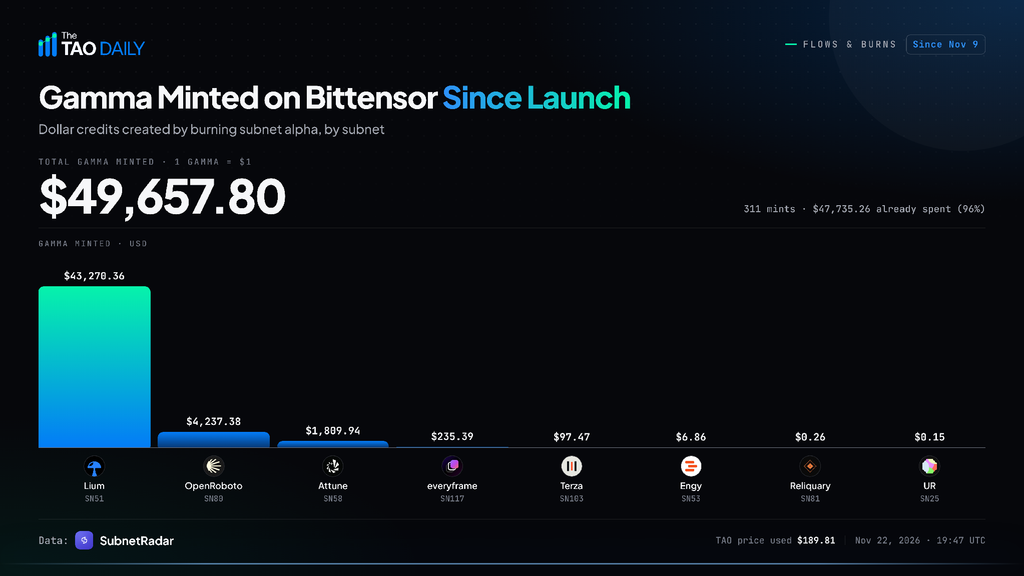
The most striking thing in the data is concentration. Lium (SN51), the GPU rental marketplace, accounts for $43,270.36 of gamma minted, roughly 87% of the total. Every dollar of it has been spent.
Lium switched gamma on November 12. Its page on bittensor.ai shows that gamma was minted entirely with fresh TAO instead of existing stake, with roughly 200 TAO paid in, and spent across six days from November 13 to November 18.
In practice, that means new TAO went into Lium’s pool to buy alpha, which was then burned.
Context matters here. Lium logged about $2.70 million in GPU rentals over the 31 days to November 9, from 2,394 billed customers. Gamma is still a small side door into a much bigger business. But it is a side door that settles on-chain, and that is the point.
OpenRoboto (SN80) is a distant second with $4,237.38 minted and $4,125 spent. Attune (SN58) follows with $1,809.94 minted, none of it spent yet.
Everything below that is in the hundreds of dollars or less, with Everyframe (SN117) at $235.39, Terza Inference (SN103) at $97.47 and Engy (SN53) at $6.86.
Terza is a nice marker of how quickly things have moved. When we first reported on gamma on November 11, SubnetRadar showed about $0.42 created and spent there. It now stands at $97.47.
Almost everything minted gets used
High usage is the healthiest sign in the data. Lium, Terza and Engy have spent 100% of what was minted. Everyframe sits at 99.9%, while OpenRoboto and Reliquary (SN81) are at 97%.
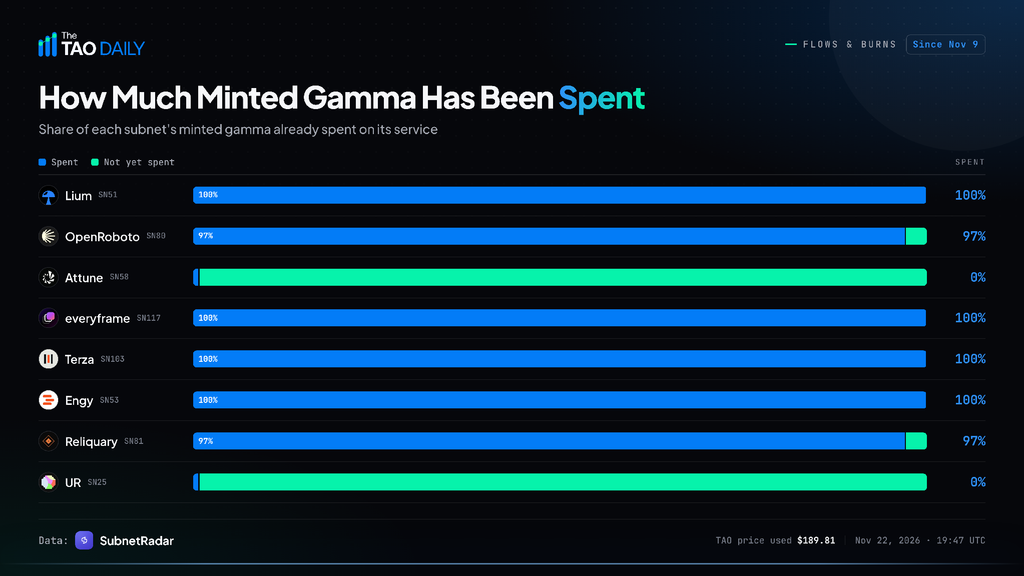
That pattern suggests people are minting gamma to buy something specific, not to park it. Since gamma can’t be traded, there is little reason to mint it for any other purpose.
The two exceptions are Attune and UR (SN25), where minted gamma hasn’t been spent yet. In both cases a single wallet holds the balance, which looks more like a team testing or prefunding a service.
Money versus users
Dollars tell one story. Wallets tell another.
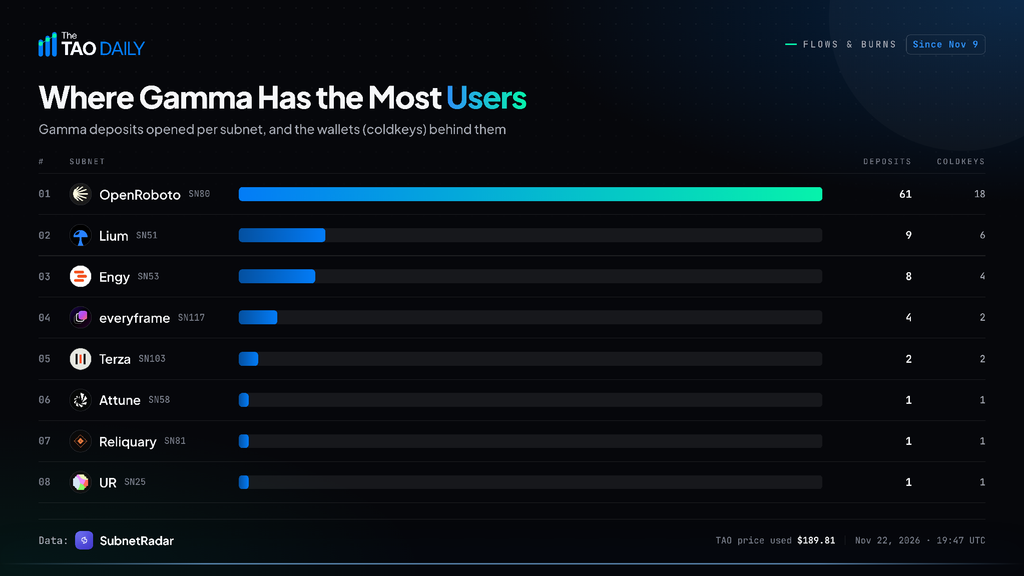
OpenRoboto has the widest user base by far, with 61 deposits from 18 separate wallets. Lium, despite holding most of the money, shows 9 deposits from 6 wallets. Engy has 8 deposits from 4.
In other words, Lium has a few large payers while OpenRoboto has many smaller ones. Both are encouraging for different reasons. One shows serious spend can flow through gamma, and the other shows plenty of people are willing to try it.
One word of caution. A wallet (or coldkey) is not necessarily a person or a company. A single customer can run several wallets, and a team can test its own service. The chain shows that money moved, not who paid or why.
Adoption is still early
Attune, Engy and Terza were the first three subnets to switch gamma on, all on November 10. Four more followed on November 11, then Lium on the 12th and Ormas (SN76) on the 14th. The newest arrivals are Cathedral (SN94) and Aurelius (SN37) on November 16, SayGM (SN28) on the 18th and Hippius (SN75) on the 19th.
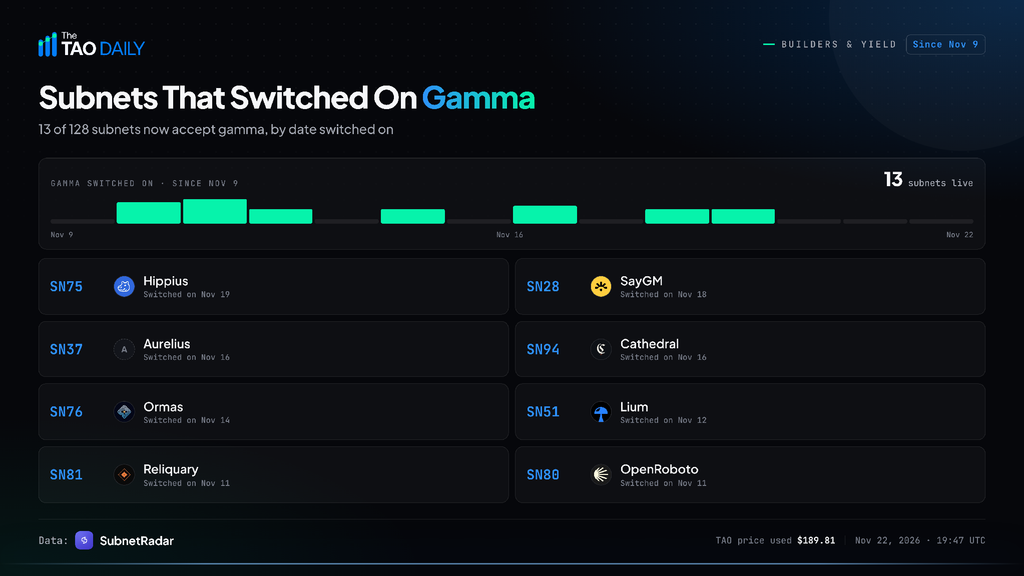
Five of the 13 have not seen a single mint yet. Those are SayGM, Aurelius, Hippius, Ormas and Cathedral. Switching gamma on is only step one, since a subnet also needs to publish a service people can pay for. Aurelius, Ormas and Cathedral have no service registered at the owner hotkey yet, according to SubnetRadar.
Hippius is worth watching. In our launch piece, we used an AI assistant drawing compute from Lium, inference from Chutes and storage from Hippius as the example of what gamma makes possible. Two of those three now accept gamma. Chutes (SN64) has not switched it on yet.
A built-in guard against gaming the mint
There is a small detail in the data that shows how carefully gamma was designed.
Each subnet has a gamma price that trails its market price. If alpha’s price falls, the gamma price drops with it immediately. If alpha’s price rises, the gamma price catches up gradually, closing half the gap roughly every two hours, according to the Bittensor documentation.
Burned alpha is always valued at the lower of the two prices. So if someone pumps a subnet’s alpha to mint cheap gamma, the chain doesn’t play along. That is why SubnetRadar shows most subnets minting between 0% and 2% below spot. On OpenRoboto, for example, alpha worth 1 TAO currently mints $187.78 of gamma rather than the full $189.81.
The same caution applies to the dollar price. The TAO/USD feed must be less than an hour old for any mint to go through, and upward moves in the feed are phased in at about 2% per hour.
Read more below:
Why this is worth paying attention to
Every mint is a burn. Gamma permanently removes alpha from circulation, and it does so because someone wanted a service, not because of speculation. Unlike most revenue claims in crypto, this one can be checked block by block.
The service gets nothing on chain, and that is by design. Spent gamma is simply destroyed. The value of the original burn stays with the subnet’s alpha holders, which ties usage directly to token value.
It is built for agents. A hotkey with a balance and a daily spending cap is exactly what an autonomous AI agent needs to buy compute, inference or storage without a human holding a credit card. Owners can pause a key, cap it or move its balance at any time.
Subnets can become each other’s customers. The Bittensor documentation already describes a route for subnets to buy gamma from other subnets using a share of their emissions, once whitelisted by root. That is the piece that turns gamma from a payment rail into what our October opinion piece called applied interdependence. Nothing in the data shows emissions-funded gamma yet, which makes it the next milestone to watch.
What the chain can’t tell us yet
Two weeks of data from 13 subnets is just a starting point. Nearly nine in ten gamma dollars came from one subnet, and the tracker can’t separate outside customers from teams testing their own services.
The question for the coming weeks is breadth. More subnets with live services, more wallets minting and repeat spending outside Lium would show gamma growing into the native payment layer Const described at Exploit Summit on September 28.
For now, the chain’s verdict is simple. Gamma works, people are using it, and almost every dollar minted is being spent.
More on gamma from The TAO Daily
Gamma Tokens Go Live, Bringing Native Payments to Bittensor’s AI Economy
Bittensor’s Gamma Tokens and Applied Interdependence
Enjoyed this article? Join our newsletter
Get the latest TAO & Bittensor news straight to your inbox.
We respect your privacy. Unsubscribe anytime.
Enjoyed this article?
Join our newsletter
Get the latest TAO & Bittensor news straight to your inbox — every morning before markets open.

No comments yet — be the first.