

Zeus, the decentralized weather forecast aggregation market running on Bittensor Subnet 18, has been live for roughly two months. The team behind it, Ørpheus AI, just published the protocol’s preliminary performance audit, and the results are worth attention.
Across an 18-day evaluation window in April 2026, Zeus posted double-digit relative improvements over both the ECMWF IFS HRES (the traditional flagship numerical weather model) and AIFS (ECMWF’s data-driven AI forecasting system) across four core atmospheric variables, while disseminating forecasts roughly 75% faster than institutional baselines.
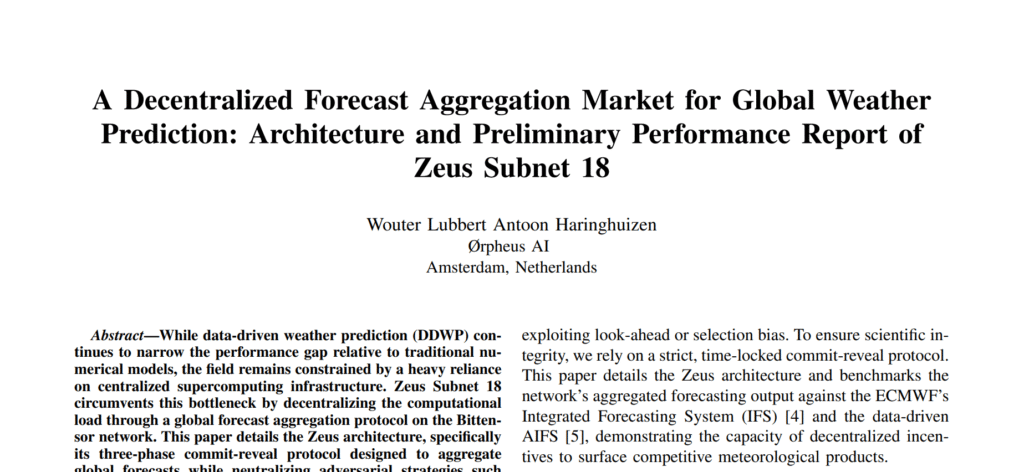
The paper, “A Decentralized Forecast Aggregation Market for Global Weather Prediction: Architecture and Preliminary Performance Report of Zeus Subnet 18,” is careful to position the results as a proof-of-concept rather than a definitive claim of generalized atmospheric superiority.
What it demonstrates is something more nuanced: a decentralized incentive market, when correctly structured, can surface competitive operational meteorological output through pure information arbitrage.
What Zeus Is and How It Works
Zeus is a continuous tournament where miners compete to predict the global atmospheric state on a 0.25° grid (roughly 28km resolution). Unlike monolithic weather models, the protocol does not enforce a specific forecasting architecture.
Miners are free to use institutional forecasts, AI foundation models, proprietary ensembles, or statistical correction pipelines, provided their forecast states are cryptographically committed before the operational cutoff.
The integrity of the market runs on a three-phase commit-reveal protocol that spans approximately 20 days end-to-end:
a. PHASE 1 (Cryptographic Commitment): Every participant submits a SHA-256 hash of their predicted atmospheric state, salted with their unique hotkey address.
The salting prevents adversarial relay mining, since identical predictions from different miners produce distinct hashes, forcing each participant to reveal their own underlying data later. The hash is anchored to the Bittensor blockchain, creating a trustless, immutable timestamp.
b. PHASE 2 (Top-K Selection and Reveal): The validator selects the top 10 miners per variable based on rolling historical ranks, prompts them to reveal their unhashed predictions, and feeds the top performer’s data into the subnet’s live operational stream.
The selection happens before any forecast data is exposed, which structurally prevents post-hoc cherry-picking.
c. PHASE 3 (Final Scoring): Approximately 20 days after commitment, once ERA5 reanalysis ground truth is available, miners must reveal their original Phase 1 data.
The validator verifies the cryptographic match and calculates forecast error. Any hash mismatch or failed reveal results in a total incentive penalty for that epoch.
Two metrics govern the system. The scientific audit uses standard area-weighted RMSE for apples-to-apples comparison with institutional benchmarks. The internal market score (iwScore) applies geographic scalars to incentivize accuracy in high-value economic zones, particularly the European energy corridor.
The 18-Day Audit Results
Zeus benchmarked its aggregated output against ERA5 reanalysis across four variables during the April 3 to April 21, 2026 window.
The relative improvements over institutional baselines:
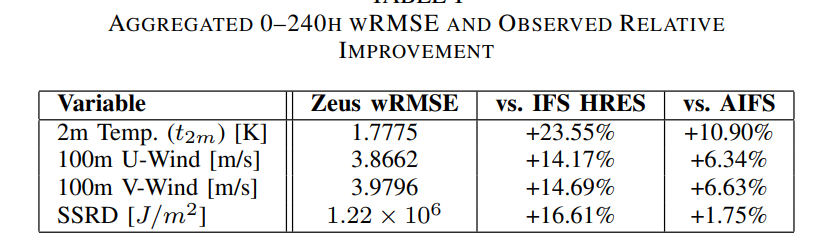
a. 2-Metre Temperature (t2m): 23.55% improvement over IFS HRES, 10.90% over AIFS.
b. 100-Metre U-Wind: 14.17% over IFS HRES, 6.34% over AIFS.
c. 100-Metre V-Wind: 14.69% over IFS HRES, 6.63% over AIFS.
d. Surface Solar Radiation Downwards (SSRD): 16.61% over IFS HRES, 1.75% over AIFS.
The 23.55% improvement on temperature is the headline number, but the paper contextualizes it carefully. The audit period covered a window of relative synoptic equilibrium, which favors aggregator-style optimization, and there is a known structural affinity between ERA5 ground truth and IFS-family models because both rely on the same data assimilation lineage.
The team’s interpretation is that the network’s top performers are successfully executing high-speed regression toward the reanalysis target, post-processing institutional boundary conditions to align more closely with ERA5’s statistical distribution. That is precisely the information arbitrage the market is designed to surface.
The Dissemination Advantage
The other result worth noting is speed. Zeus disseminates forecasts roughly 1.5 hours after initialization, compared to the 6-hour delay typical of institutional models like IFS HRES.
The compression is not because decentralized hardware is computationally superior, but because Zeus miners largely use boundary conditions from prior institutional cycles rather than performing real-time 4D-Var data assimilation of raw observations.
This is the architectural tradeoff that defines the protocol’s identity. Zeus functions as a high-speed optimization and dissemination layer rather than a fully independent foundation model.
The network’s performance floor is tied to upstream institutional data, while its ceiling is defined by miner-driven optimization. The market exists specifically to surface the residual accuracy that centralized monolithic models fail to capture.
Limitations Worth Acknowledging
The team is transparent about what the audit cannot yet prove:
a. Evaluation Window: Eighteen days in April 2026 is short, and broad seasonal validation across regime shifts and extreme weather remains required.
b. Upstream Dependency: Performance is tied to the quality of public institutional data, since miners aggregate and optimize rather than originate from first principles.
c. Methodological Opacity: Miner pipelines are competitive black boxes, which protects intellectual property but limits scientific interpretability of which architectures drove a given result.
d. Incentive Bias: Geographic scalars deliberately weight optimization toward economic zones, meaning global accuracy may occasionally trail regional precision.
Since the audit period, the protocol has transitioned to anchoring all forecast hashes directly to Bittensor block headers, enabling fully trustless third-party verification of temporal provenance.
Conclusion
Zeus (Subnet 18) is the cleanest demonstration to date that decentralized incentive markets can produce competitive operational meteorology, not by replicating supercomputing infrastructure but by surfacing high-speed optimization of existing institutional signals through cryptographically verified competition.
The 18-day audit is a proof-of-concept rather than a generalized superiority claim, and the team is direct about the limitations.
What it shows is that the protocol’s selection and verification logic works as intended, that decentralized aggregation can deliver meaningful speed advantages over centralized workflows, and that the path from proof-of-concept to global decentralized meteorology hub is now technically credible.
Enjoyed this article? Join our newsletter
Get the latest TAO & Bittensor news straight to your inbox.
We respect your privacy. Unsubscribe anytime.
Enjoyed this article?
Join our newsletter
Get the latest TAO & Bittensor news straight to your inbox — every morning before markets open.



No comments yet — be the first.