


Yuma has reached 1 million TAO staked through its validators, marking a major milestone for the Bittensor infrastructure provider.
Announced on September 1, Yuma said the TAO is being staked through validators running on Yuma-owned hardware, with participants ranging from non-custodial wallet holders to global exchanges and institutional custodians.
Yuma now describes itself as the largest hardware validator on Bittensor.
The milestone is also a snapshot of a much broader strategy. Yuma is building across several layers of the Bittensor economy from staking infrastructure and subnet development to asset management.
Building Bittensor’s staking rails
Yuma has increasingly become infrastructure for platforms that want to offer Bittensor staking without having to operate the underlying validator stack themselves.
Its infrastructure powers staking through platforms including MEXC, Talisman, SubWallet and BitGo, giving both retail and institutional users access to TAO and subnet staking.
With 1 million TAO now staked, Yuma is becoming an important piece of the infrastructure through which outside capital participates in Bittensor.
Backing the subnet economy
Yuma’s involvement goes beyond validators.
Through its subnet accelerator, the company supports teams building applications on Bittensor, including Numinous (SN6), Trishool (SN23), Score (SN44), Yanez MIID (SN54), NIOME (SN55), Bitsec (SN60), RedTeam (SN61) and Beam (SN105).
The projects cover areas ranging from forecasting and AI safety to synthetic data, cybersecurity, translation and decentralized bandwidth.
If more subnets become useful businesses and products, there are more reasons for people to participate in Bittensor, and Yuma is facilitating that.
Turning Bittensor into an investable market
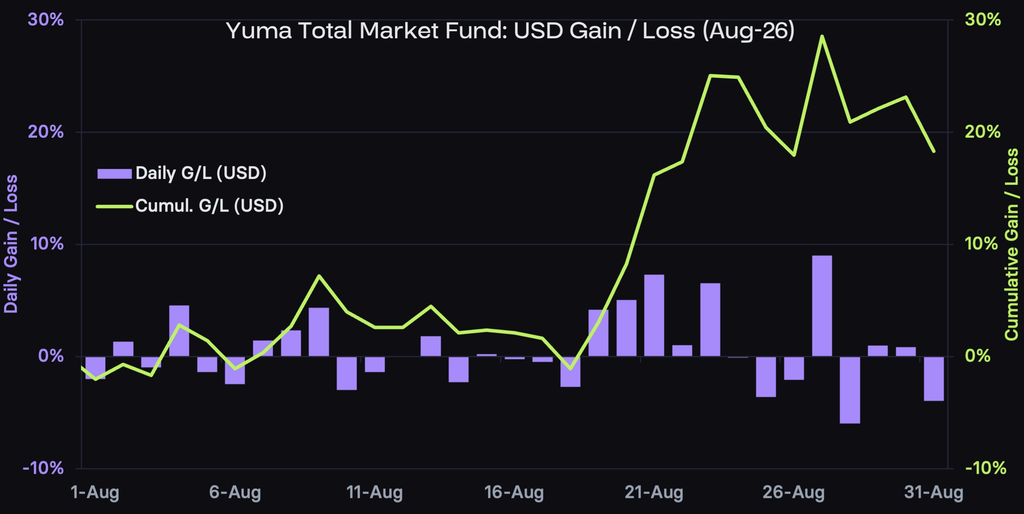
Yuma is also building on the capital side through Yuma Asset Management, which offers funds giving investors diversified exposure to TAO and subnet tokens. And that strategy recently produced a notable result.
On September 3, Yuma announced that its Total Market Fund had its best monthly performance since inception in August, gaining 18.3% month-over-month in USD, compared with a 17.9% gain for TAO/USD. The fund combines exposure across TAO and subnets, which Yuma compares to a “60/40” portfolio.
Yuma’s Composite Fund also gained 21.4% in August, according to the company.
The significance goes beyond one month’s returns. Yuma is trying to make exposure to Bittensor’s increasingly fragmented subnet economy easier to access through a single investment product.
More than a validator
Yuma is trying to exist on nearly every side of the Bittensor economy at once, accelerating new teams, validating stake, mining compute into the subnets it backs, and packaging the resulting assets for allocators who will never run a node.
That makes Yuma’s role in the ecosystem increasingly distinct. It is actively working to make Bittensor easier for new users, builders and investors to enter.
Read more about Yuma’s portfolio of subnets:
Enjoyed this article? Join our newsletter
Get the latest TAO & Bittensor news straight to your inbox.
We respect your privacy. Unsubscribe anytime.
Enjoyed this article?
Join our newsletter
Get the latest TAO & Bittensor news straight to your inbox — every morning before markets open.



No comments yet — be the first.