


Root Reborn was pitched as a way to give root stakers freedom and let capital flow toward subnets that perform.
The mechanism replaced Root’s automatic sell with validator-set weight vectors that redirect reward TAO into chosen subnet baskets.
In theory, that spreads support across the network and rewards good curation over passive yield extraction.
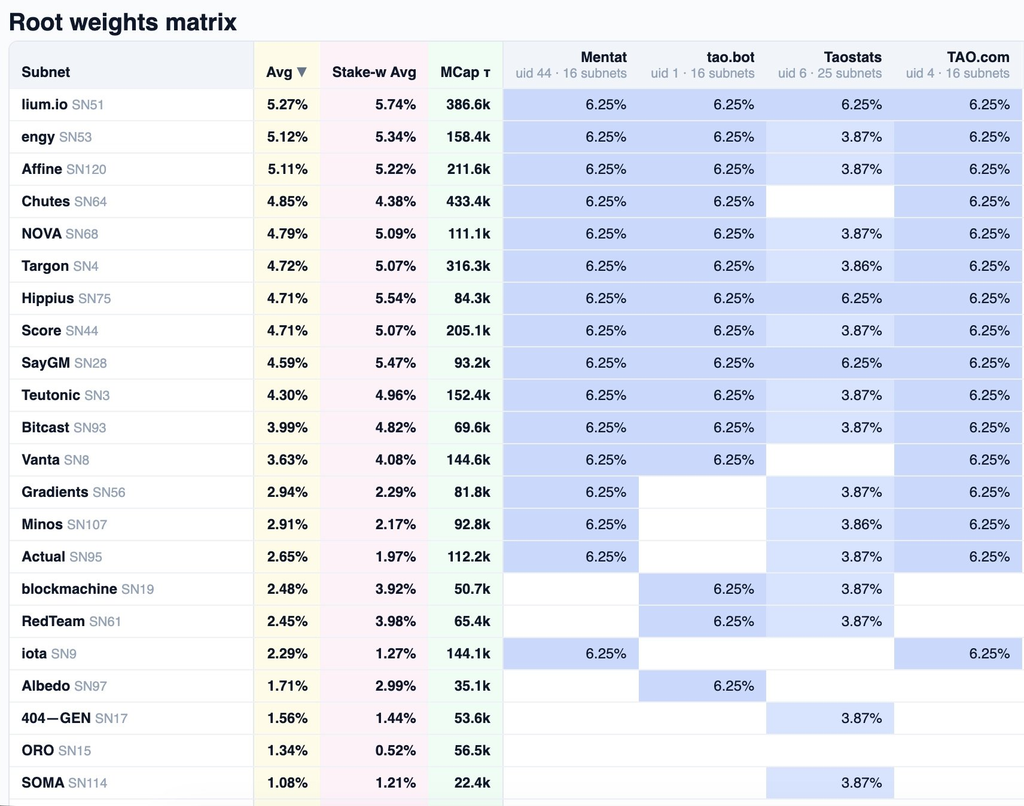
In practice, a small fee buried in the claiming process is pulling the whole system toward concentration instead, an issue Mentat Minds unveiled in their research.
Where the Fee Comes From
Every time a staker claims their Root rewards back to TAO, they pay a fee that scales with the size of the validator’s basket.
Mentat estimates the claim fee at roughly:
0.000054 + 0.0004475 × number of subnets in the validator’s basket
A 16-subnet basket costs about 0.0072 τ to claim, an 84-subnet basket costs about 0.0376 τ, and a 128-subnet basket costs somewhere near 0.057 τ per claim. The cost climbs in a straight line with every additional subnet a validator chooses to support, which means breadth is directly and mechanically penalized at the point of withdrawal.
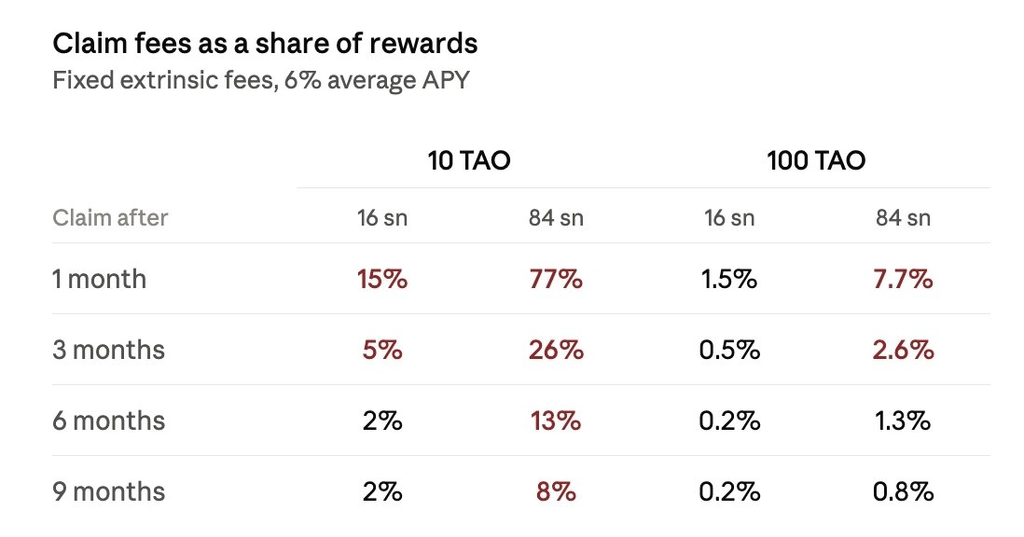
That penalty compounds badly for smaller wallets and longer holding periods, because the fee is fixed per claim regardless of how much reward sits behind it.
For instance, an 84-subnet basket costs a 100 τ wallet 7.7% of its rewards in fees when claiming after one month, and costs a 10 τ wallet 13% when claiming after six months. Those are large enough numbers to change how a rational validator builds a basket in the first place.
What Validators Are Doing About It
Faced with a fee that grows with every subnet added, validators are taking clear directional positions, and they are mostly pointing at the same place.
According to available data, 74% of the root emissions redirected by validator vectors currently flow to just 16 subnets out of more than 100 eligible.
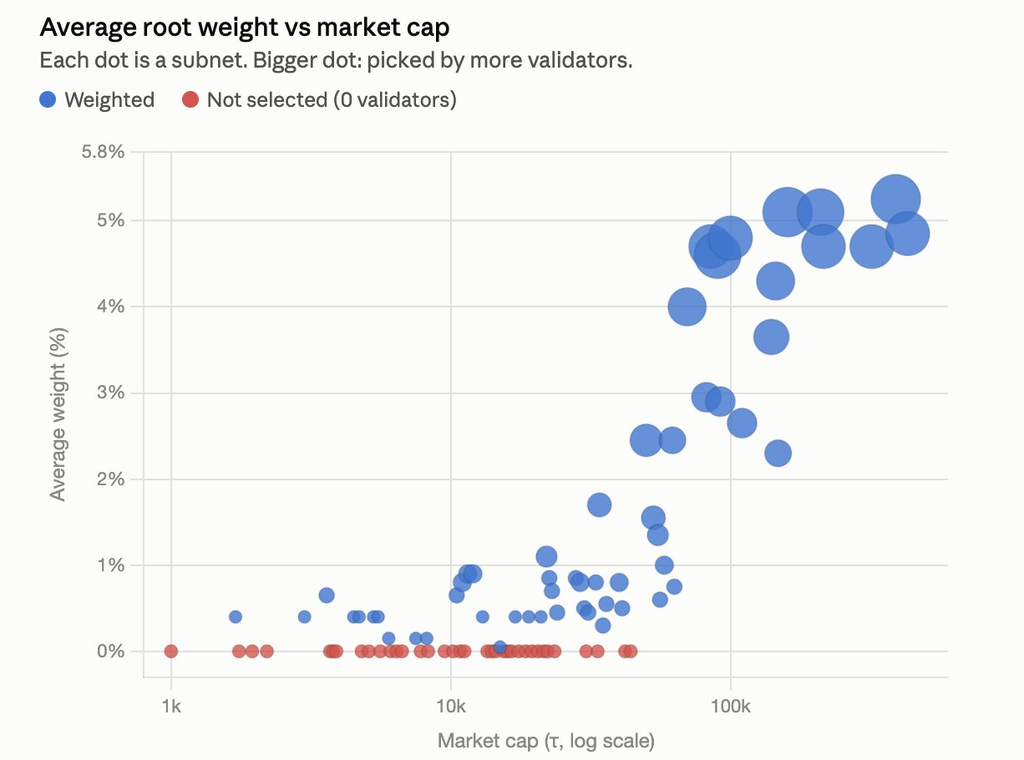
The subnets with the largest market caps absorb most of the redirected buy pressure, while the long tail of smaller subnets sees comparatively little.
The result is that Root Reborn’s buy-side support goes to where it is needed least. Large subnets get meaningful offsetting buy pressure and effectively stop feeling root sell pressure, while the smaller subnets that could most use that capital keep facing net selling.
The mechanism designed to reward performance across the network is instead reinforcing the existing hierarchy of who already has the most.
What It Means for dTAO Stakers
For anyone staking through Root, the fee structure quietly narrows the menu of validators worth staking with, because a validator running a wide, infrastructure-agnostic basket has to pass higher claim costs onto stakers or accept a worse net yield.
That pushes stakers toward validators running tight, top-heavy baskets, which is the same concentration pressure seen from the emissions side.
The staker optimizing purely for net yield ends up subsidizing the concentration whether they intend to or not.
There is also a cost to the broader dTAO market here. One of Root Reborn’s central promises was recycling value back into subnets instead of leaking it out as sell pressure, and that promise only holds if the buying spreads wide enough to reach subnets beyond the top handful.
When 74% of redirected emissions cluster in 16 subnets, most of the network’s price discovery stays exposed to the same forced selling Root Reborn was meant to soften. Stakers holding alpha in smaller subnets get very little of the protection the proposal advertised.
A Few Things That Could Fix It
The clearest fix is the one Mentat raised directly, which is simply lowering the claim fee so that basket breadth stops being punished at withdrawal.
A cheaper idea is to allow validators run wider baskets without eroding staker yield, and it would let infrastructure operators stay agnostic across the network instead of being forced into a narrow directional bet.
Few other opinions:
- Flatten the per-subnet component so the fee no longer scales linearly with basket size, charging a small flat claim fee plus a much gentler curve that does not make the 80th subnet meaningfully more expensive than the 20th.
- Batch or amortize claims so a staker pays one fee across multiple baskets or across a longer accumulation window, which softens the penalty that currently hits small wallets and long holders hardest.
- Weight the fee against basket concentration rather than basket count, so a validator supporting many subnets evenly is not charged more than one dumping everything into the top 16, which flips the current incentive toward breadth.
- Subsidize claims from smaller or underweighted subnets through a portion of network emissions, creating a counterweight that makes supporting the long tail economically viable.
Each of these attacks the same root problem from a different angle, which is that the fee currently makes doing the network-healthy thing more expensive than doing the concentrated thing.
The Number That Matters
Root Reborn’s whole case rests on capital staying in the dTAO market and flowing toward subnets on merit.
Right now the fee math is quietly overriding that intent, sending 74% of redirected emissions to 16 subnets while the rest of the network keeps selling into the same pressure it always did.
Fixing the claim fee might be the difference between a meta-layer that supports the whole network and one that just re-concentrates capital where it already sits. The proposal is still a pull request, which means the fee curve is still a design choice and fixes could still be made.
Enjoyed this article? Join our newsletter
Get the latest TAO & Bittensor news straight to your inbox.
We respect your privacy. Unsubscribe anytime.
Enjoyed this article?
Join our newsletter
Get the latest TAO & Bittensor news straight to your inbox — every morning before markets open.



No comments yet — be the first.