


RESI, Bittensor Subnet 46, is roughly nine months into its build, and the team has shipped a live, public product and is now navigating the most difficult part of operating any Bittensor subnet: Refining an incentive mechanism into something miners cannot game.
The ambition behind the project is to create real estate appraisals as a permissionlessly produced digital commodity, with a longer-term path toward real-world asset (RWA) backed lending stacked on top.
What RESI Is Building
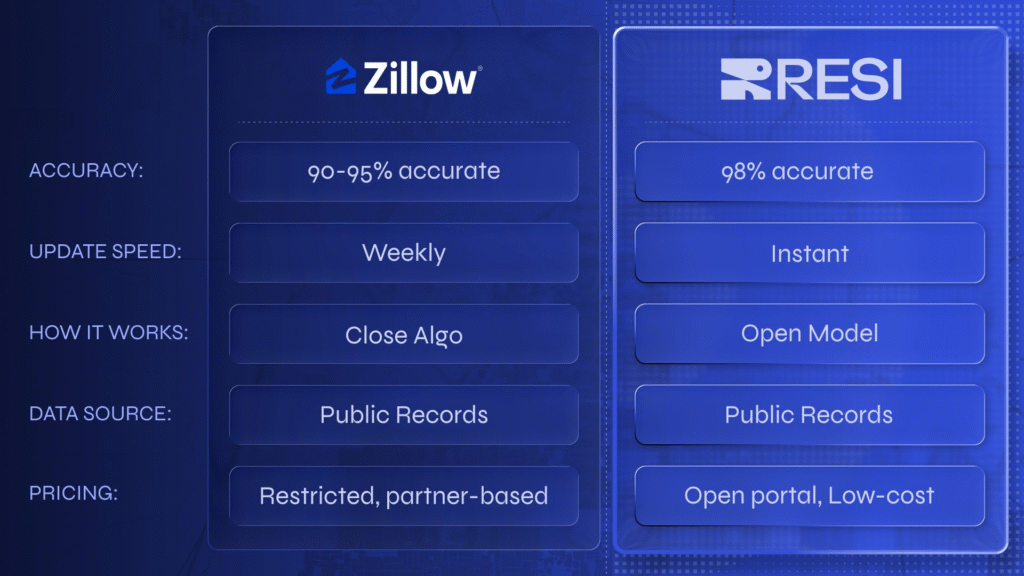
The mechanics of the subnet are straightforward: Miners train AI models for property valuation, validators evaluate those models against recently sold properties, and the best-performing model at any given moment powers RESI’s public appraisal portal.
The broader thesis rests on three connected ideas:
a. Permissionlessly produced appraisals carry standalone value as a data product.
b. A reliable appraisal layer unlocks the ability to lend against tokenized property.
c. On-chain lending against real-world real estate is the eventual flagship product.
The Current State
The appraisal portal is live and available without cost. A small number of paying users have come through, and all-time revenue stands at roughly $15,000, the majority of which was generated through earlier sales of predictive data rather than through the live portal itself.
The dashboard reports approximately 98% accuracy against Zillow’s Zestimate baseline, while the top individual miner sits closer to 94%. That gap deserves scrutiny.
Headline accuracy can be inflated when it reflects strong streaks from a rotating set of top miners rather than sustained performance from a single stable model. The more durable read on quality is whether one model holds high accuracy over a long stretch of time.
RESI does carry one structural advantage worth noting; Zillow revises its Zestimates after the fact, while a Bittensor subnet has the ability to timestamp predictions immutably. Surfacing that asymmetry directly, with verifiable proof that past predictions were not retrofitted, would be one of the cleaner paths to demonstrating that the commodity RESI produces is real.
The 100% Miner Burn in Context
RESI once operated at 100% miner burn, meaning miners are not receiving emissions. On its surface, this can read as alarming, and in context, it reflects a deliberate and appropriate decision.
Every Bittensor subnet eventually has its incentive mechanism exploited: Miners are economically rational actors searching for the cheapest path to emissions, and any subnet that has not yet been exploited has simply not been around long enough to attract serious attempts.
RESI’s emissions history reflects the standard cycle: an initial stretch of full burn during the build-out, brief activations to test the design, exploitation, deactivation, patching, and reactivation. The pause was a continuation of that loop.
Underneath the burn, the project shows the markers of a healthy first-year subnet, daily code commits, an active Discord, and consistent public communications. The absence of manual buybacks is appropriate at this stage. Buyback programs belong to subnets that have already established leak-proof mechanisms and consistent revenue, neither of which RESI claims to have today.
Strengths and Outstanding Questions
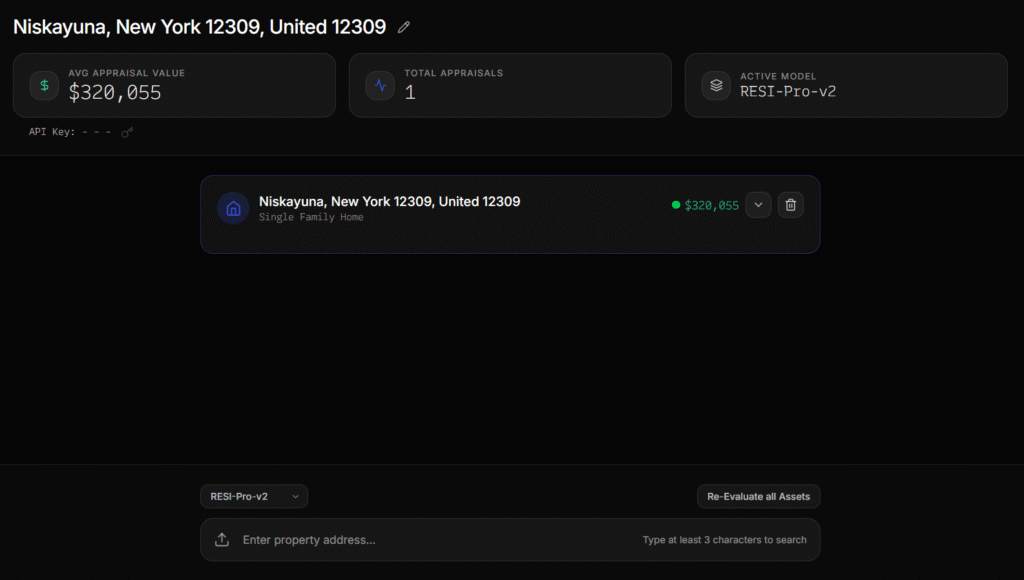
The strengths are genuine. The appraisal portal is a functioning product, the backing is credible, the subnet owner is unusually communicative, and the iteration on the incentive mechanism is visible in public.
The outstanding questions are equally real as the dashboard’s accuracy figure does not yet reconcile cleanly with the top-miner score. There is no tamper-proof public verification that past predictions were timestamped rather than retrofitted. The project has not yet introduced a revenue buyback program. And the lending product, which represents the long-term prize, remains likely a year or more from launch.
Conclusion
RESI is engaged in the unglamorous portion of building a Bittensor subnet in public: Activating emissions, observing the mechanism break, patching, and reactivating. The projects that eventually produce durable digital commodities are the ones that move through this loop honestly rather than around it.
Nine months in, RESI reads as a subnet in the middle of the hard part rather than a subnet stuck. The signals worth tracking from here are clear: the introduction of consistent revenue buybacks, the tightening of dashboard verification, and the movement of the lending roadmap from an undefined future to a defined near-term timeline. The underlying bet is that real estate, the largest asset class in the world, eventually meets its on-chain credit market, and that the appraisal layer beneath that market is better produced by a decentralized network of modelers than by a single legacy provider.
If RESI reaches that destination, the appraisal product is the foundation. The lending stack on top is where the actual value resides.
Enjoyed this article? Join our newsletter
Get the latest TAO & Bittensor news straight to your inbox.
We respect your privacy. Unsubscribe anytime.
Enjoyed this article?
Join our newsletter
Get the latest TAO & Bittensor news straight to your inbox — every morning before markets open.


No comments yet — be the first.