

There is a particular kind of trade that almost nobody takes seriously until it is too late. The market underneath it is small, the technology is hard to explain, the timelines feel uncomfortably distant. And then, almost without warning, the curve compounds into something the market has to reprice in a hurry.
Quantum computing is shaping up to be exactly that kind of trade, and on Episode 67 of Revenue Search, Bob Wold, founder of qBitTensor Labs, made the case for why Quantum Compute (Bittensor Subnet 48) is the cleanest expression of it currently available in crypto.
The conversation, hosted by Siam Kidd and Mark Creaser, ran from the science of quantum compute through to encryption-breaking timelines, governance philosophy, and the structural acquisition logic underneath the project.
Notes From the Frontier
Bob spent the first stretch of the conversation walking through what quantum computing actually is, and the framing is worth holding because most retail explanations get it wrong from the start.
a. Forget the Ones-and-Zeros Pitch: Quantum computers are machines that compute with physics directly. You encode a problem into a physical system, isolate it from outside interference, and let physics produce the result.
The challenge is the isolation, which is why current machines remain small and noisy.
b. The Applications are Civilization-Shifting if the Technology Matures: Bob landed the framing on cancer specifically. Future generations may grow up in a world where it seems arcane that people once died of diseases simply because the right drug had not been simulated. Battery science, materials engineering, and many-body modeling sit on the same curve.
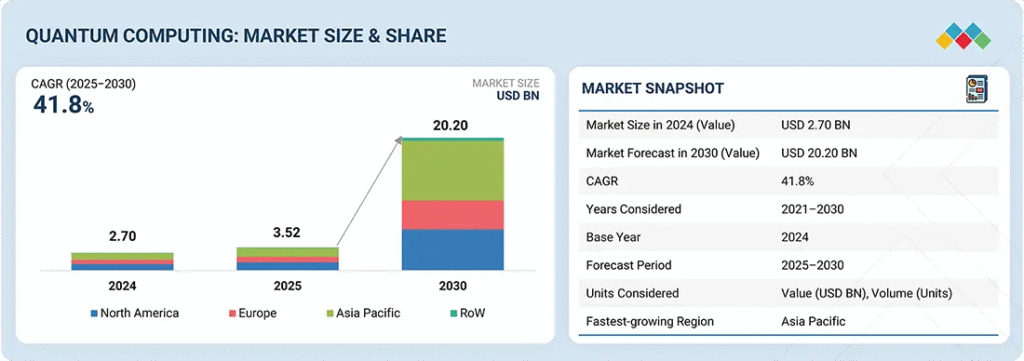
c. The Market Today is Small. By 2030, it Won’t: Quantum compute is roughly $3.5 billion today, projected at $20 billion by 2030. Hardware names like IonQ and Quantinuum cover one slice. The compute layer itself remains gated behind enterprise contracts running $5,000 to $15,000 per hour.
Where Subnet 48 Actually Sits
This is where the asymmetry begins to take shape. Bob walked through the SN48 mechanism without theatrics, but the implications stack quickly:
a. SN48 is The Only Cryptocurrency in Existence, Mineable Exclusively through Quantum Compute: Miners pay to run jobs on real quantum machines, execute user workloads from a two-sided marketplace, and earn the $SN48 token in return.
No other crypto asset has this relationship to quantum hardware.
b. OpenQuantum.com is the Consumer Surface: SN48 supplies more than 90% of all jobs executed through OpenQuantum, with hardware support spanning IonQ, Rigetti, IQM, and AQT.
The structure parallels Chutes, capturing over 30% of its traffic through OpenRouter.
c. The Revenue Flywheel Goes Live in Days: The free-credit phase ends imminently, replaced by a half-priced model where users buy on-chain quantum compute at roughly 50% of market rates.
Revenue routes directly into $SN48 buybacks, with pricing tuned to read as credible rather than too-good-to-be-true.
The Encryption Clock Most People Aren’t Watching
Bob walked through one of the more uncomfortable threads in the conversation: how close quantum capability actually is to breaking the cryptography underneath Bitcoin.
a. The 2028 Timeline is Real: Google recently published proof that breaking elliptic curve encryption requires 1,200 to 1,400 logical qubits. IonQ’s roadmap puts that capability inside 2028, with 80,000 logical qubits by 2030. Google declined to release the methodology because it was deemed too dangerous to publish openly.
b. The Vulnerability Lives in Ownership, Not Mining: SHA-256 is how miners find blocks, and no published quantum algorithm currently breaks it. Elliptic curve encryption protects ownership of already-mined Bitcoin. If that breaks before the network migrates to post-quantum cryptography, dormant wallets become structurally exposed.
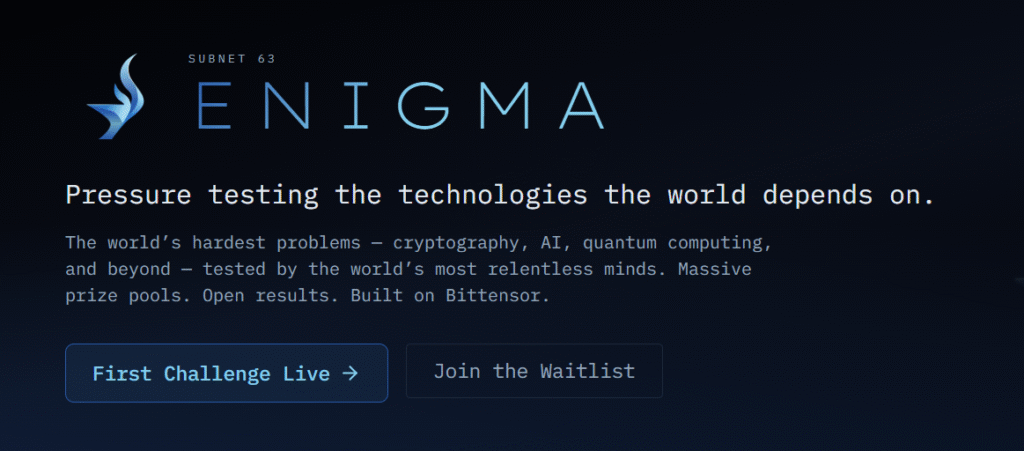
c. Subnet 63 (Enigma) is the Sister Subnet Built Specifically to Track This: Enigma incentivizes public progress on encryption-breaking through prize pools, with the roadmap eventually requiring SN48 as the verification layer. The two subnets create direct demand flow into each other.
The Tokenomics Tension Bob Was Honest About
This is where the conversation turned into something more interesting than a typical subnet pitch. Bob was direct about the structural challenge Tao Flow creates for any subnet whose miners carry real-world costs.
a. Compute Subnets Face Downward Sell Pressure by Design: Miners pay for quantum compute in dollars and need to sell $ALPHA to recoup costs. Without intervention, this creates persistent sell-pressure that Tao Flow rewards mechanically.
b. qBitTensor Labs is Engineering Around It: The plan involves two parallel mechanisms: a structured liquidity pipeline through Astrid Vault to convert $ALPHA into $TAO without sell pressure, and a crowdsourced OTC structure offering discounted $ALPHA in exchange for lockups.
c. Complexity is the Breeding Ground for Exploits: Bob’s clearest philosophical thread of the day: Every governance change introduces new attack surfaces. Also, roughly 20% of current network emissions appear to be flowing to subnets generating no productive output, where capital and hype alone produce emission share.
The Governance Read That Stayed With Both Hosts
Bob’s broader read on Bittensor governance was the kind of thing that pulls a conversation into different territory. Mark and Siam stayed with him on the substance.
a. Conviction Governance opens New Attack Vectors: While it addresses the rug problem the Templar exit exposed, it also enables capital-rich actors to potentially take subnets away from original teams.
The trade-off subtly favors the well-capitalized over the genuinely innovative.
b. The New Registration Model is a Financial Shift, Not a Technical One: Mark walked through how the median-price $ALPHA injection mechanism changes new subnet economics.
The more $TAO spent on a slot, the deeper the initial liquidity pool. Whether the subnet drifts up or down depends entirely on what gets built afterward.
c. Subnet Exits Remain the Unsolved Governance Problem: Current options reduce to slow drift, silent departure, or rug-style exits. Bob argued exits should be a first-class protocol feature, not an emergent behavior subnet operators are forced to invent privately.
d. Innovation over Protectionism is the Right Frame: The ecosystem has spent too much energy building defensive walls and not enough pouring rocket fuel on the sparks already lit. Governance should fail fast and iterate rather than try to anticipate every exploit before launch.
The Exit Strategy Most Subnet Teams Aren’t Thinking About
Bob’s framing of how SN48 actually exits was the most strategically interesting moment of the conversation, and it generalizes beyond his project.
a. Acquisition Beats IPO (Initial Public Offerings) for open infrastructure plays: The publicly-traded quantum names are hardware companies. qBitTensor Labs is building open, decentralized infrastructure on top of that hardware.
That structure makes it a natural acquisition target for Nvidia, AWS, or Microsoft rather than an IPO candidate.
b. Most Crypto Teams Default to the Wrong Mental Model: IPO is the assumed exit, and acquisition is often the more realistic and more lucrative path, particularly for projects building infrastructure that fits inside a larger company’s strategic stack.
Reading the Trajectory
The size of the market underneath Subnet 48 is what separates this conversation from most subnet introductions. Quantum computing is one of the few technology categories with verified scientific potential and credible commercial adoption inside this decade.
SN48 gives retail participants direct exposure to that market while supporting the infrastructure that makes broader access possible. Pair that with Enigma’s encryption-breaking incentive layer, a half-priced revenue model arriving within days, and the structural acquisition logic of open infrastructure on proprietary hardware, and the surface area becomes something most subnets cannot replicate.
The trade most people will eventually take seriously is sitting in plain sight while almost nobody is looking. That is usually how the asymmetric ones start.
Enjoyed this article? Join our newsletter
Get the latest TAO & Bittensor news straight to your inbox.
We respect your privacy. Unsubscribe anytime.
Enjoyed this article?
Join our newsletter
Get the latest TAO & Bittensor news straight to your inbox — every morning before markets open.


No comments yet — be the first.