


Jason Calacanis of This Week in Startups dedicated a full-length episode to Bittensor’s Const, declaring himself officially “$TAO-pilled” and comparing it to his earliest conviction moments with Bitcoin.
The conversation covered Bittensor’s first-principles origins and its subnet model as an accelerator for AI startups, with Engy (SN53) and Affine (SN120) as working examples.
They also discussed the Templar rug pull and Const’s vision of intelligence itself becoming the next commodity worth mining.
Jason’s closing advice was simple: buy one $TAO, take a front-row seat, and watch the experiment unfold.
What Const Revealed About Bittensor
The session moved from Bitcoin’s original innovation through Bittensor’s abstraction layer, into working subnet examples, the Templar situation, and the intelligence commodity Const is chasing right now.
1. Jason called Bittensor his second true crypto conviction moment: After watching decades of crypto and picking Bitcoin correctly, he described spending the year searching for a project that solved real-world problems, and Bittensor is the answer he settled on.
“Definitely not a scam, definitely something going on here” was how he put it.
2. The founding thesis was to connect Bitcoin to AI: Const started as a Bitcoiner studying machine learning and wondered how to link the most powerful computer ever built to the most important computational problem of the century. That question produced Bittensor.
3. Bittensor abstracts Bitcoin’s mining primitive across every commodity: Bitcoin proved you could mine one thing (hashes) permissionlessly. Bittensor proves the same model works for inference, training, storage, model building, web scraping, and dozens of other digital commodities.
4. Subnets operate like an accelerator for permissionless AI startups. Jason compared the subnet model to Y Combinator and TechStars, where 128 different projects compete openly for capital, talent, and emissions on a shared platform.
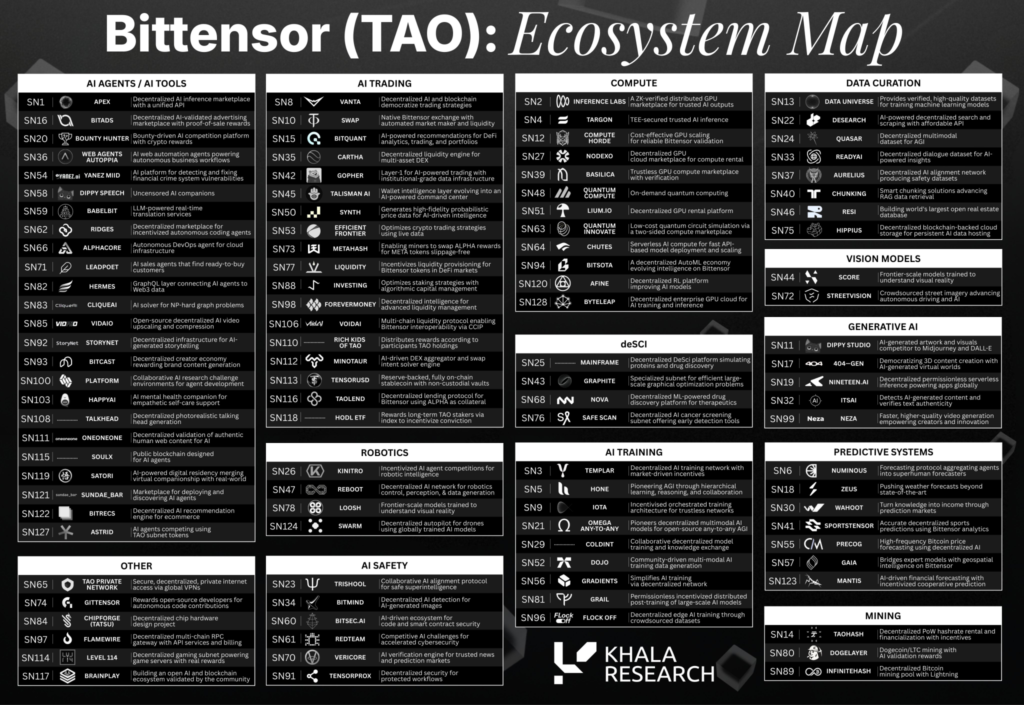
5. Subnet registration currently costs about 608 $TAO right now: Roughly $121,000 at current prices. The fee seeds the initial liquidity pool between $TAO and the subnet’s alpha token. Comparable to accelerator entry costs in traditional startup land.
6. Each subnet issues its own alpha token capped at 21 million supply: Paired to $TAO in a V3 automatic market maker pool. Price signals drive emissions to the strongest projects, and selling alpha means selling into $TAO, which builds durable demand for the base asset.
7. Engy (SN53) makes the mechanism visible. Qwen, Kimi, and GLM 5.2 all served at roughly half the price of centralized providers, because permissionless supply keeps compressing costs whenever excess capacity appears anywhere in the world.
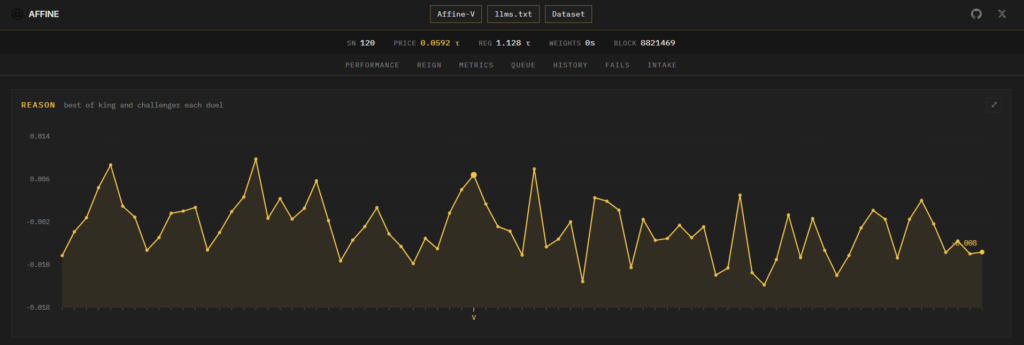
8. Const runs Affine (SN120), which mines reasoning as an intelligence proxy. The mechanism trains small models to make larger models think better. If talking to a small Affine model makes GLM produce better answers, that’s a signal the smaller model has real reasoning capacity worth rewarding.
9. The Templar situation was a founder walking away, not a protocol failure: Templar team sold their alpha, wrote an article blaming the network and Const for the fallout, and the project collapsed on its own within weeks.
Const compared it to a Y Combinator startup founder taking demo day money and disappearing, which happens across every ecosystem funding early-stage work.
10. Conviction was built specifically as a response to that. Subnet teams can lock their alpha tokens publicly to express long-term commitment. Any large unlock becomes a public event that lets investors position ahead of a founder walking away.
Const called the community response “beautiful” as teams have voluntarily locked tokens for years.
The Third Path for What AI Can Be
Const’s ambition for Bittensor is to make intelligence itself the ultimate commodity, with compute and inference serving as the starting points.
The goal is to compete directly with the world’s leading centralized AI labs through what he calls a “third path” for building artificial intelligence.
Early results include Engy (SN53) delivering Qwen and GLM at roughly half the cost of centralized providers, while Lium (SN51) has reached $12 million in annualized GPU rentals.
Calacanis’ advice was to acquire one $TAO, take a front-row seat, and watch as the network, its teams, and the broader decentralized AI experiment continue to evolve in public.
Enjoyed this article? Join our newsletter
Get the latest TAO & Bittensor news straight to your inbox.
We respect your privacy. Unsubscribe anytime.
Enjoyed this article?
Join our newsletter
Get the latest TAO & Bittensor news straight to your inbox — every morning before markets open.

Be the first to comment