


Jacob ‘Const’ Steeves joined a Bittensor community space hosted by Jesus Martinez to break down the protocol change being called Root Reborn, addressing concerns raised by Algod and other community members over its potential exploit surface.
The change lets validators redistribute root stakers’ yield into subnet ‘$ALPHA’ tokens across the subnet ecosystem rather than auto-selling that yield into $TAO.
Const’s argument is that this is already happening manually through validators like Trusted Stake, Mentat Minds, and Crucible Labs, and the protocol-level change just standardizes it on-chain.
The deeper bet is that turning root yield from a daily 1,000 $TAO drain into a compounding curation signal could restructure how Bittensor’s protocol revenue gets reinvested across subnets.
What’s Changing at a Glance
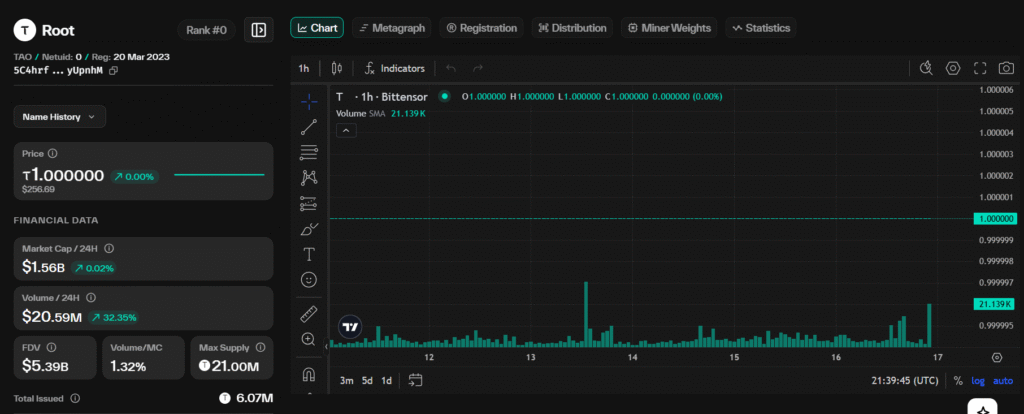
Root staking previously worked one way: stake $TAO on root, earn dividends in $TAO, and those dividends create about 1,000 $TAO per day of sell pressure on the network (~$276,000 daily).
The new mechanism keeps the dividend stream but holds it in $ALPHA form until the staker explicitly claims it.
The core elements:
1. Yield is held in $ALPHA until claimed. Each unit of $ALPHA earned through root staking gets redistributed by the validator across subnets based on a weight vector they set on the root network.
2. The principal is untouched. Stakers cannot lose their staked $TAO, only the yield is at risk.
3. Default claim behavior matches the old system. If a staker does not want to participate, they run the claim operation continuously and the experience is identical to today.
4. Validators set the redistribution weights. A validator might direct yield back into the subnet that generated it, into a basket of other subnets, or any other allocation they choose.
The mechanism is built on the same lazy accounting infrastructure that powered the keep-swap rollout, which made the actual code change small: about 25 lines for the base case.
Why This Is Not a New Behavior
The strongest argument in Const’s defense is that the redistribution behavior already exists in the network. Validators like Trusted Stake, Mentat Minds, and Crucible are all manually performing exactly this operation today.
The protocol change standardizes the behavior across all validators:
1. On-Chain, Not Off-Chain: The redistribution happens through chain-visible weight vectors rather than off-chain coordination.
2. Trustless and Verifiable: Stakers can audit what their validator is doing without taking the validator’s word for it.
3. Comparable Across Providers: Stakers can evaluate Trusted Stake, Mentat Minds, Crucible, Taostats, Opentensor, and other validators side by side on the same dimension.
The exploit surface argument essentially evaporates if the behavior is already possible. The protocol change just brings transparency to something that has been operating manually.
Old Root vs Root Reborn: Skin in the Game
The closest analog to Root Reborn is the original root network. Const was firm about why this time is different.
The old root network problem:
1. Validators Had No Real Consequences: Setting weights in the wrong direction had no impact on the validator’s return. The worst that could happen was getting yelled at on Discord.
2. Single-Sided Incentive: Bad weight-setting could not be punished by stakers because there was no economic feedback loop.
What Root Reborn changes:
1. Validators Absorb The Risk Through Their Stakers: If a validator pumps its own subnet and the subnet underperforms, the stakers lose yield (not principal).
2. Stakers Can Switch Validators: Bad performance shows up in the yield numbers, and stakers can move their stake to a better-performing validator.
3. The Feedback Loop Is Two-Sided: Validators are now incentivized to maximize yield for their stakers, not just direct flows wherever they personally prefer.
Const described this as a fairness mechanism: validators can have power, but they have to earn it and keep earning it.
The Economic Argument
The bigger picture Const laid out is what this does to Bittensor’s overall economic model. The current state:
1. Root Sell Pressure (About 1,000 $TAO Per Day:) Roughly $276,000 in daily protocol value being drained as it converts to $TAO and gets sold.
2. About 32% of Inflation Goes to Root Yield: Around $100 million per year of protocol revenue currently being auto-sold.
3. Subnet Prices are Suppressed: Const’s view is that subnet token prices are “massively suppressed” because the protocol continuously sells back into the market.
The reinvestment case:
1. Root sell pressure drops to zero on aggregate. Yield held in $ALPHA stops dumping into $TAO.
2. Yield compounds over time. Held $ALPHA can appreciate, and reinvested capital accrues.
3. Aggregate ecosystem value can exceed nominal emissions. Const’s example: the protocol may emit 3,600 $TAO per day, but the compounding effect could push daily ecosystem value to 7,000 $TAO equivalent.
Const prefers to think about $TAO as “a bank of assets” rather than “a token that auto-sells everything it makes.” A bank holds and curates a basket. The protocol should behave the same way.
Addressing the Manipulation Concerns
The clearest concern raised on the X Space is the predatory validator scenario: a validator owns subnets, manipulates their incentive mechanisms, and directs root yield into those subnets to extract maximum value before exit.
Const’s response broke into three parts:
1. Yield manipulation inside a subnet is hard. Bittensor’s child key mechanism and weight copying make it possible for any validator to get similar yields to the top validator on a subnet.
Tao.bot, the largest validator on the network, owns no subnets and consistently gets top yield. Subnet-level yield manipulation does not work the way the concern assumes.
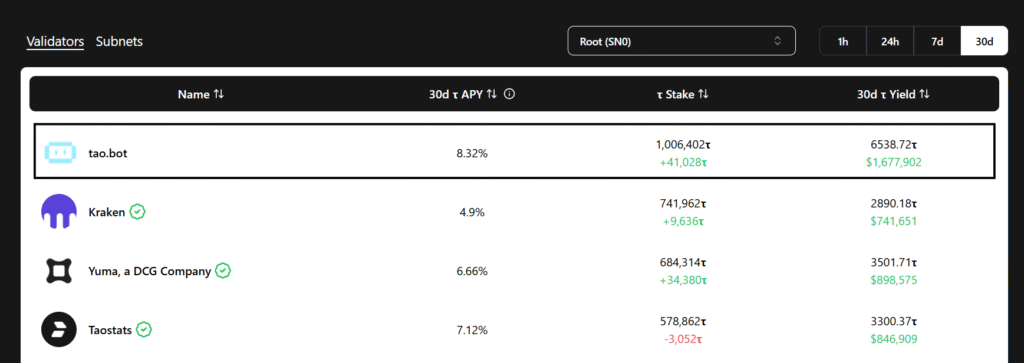
2. Predatory subnet ownership has its own counter-pressure. If a validator directs stakers’ yield into a subnet they personally own and intend to dump, those same stakers now hold positions in that subnet. They can un-stake and sell before the validator does. The scam becomes a self-defeating prophecy.
3. Bad behavior shows up in yield numbers fast. Stakers chasing optimal yield will move away quickly from validators whose redistribution choices are underperforming. The feedback loop is faster than the exit timeline of a typical scam.
The point is that the manipulation concern is already real today (with Crucible, Mentat Minds, and others doing this manually) and has not produced widespread exploits. Making the behavior protocol-native does not increase the attack surface.
Subnet Owners Get Optionality, Not Risk
A natural question is what happens to subnet owners who do not get picked by any validator’s redistribution weights. Const’s answer:
1. No selection equals the status quo. A subnet that is not chosen by any validator gets the same root yield sell pressure as before. Nothing changes for the worse.
2. Selection equals direct buy pressure. A subnet chosen by validators gets root yield flowing into its alpha pool instead of being sold. This is net positive buy pressure.
3. The market gains a curation signal. Validators choosing to redistribute into a subnet acts as an additional credibility signal, similar to how institutional buying signals confidence in traditional markets.
There is also an institutional investor angle worth noting. Holding yield in $ALPHA rather than auto-realizing it in $TAO may have favorable tax implications, since the tokens are not “realized” until the claim operation runs.
The Governance Context
Again, a unique, separate but related question was asked on the Space: was this change discussed enough with the community before being announced.
Const’s response to this is that:
1. The conversation in progress is the process. Community spaces, Church of Rao discussions, Discord debates, and PR reviews are the governance system as it currently exists.
2. Bittensor is faster than most chains and slower than centralized companies. Anthropic does not consult anyone before releasing a new model. Bittensor publishes PRs (Pull Requests), allows code review, and runs Spaces like this one.
3. The on-chain governance system is being built. Validators on one side, subnet owners and a track on the other, with a council accepting PRs into the chain through an upgrade process. The full version takes time, like building a national governance from scratch.
Const acknowledged the system is incomplete but said this is the design decision: ship aligned, ship slow, build the rails for full on-chain governance over time.
The Curation Layer
Root Reborn is, at its core, the restoration of a curation layer to Bittensor’s economic model. The old root network had curation but no feedback loop. dTAO removed the curation entirely and let the market run wild. Root Reborn keeps the dTAO mechanics in place but reintroduces validator-led curation on top, with real economic consequences for bad behavior.
The behavior already exists in the network through Trusted Stake, Mentat Minds, and Crucible. The protocol change just standardizes it, makes it visible, and adds an additional yield-maximization competition between validators.
Const’s bigger bet is that turning the protocol’s 1,000-$TAO-per-day sell pressure into compounding ecosystem reinvestment will be one of the biggest macroeconomic upgrades Bittensor has shipped this year.
Whether the community agrees, and whether the validators behave well enough to prove the model, is what the next few months of data will reveal.
Enjoyed this article? Join our newsletter
Get the latest TAO & Bittensor news straight to your inbox.
We respect your privacy. Unsubscribe anytime.
Enjoyed this article?
Join our newsletter
Get the latest TAO & Bittensor news straight to your inbox — every morning before markets open.



Be the first to comment