

Poker44 (SN126) released v3.1.0 with a training benchmark most bot-detection subnets could not build.
Humans and multi-profile AI agents play against each other on the same tables, generating behavioral data that reflects how bots actually behave when they know a human is watching.
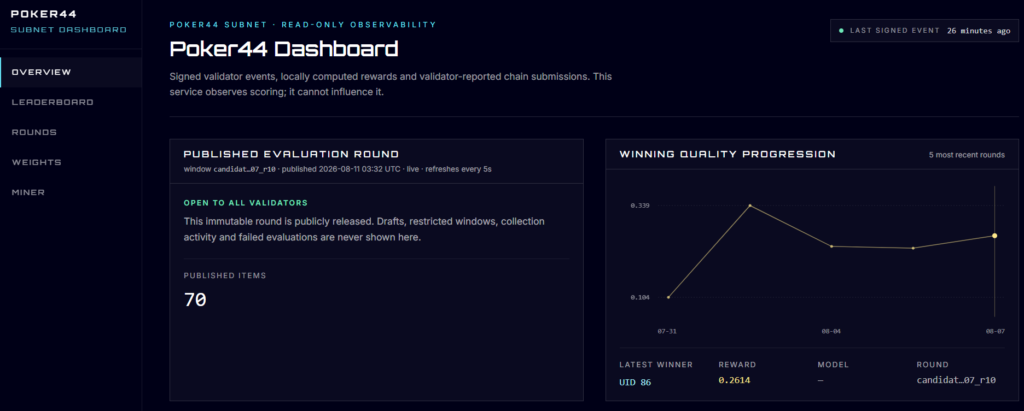
That specific design attacks the biggest weakness in every existing detection dataset: models trained on solo-bot data memorize one signature and miss anything that looks new.
Why the Data Design Beats What Anyone Else Has
Most bot-detection datasets share one flaw, and it is that they train models on bots that never had to blend in.
Poker44 solves that at the source.
1. Multi-profile agents, not a single strategy: Different playing styles, interaction patterns, and behavioral quirks create a training environment that punishes memorization.
2. Extended telemetry beyond completed hands: Decision timing, bet sizing, and session-level patterns all get captured alongside the plays themselves.
3. Privacy-safe processing: Structured signals ship publicly. Identities, raw telemetry, and exploitable tournament provenance stay excluded.
4. Quality gates on every release: Duplication controls, class balance, and diversity validation run before any dataset goes out.
5. SHA-256 immutable releases: Every miner works from the same reproducible benchmark. Nobody quietly edits a dataset after the fact.
Inside the Preview Release
The first labelled dataset is live for miners to validate their pipelines against.
1. 10 schema-v4.1 micro-sessions: Ready for immediate ingestion.
2. 40 strategic decisions: Labeled and structured for supervised learning.
3. Balanced human/bot labels: No class imbalance skewing training runs.
4. The same input structure used by MicroSessionDetectionSynapse: No adapter layer between benchmark and production inference.
5. Transparent audit reporting: Preview status does not relax the quality controls, and any remaining discrepancies get published openly.
6. Automatic dataset expansion: Future Miner Training tournaments add to the cumulative release without manual curation.
Live Gameplay Feeding a Detection Model That Keeps Improving
The compound is what makes the whole design work.
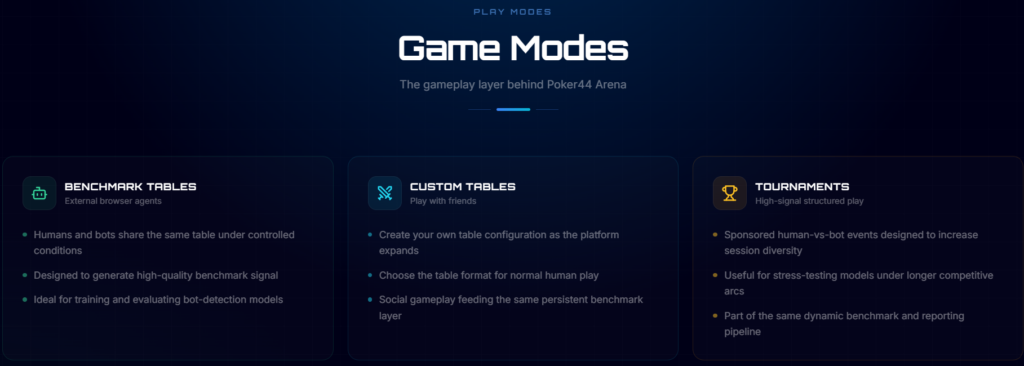
1. Every tournament produces new hands: Fresh gameplay across humans and diverse agent profiles.
2. New hands publish better datasets: Each release expands the training surface.
3. Better datasets train high-quality detection models: Miners iterate against increasingly hard-to-game data.
4. Models get evaluated against fresh private tournament data: Overfitting gets caught before anything reaches production.
The loop resembles how a real poker platform would operate its own detection stack rather than a static benchmark subnet. The API is live, with dataset downloads and full documentation available now.
Enjoyed this article? Join our newsletter
Get the latest TAO & Bittensor news straight to your inbox.
We respect your privacy. Unsubscribe anytime.
Enjoyed this article?
Join our newsletter
Get the latest TAO & Bittensor news straight to your inbox — every morning before markets open.

No comments yet — be the first.