
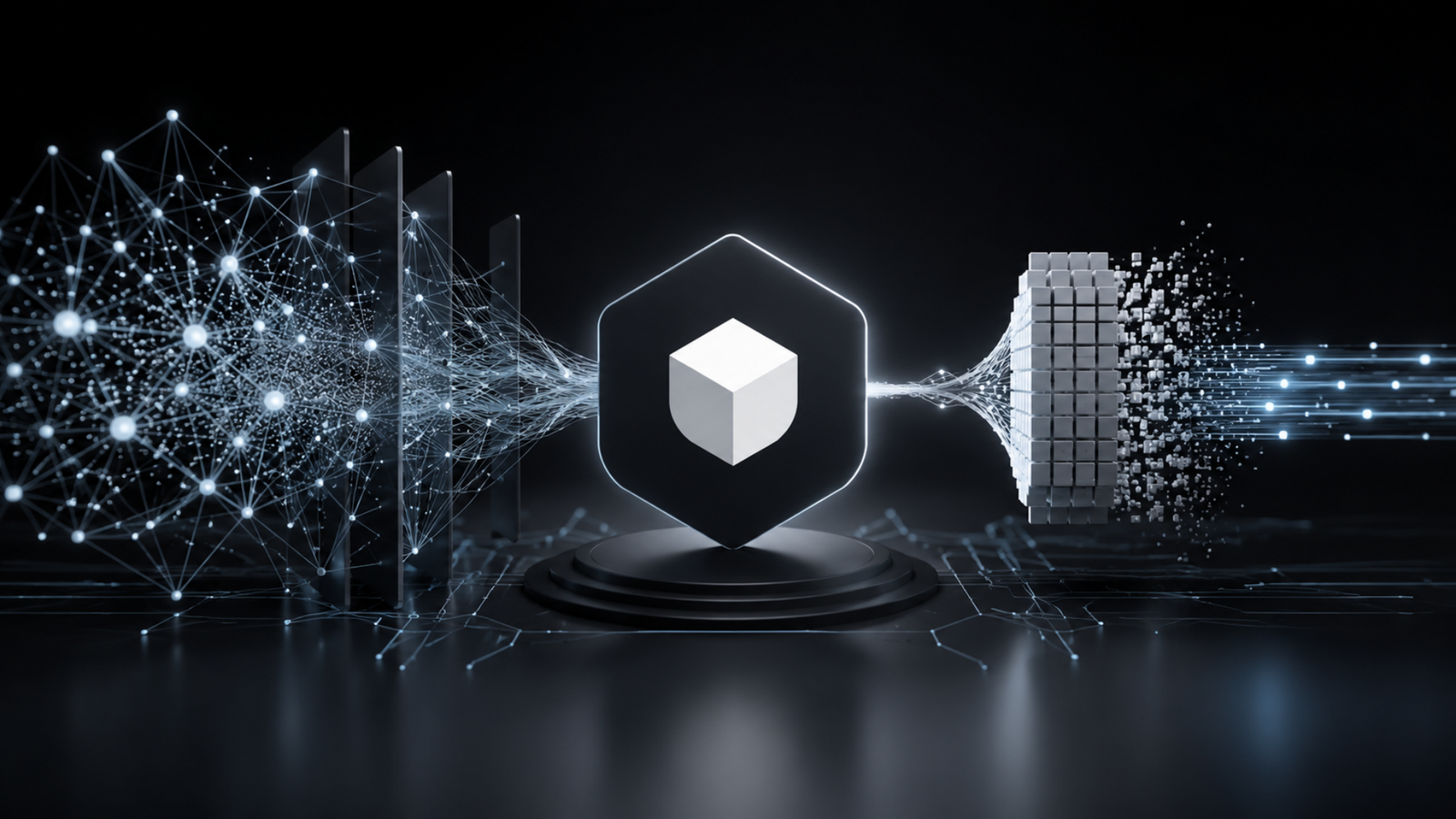
TPN (SN65) published the full walkthrough of its pivot from VPN infrastructure to distributed LLM compression and optimization. The team is positioning itself as the layer in the Bittensor stack that takes large open-source models and produces smaller, faster versions tuned for specific hardware and performance constraints.
The announcement covers the size-versus-quality problem the network targets, how miners compete to solve it, and the use cases the team is going after first. Current models are expensive to run, and TPN is betting that solving that cost problem at the network level is a bigger market than VPN infrastructure was.
The New Problem Tao Private Network (TPN) Is Solving
The AI economy runs on large models that are expensive to host and impossible to run locally:
1. State-of-the-art models need a $30,000 server to run a single instance. They cannot run on a laptop, car, or phone.
2. Cloud hosting for AI products costs millions of dollars a month for companies building on top of these models.
3. Users get no path to private, self-sovereign access to frontier intelligence.
4. Compression has existed since the 1990s. The AI industry only rediscovered it recently as a way to fit large models onto smaller hardware.
5. The hard part is predicting the quality loss. You compress the model, benchmark it, and only then know how much intelligence you gave up. That cycle takes time, expertise, and hardware.
TPN is building a network that takes the guesswork out of that loop.
How the Network Works
TPN operates as an adversarial competition where miners race to produce the best-optimized version of a model under user-defined constraints:
1. Users submit a request with hardware target, performance threshold, and bid. Bids are accepted in TAO or fiat.
2. Requests can be specific. “I need a 512MB model that passes software benchmarks at 90% but cannot write poetry.” Or: “I want Mistral-7B-Instruct-v0.3 to fit in 1GB of memory, the one best at poetry wins.”
3. Miners worldwide race to produce the best version of the requested model under those constraints.
4. They benchmark against industry-standard tests and submit their optimized versions for validation.
5. Validators verify the output. The winner is rewarded and the user gets the model.
6. The competition runs every epoch. The network accumulates optimization knowledge with every request.
It is a permanent global competition where the prize is the most efficient version of any model under any constraint.
What Miners Actually Do
Miners explore a large search space of compression and optimization techniques in parallel:
1. Quantization: Compresses the model the way h264 or h265 compresses video. A Blu-ray movie can drop to roughly 10% of its original size at h265 without visible quality loss on most screens. LLM quantization works the same way: reduce model precision in ways that are hard to notice in output quality.
2. Pruning: Removes parts of the model that do not meaningfully contribute to its intelligence. Done correctly, this speeds the model up without affecting output.
3. Model Merging: Blends multiple specialized models into a hybrid tuned for specific benchmark targets.
4. Distillation: Trains a small model to mimic the reasoning patterns of a much larger one.
The best miners stack these techniques sequentially. The combined result consistently outperforms what any single technique or internal team can produce.
Why the Bittensor Structure Fits
TPN’s argument is that LLM optimization maps cleanly onto Bittensor’s incentive design:
1. The search space is too large for any single team. Thousands of compression and optimization combinations exist for any given model.
2. A distributed network exploring in parallel covers more ground. Different miners, different hardware, different strategies, all running at the same time.
3. The epoch structure maps onto the problem. Each epoch is a competition. Each competition produces a winner. The network gets sharper over time.
This is the Bittensor thesis applied to a specific bottleneck in the AI stack.
Who TPN Is Built For
The team named three clear early use cases:
1. Developers and AI teams running powerful open-source models locally without the quality loss that standard compression tools produce.
2. Companies paying large monthly cloud bills to run AI models who want to move to leaner self-hosted versions without sacrificing performance.
3. AI agent builders who need fast, lightweight models that can run cheaply at scale.
The longer-term targets are:
1. Automotive companies running models on onboard chips.
2. Hardware manufacturers optimizing for specific silicon.
3. Enterprises requiring AI inside air-gapped infrastructure.
The Compression Play
TPN is betting that the next phase of the AI economy will not be about who can build the largest model. It will be about who can run those models cheaply on the hardware that already exists. The size-versus-quality problem is real, the cost of getting it wrong is high, and no single internal team can search the full optimization space. TPN’s position is that distributed competition is the right structure for that problem.
The pivot keeps the team’s core engineering strengths but points them at a market with a much larger ceiling than VPN infrastructure. If the AI industry spent the last decade making models bigger, TPN is building the infrastructure that makes those models usable everywhere.
Learn more:
Enjoyed this article? Join our newsletter
Get the latest TAO & Bittensor news straight to your inbox.
We respect your privacy. Unsubscribe anytime.
Enjoyed this article?
Join our newsletter
Get the latest TAO & Bittensor news straight to your inbox — every morning before markets open.
No comments yet — be the first.