

Prediction markets are often framed as elegant systems where collective intelligence converges on truth, yet anyone who has spent real-time trading knows the reality is far less refined. What emerges instead is a noisy arena driven by sentiment, misinterpretation, and poorly timed conviction, where most participants react emotionally while a small minority operates with discipline and structure.
The traders who consistently win are not defined by superior insight or privileged information, but by a repeatable process that allows them to navigate inefficiencies with precision. Their edge is not prediction in the dramatic sense, but the ability to interpret contracts correctly, evaluate probabilities objectively, and manage risk without compromise.
Understand the Instrument Before You Trade It

Every prediction market contract is a precisely defined financial instrument, not a loose interpretation of an event, and the majority of losses can be traced back to traders engaging with narratives rather than rules.
A market title may suggest a broad outcome, but resolution is always tied to a specific condition, a defined data source, and an exact moment in time.
Consistent traders anchor every decision in these fundamentals:
a. The exact resolution criteria and how the outcome is formally measured,
b. The oracle or data source that determines the result, and
c. The timing and structure of settlement.
The disconnect between headline interpretation and rule-based reality is where inefficiencies are created, and those who take the time to understand this gap position themselves ahead of the crowd without needing to move faster than it.
Build an Information Stack That Filters Noise

Information advantage in prediction markets is not about consuming more content, but about understanding where information sits within a hierarchy and how quickly it degrades as it moves outward.
Most participants rely on social platforms, which primarily reflect sentiment rather than truth, leaving them structurally late to meaningful developments.
A disciplined information stack separates signal from noise:
a. Primary data such as official filings, raw datasets, and on chain activity,
b. Institutional distribution channels where verified information appears early,
c. Domain expertise that explains how outcomes are actually produced, and
d. Social sentiment, useful only for gauging crowd positioning.
The traders who outperform are not reacting to what is being said, but verifying what is real before it becomes consensus.
Trade Mispricing, Not Narratives
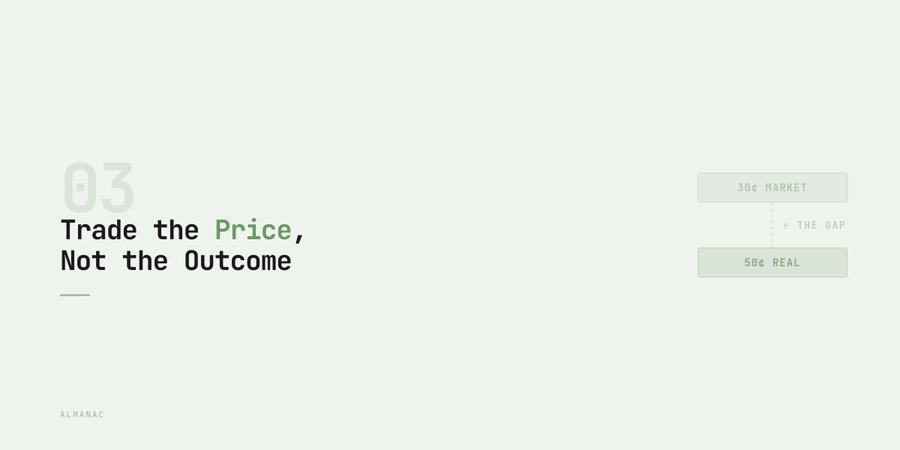
The defining shift in professional trading is moving away from asking what will happen and focusing instead on whether the market has priced an event correctly. Every contract represents an implied probability, and profit emerges only when that probability diverges meaningfully from reality.
This reframing introduces a more disciplined approach:
a. Enter positions only when a clear probability gap exists,
b. Ignore momentum driven narratives that distort pricing, and
c. Evaluate decisions based on expected value rather than binary outcomes.
A trade is not validated by being right in hindsight, but by being correctly priced at the moment of entry, which is the only condition that compounds over time.
Control Bias and Protect Capital Relentlessly

Emotion is most destructive in markets tied to identity, belief, or high stakes narratives, where confirmation bias quietly influences decision making and distorts risk perception. The solution is not attempting to remove emotion, but building a process that limits its influence through deliberate structure.
Effective traders rely on simple but rigid controls:
a. Forcing counterarguments before committing capital,
b. Maintaining awareness of opposing outcomes when conviction is high, and
c. Treating capital allocation as a purely functional decision.

Alongside this, survival becomes the primary objective, as no edge can compound without longevity:
a. Limit position sizing to preserve capital across multiple trades,
b. Maintain liquidity to exploit volatility and dislocations, and
c. Exit positions decisively when underlying assumptions break.
The goal is not to avoid losses, but to ensure no single mistake defines the outcome of the entire portfolio.
The Real Edge Is Process
Becoming consistently profitable in prediction markets is less about discovering hidden information and more about executing a disciplined framework that most participants ignore. It is built on reading contracts with precision, verifying information at its source, identifying mispriced probabilities, neutralizing bias, and managing risk with consistency.
These principles are not complex, but they require restraint and repetition, which is why they remain uncommon. Over time, the distinction becomes clear, as one group continues to react to noise while the other quietly compounds an edge grounded in process rather than instinct.
Enjoyed this article? Join our newsletter
Get the latest TAO & Bittensor news straight to your inbox.
We respect your privacy. Unsubscribe anytime.
Enjoyed this article?
Join our newsletter
Get the latest TAO & Bittensor news straight to your inbox — every morning before markets open.



1 Trackback / Pingback