

Cover Image Credit: Tao Templar
The most interesting voice on Bittensor’s latest emissions change is not the one celebrating it. Travis ‘Tao Templar’ Millott just published a video walking through the new mechanism that lets the protocol block emissions to unproductive subnets.
His read is that the criteria make sense in principle but the implementation introduces a kind of power centralization the network is supposed to be moving away from.
He is asking whether the mechanism gets sunset cleanly or quietly becomes permanent infrastructure (not predicting doom!)
The Argument
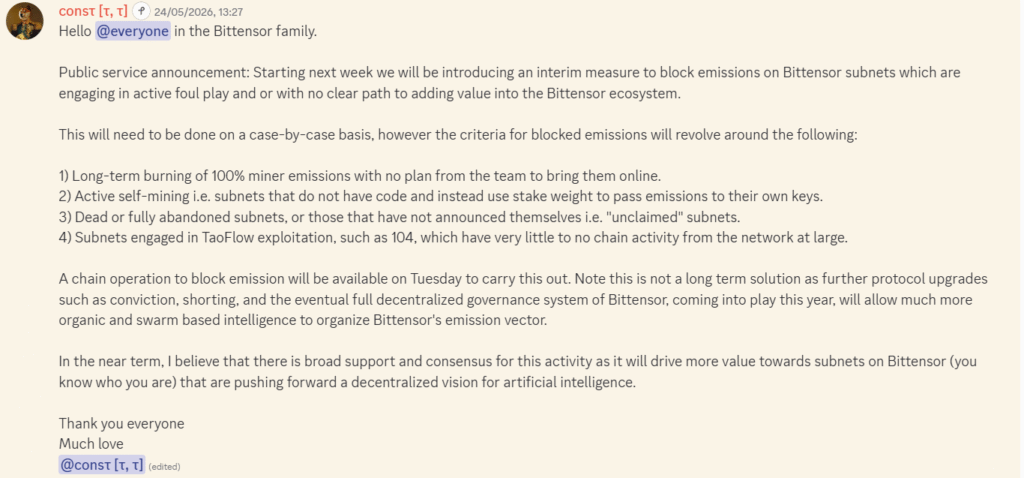
Jacob ‘Const’ Steeves laid out four explicit criteria for blocking emissions, with the operation going live on Tuesday, May 26:
a. Long-term 100% miner emission burn with no plan to bring miners online. Subnets like Bitcast burn at high rates because they offset emissions with real revenue, which is structurally different.
b. Active self-mining, where a subnet has no code and uses stake weight to pass emissions to its own keys. Legitimate winner-take-all subnets can technically trigger the same flag, so nuance matters.
c. Abandoned or unclaimed subnets whose owners have not announced themselves.
d. Tao Flow exploitation, specifically Subnet 104, where the owner buys small amounts of their own token to push price upward and trigger emission inflows.
Travis’s first concern is what the list misses. Newly registered subnets are quietly capturing close to 100% of possible chain-buy emissions despite having proven nothing:
a. Recently registered subnets dominate chain-buy proximity rankings, receiving near-maximum emissions into their pools.
b. Many have prices above $0.01, which compounds the effect since chain-buy proximity scales with price.
c. None have approached buyback-and-burn maturity, meaning emissions flow into pools that have not returned value.
d. The pattern suggests a Tao Flow quirk where new subnets benefit from prior owner price history without earning the emissions themselves.
The deeper concern is structural:
a. Centralized regulation tends to outlast its mandate. Temporary fixes rarely sunset on schedule.
b. No control mechanism exists for the controller. The system works if the power is used well, but no fallback exists if it is not.
c. A sunset clause would help. A specific block height at which the operation expires would create a hard deadline for the decentralized alternative.
d. Letting the problem persist might have been better. The continued existence of subnets like 104 and 29 is itself a signal that something in the network’s alignment is broken, and removing the signal removes the pressure to fix the underlying mechanism.
Tao Templar closed on a line he originally used in a video Const himself praised: regulation is power centralization, and centralizing power leaves no mechanism to control that power when corruption sets in.
Where This Lands
Travis described himself as a complete Bittensor maxi while still raising the concern, which is why the read is worth taking seriously.
The emissions block solves a real problem and lands well as a near-term fix, but the deeper test is whether it stays near-term. Conviction, shorting, and decentralized governance are all on the roadmap and are the right structural replacements.
The cleanest outcome is that the operation gets used a few times, the broken subnets stop receiving emissions, and the mechanism quietly retires when its successor ships. The risk is that it becomes the default infrastructure. The video is a useful reminder that the second outcome is what the broader Bittensor thesis is supposed to make impossible.
Enjoyed this article? Join our newsletter
Get the latest TAO & Bittensor news straight to your inbox.
We respect your privacy. Unsubscribe anytime.
Enjoyed this article?
Join our newsletter
Get the latest TAO & Bittensor news straight to your inbox — every morning before markets open.


No comments yet — be the first.