

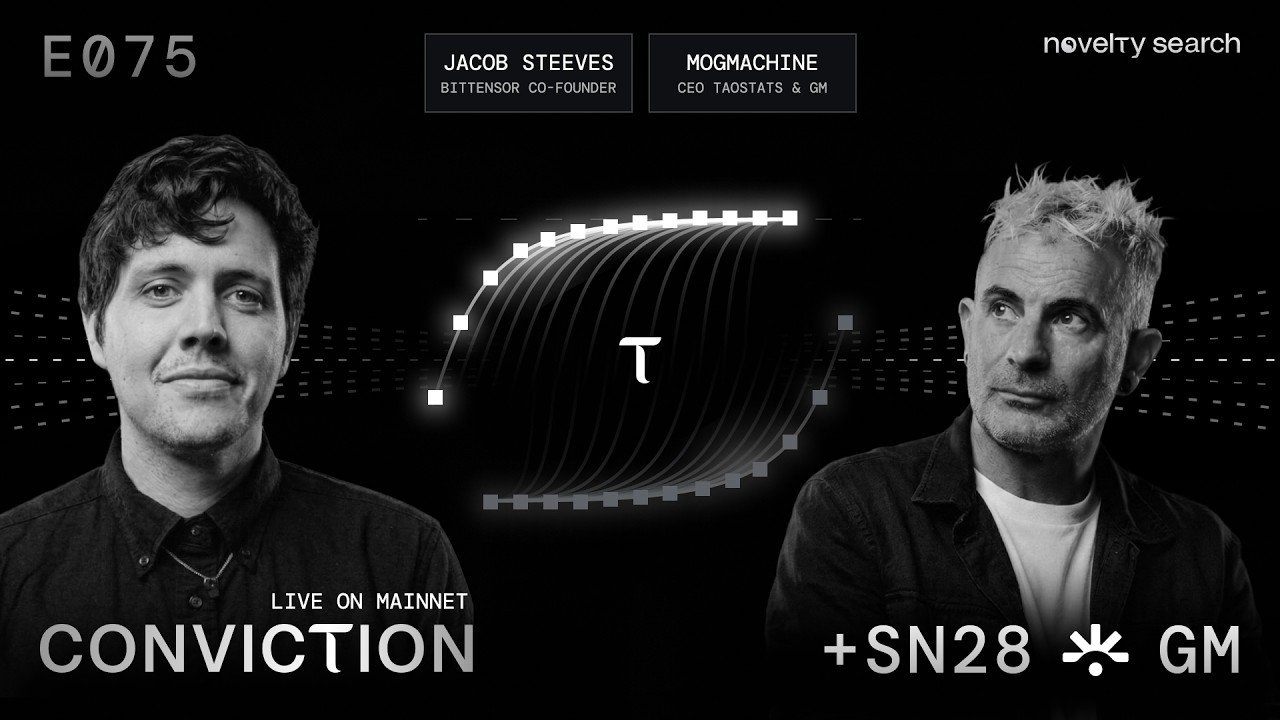
Three structural upgrades landed on Bittensor in this single week, and Novelty Search E075 broke each of them down in detail.
Jacob ‘Const’ Steeves ran through Tao Flow V2, the new chain operation that lets the protocol disable emissions to specific subnets, and the initial release of Conviction locks. Then Marcus ‘Mogmachine’ Graichen of TaoStats came up to introduce Good Morning, the brand new subnet 18 targeting OpenRouter directly.
The combined effect of all four moves is that the network now has sharper tools for steering emissions away from unproductive subnets, harder protection for $TAO holders against deregistration extraction, and a serious consumer-facing inference product to add to its stack.
What Shipped This Week
The Const segment of the call laid out four distinct changes, each addressing a different part of the protocol stack:
a. Tao Flow V2 adjusted how subsidies and individual flows are measured against each other. The practical effect is reduced emission variance and a stronger reward signal for subnets that pull sustained flow over longer periods rather than spiky bursts.
b. The new chain operation for disabling subnet emissions is now active. Subnets that lose emissions can keep their token and liquidity, but stop receiving $TAO injections into the pool. The intent is to use this against the most extractive cases first, with the longer-term solution being mechanism-based rather than discretionary.
c. The protocol fund mechanism changes how chain buys interact with subnet liquidity. Alpha pulled out of pools during chain buys is now attached to the protocol itself, and during deregistration, that subnet ‘$ALPHA’ token gets converted to $TAO and burned alongside everyone else’s.
This closes the loophole where subnets could chase chain buys and then deregister with the proceeds, structurally protecting $TAO holders.
d. Conviction V0 went live as a stake-locking primitive. The full ownership-control layer is not yet enabled, since the team wants to observe how the locking mechanism behaves before wiring it to subnet takeovers.
Const himself locked 100,000 $SN120 in Affine (SN120) just before the call as an early demonstration.
Good Morning… From Mogmachine
Mogmachne’s segment then introduced Good Morning, a confidential inference routing layer claiming the Subnet 18 slot:

a. The product is a private, pay-in-$TAO alternative to OpenRouter, routing inference through major model providers including OpenAI, Anthropic, and Meta, with confidential routing handled by trusted execution environments.
b. Miners arbitrage enterprise inference keys, setting their own price floors and competing to provide the cheapest tokens. The economics mirror what early Subnet 18 demonstrated, where miners with bulk enterprise access could undercut retail pricing meaningfully.
c. The stack is designed to plug into other Bittensor subnets as providers expand. Chutes (SN64) can route through it, Hippius (SN75) and Targon (SN4) are next on the integration roadmap. Hippius (SN75) will provide the confidential CPU virtual machine layer for the supporting infrastructure.
d. The build took 14 days from first conversation to testnet launch, with mainnet rollout, miner onboarding, and customer beta access coming over the next several weeks.
The pricing model echoes what TaoStats has already validated with BlockMachine (SN19), where miners get paid only for what gets used and emission burn percentages serve as a direct readout of real usage.
Const also previewed two items further out on the roadmap:
a. The team is exploring a replacement for root yield through validator funds, with TrustStake working on a proposal that would let validators function as managed investment vehicles into the subnet ecosystem.
b. Shorting is also still on the way, framed as a two-sided market mechanism for Dynamic $TAO that should improve overall sensemaking rather than introduce instability.
Where This Leads To
The pattern across all of this is the protocol pulling levers it has previously avoided. Discretionary emission control is a sharp tool, and the framing throughout the call acknowledged that openly, with Const flagging that the long-term answer is mechanism-based and that the chain operation is meant to be temporary while the better solution gets built.
The Conviction rollout is being staged carefully on purpose, and the protocol fund change for chain buys is the kind of quiet structural fix that pays off for years without ever needing to be mentioned again.
Good Morning landing in the middle of this is timing that probably matters more than anyone realizes yet, since pulling inference customers from OpenRouter into a Bittensor-native, pay-in-$TAO product closes one of the more meaningful gaps in the network’s consumer stack. Whether the chain emission operation gets used sparingly or becomes a habit will be one of the more telling signals about where the next year of governance actually goes.
Enjoyed this article? Join our newsletter
Get the latest TAO & Bittensor news straight to your inbox.
We respect your privacy. Unsubscribe anytime.
Enjoyed this article?
Join our newsletter
Get the latest TAO & Bittensor news straight to your inbox — every morning before markets open.


No comments yet — be the first.