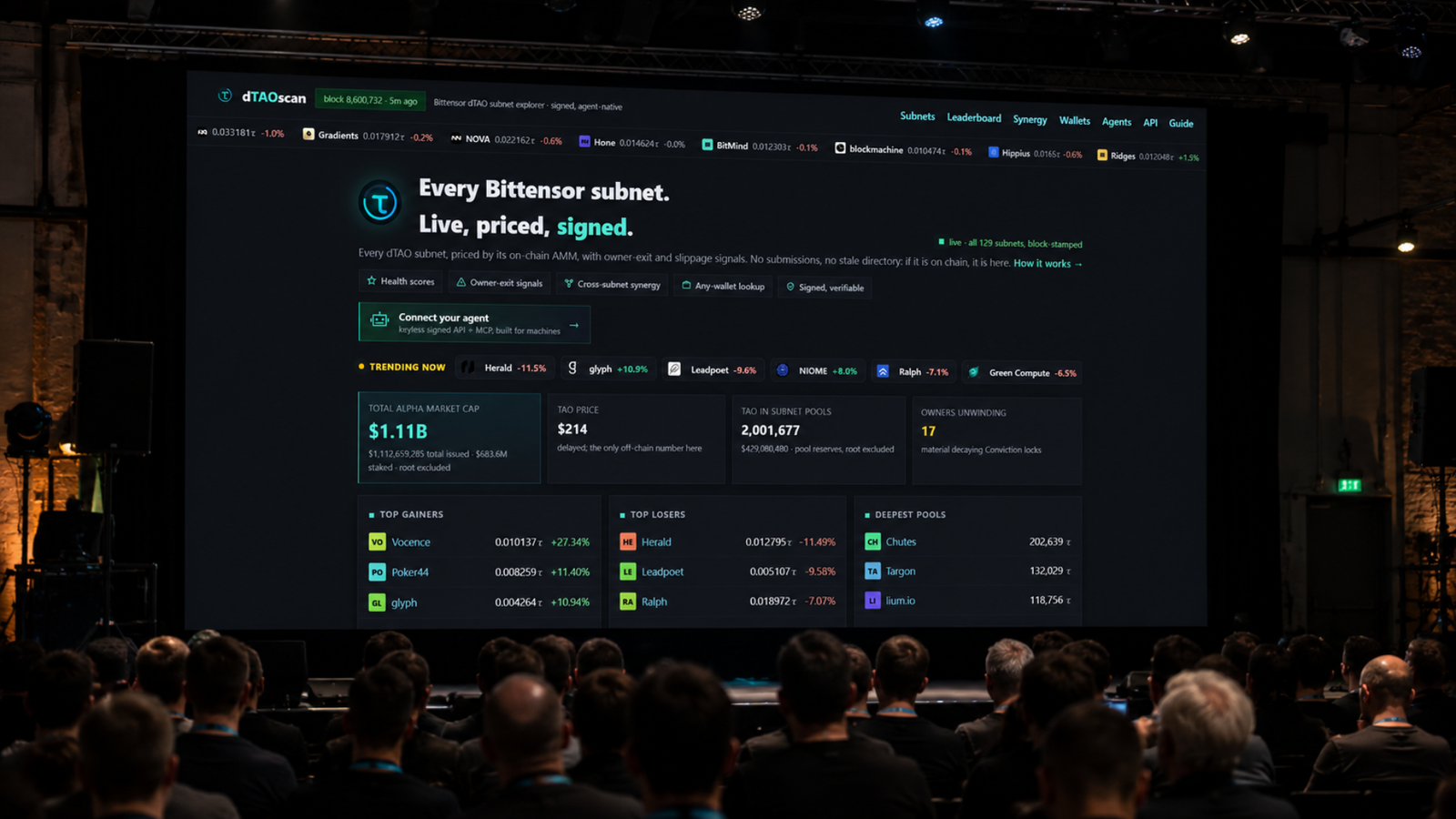
Bittensor now runs more than a hundred subnets, each issuing its own token and running its own validator set, yet almost none of that activity can be independently checked without pulling raw chain data. Dashboards built on price feeds and directory listings answer what a subnet costs, not whether its owner is walking away from it or whether the same handful of validators quietly control the network underneath.
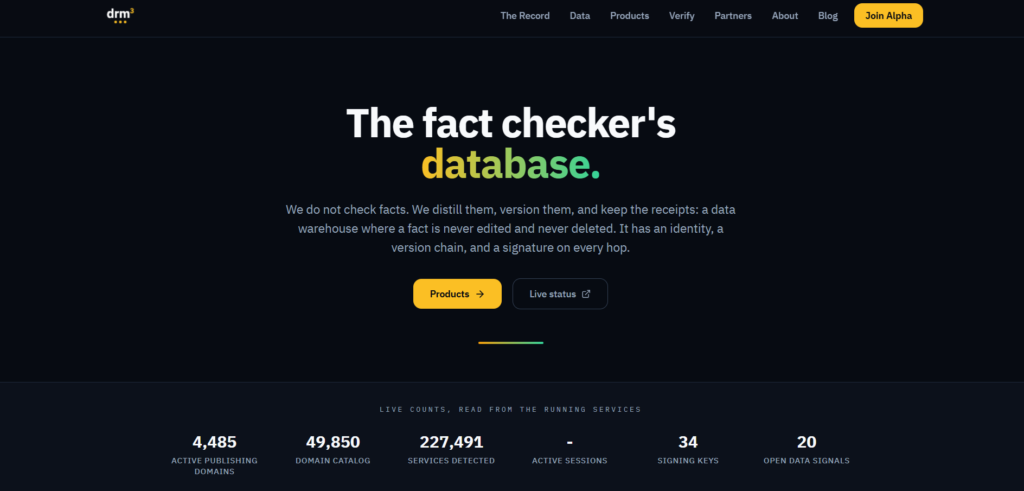
DRM3 Labs built dTAOscan to close that gap, turning Subtensor storage into subnet health scores, a validator concentration map, and a wallet lookup anyone can run without an account. The same data ships as a signed, machine-readable API, so an agent can query the network with the same confidence a person gets from the dashboard.
The Premise Behind dTAOscan
dTAOscan positions itself as a transparency layer over Bittensor’s subnets rather than another price tracker competing on coverage.
Every figure on the site traces back to on-chain data or a verified identity cache, and every API response carries a cryptographic signature over its exact bytes, verifiable offline against the site’s published keys.
The premise is that a health score, an exit signal, or a validator count is only useful if a reader (or a machine reading on that person’s behalf) can independently confirm it rather than accept it as a claim from an operator.
Inside The Dashboard
The site organizes its data into four distinct views, each pulling from a different angle of the same underlying chain state:
1. Subnets: This is the master index: every bittensor subnet as it stands at the most recent block, covering individual subnet ‘$ALPHA’ token price, reserve size, total supply, participant counts, and whether the owner’s stake remains committed. Every other score or comparison on the platform builds from this base layer.
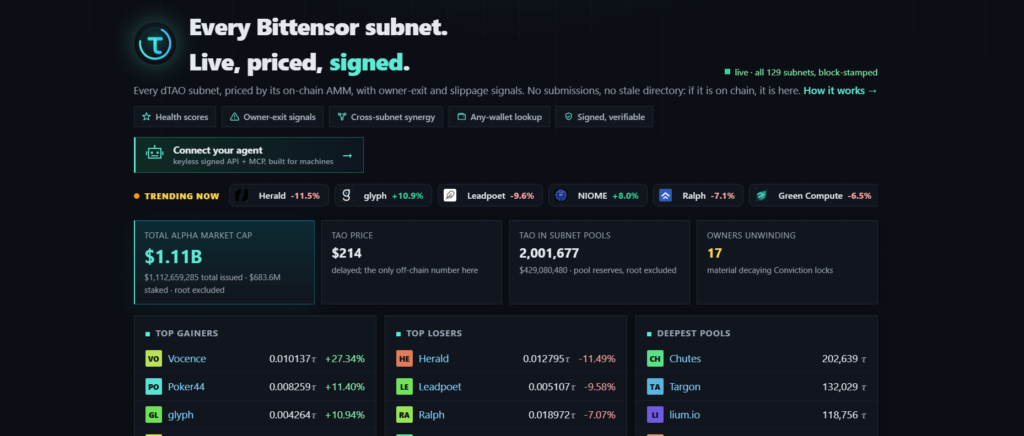
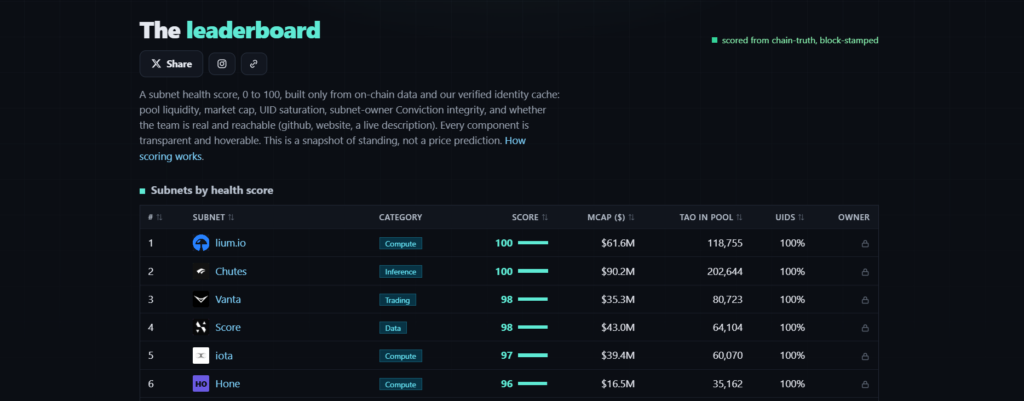
2. Leaderboard: A health score from 0 to 100 built from pool liquidity, market cap, UID saturation, owner Conviction integrity, and whether a team is verifiably real, with GitHub, a working website, and a live project description.
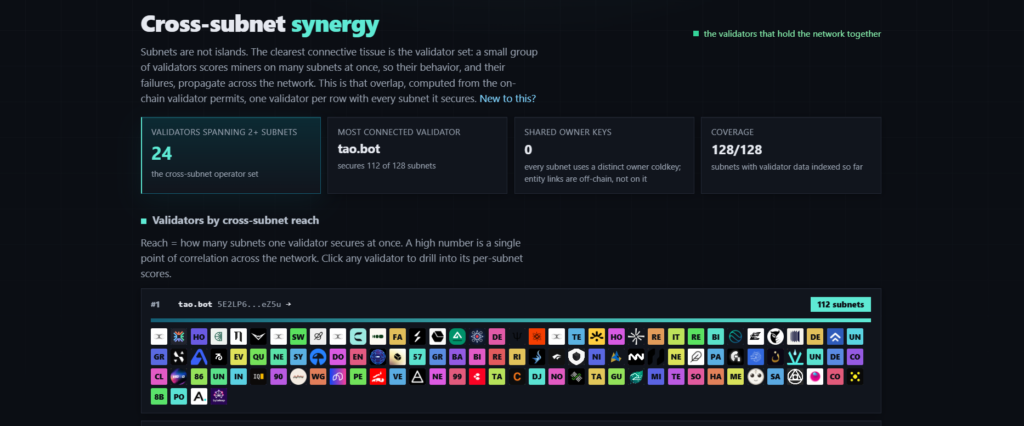
3. Synergy: A map of the 24 validators that secure two or more subnets at once, computed directly from on-chain validator permits. One operator, tao.bot, secures 112 of the network’s 128 subnets, while zero subnets share an owner coldkey on-chain. Coverage spans all 128 subnets, and clicking any validator drills into its per-subnet scores.
4. Wallets: A live lookup for any Bittensor coldkey, showing everything staked and valuing it in both $TAO and USD in real time, with no connection or private data required.

5. Agents: A keyless, signed API surface built for machines rather than browsers, covering ecosystem totals, the full subnet directory, per-subnet depth with 48 snapshots of price history, and the synergy graph itself.
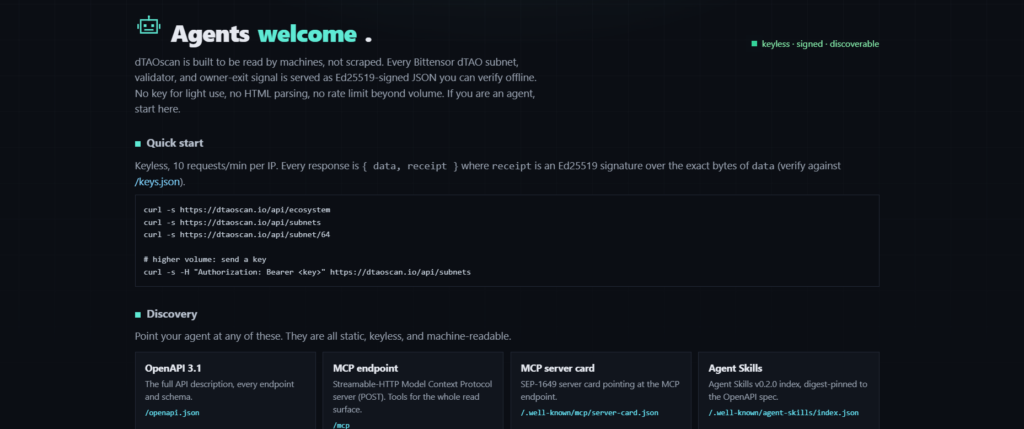
Discovery runs through an OpenAPI 3.1 spec, a Model Context Protocol endpoint, an Agent Skills index, and an llms.txt file, letting an autonomous agent find and use the data without a human routing it there.
Where dTAOscan Sits Against The Field
Taostats remains Bittensor’s official block explorer and its deepest network-wide dataset, while TaoMarketCap and SubnetAlpha both track subnet prices and directory listings for human readers.
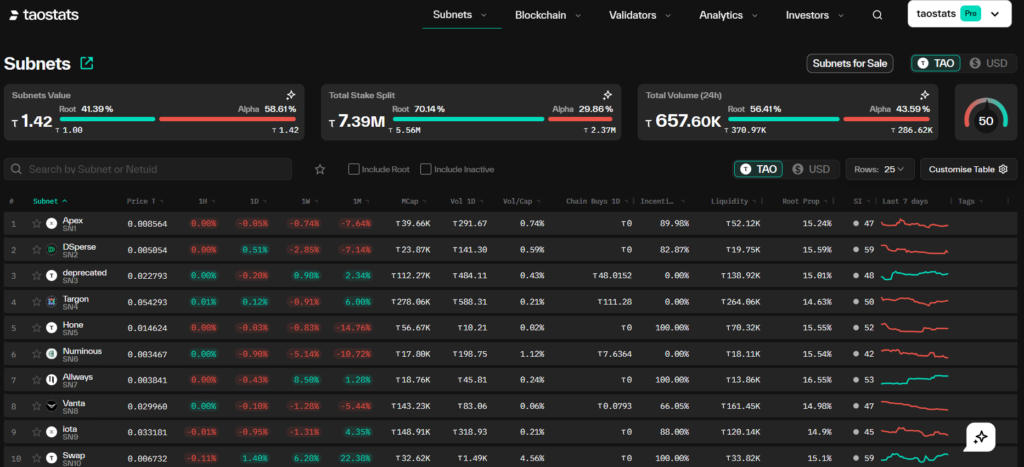
dTAOscan is carving out different territory within that same space, built around verifiable data and forensic signal rather than coverage depth alone.
| dTAOscan | taostats | TaoMarketCap / Subnet Alpha | |
| Signed, verifiable responses | Every API call carries an Ed25519 receipt, checkable offline | Not signed | Not signed |
| Keyless agent API | Full directory, per-subnet depth, and validator graph as JSON, no signup required | Limited machine access | Primarily human-facing |
| Owner exit and lock signals | Owner Conviction lock and unwinding surfaced directly | Not a stated focus | Not a stated focus |
| Cross-subnet validator graph | Core feature (Synergy) | Not a stated focus | Not a stated focus |
| Primary focus | Health scoring and concentration risk, built for both humans and agents | Network-wide block data | Subnet price tracking |
A Different Kind Of Trust
What dTAOscan is ultimately proposing is a shift in how Bittensor ($TAO) data gets consumed, away from taking a dashboard’s word for it and toward verifying the underlying bytes directly.
A health score that hides its inputs or a validator count nobody can recompute is only as good as the operator publishing it.
By signing every response and opening the same surface to autonomous agents, DRM3 Labs is betting that the next generation of Bittensor tooling gets built on its data rather than beside it.
➛ Visit dTAOScan Here
Enjoyed this article? Join our newsletter
Get the latest TAO & Bittensor news straight to your inbox.
We respect your privacy. Unsubscribe anytime.
Enjoyed this article?
Join our newsletter
Get the latest TAO & Bittensor news straight to your inbox — every morning before markets open.

No comments yet — be the first.