


‘Half the billboards in the world are sitting empty, and almost nobody is talking about it.’ That is the picture Bitcast (SN93), painted of the creator economy at this session, where a $37 billion market is growing four times faster than the rest of advertising yet leaves most of its supply untouched.
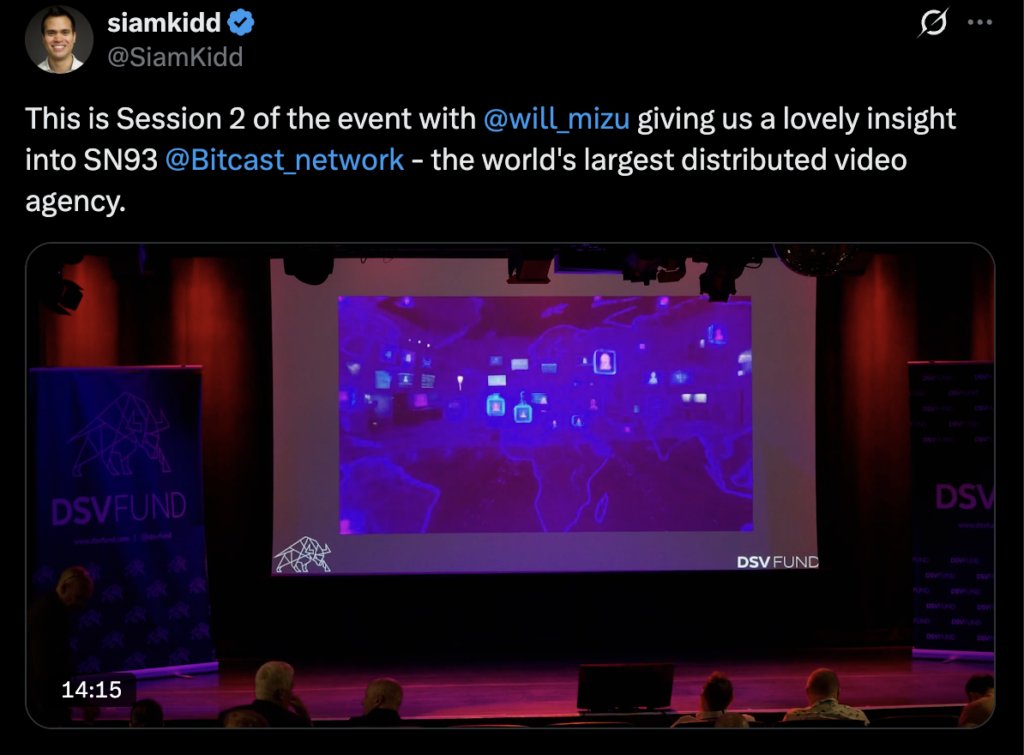
At Inside Bittensor, Will Blears, the co-founder and CTO of Bitcast (SN93), walked through why brand budgets keep landing on the same handful of giant creators while a much larger, more engaged long tail goes unpaid. He pretty much covered the scale of the inefficiency, the mechanics of Bitcast’s fix, and the results it has already produced inside a brutal bear market.
The Case, Point By Point
Before getting to the numbers, it helps to see exactly where the argument starts: a market big enough to matter, sitting on top of a structural flaw nobody had fixed.
1. The creator economy is enormous and still accelerating. Brands spent $37 billion on creator marketing in the US last year alone, a figure expanding four times faster than advertising spend as a whole, yet only about a third of content creators have ever landed a brand deal, and far fewer land one regularly.
2. Value is trapped, not missing. Micro and mid-tier creators collectively command hundreds of millions of followers, and their audiences engage roughly 60% more than those of major creators because the content reads as more authentic, meaning the demand and the value both exist, they simply cannot connect.
3. The bottleneck is neither creators nor brands. Creators cite deal-finding and deal management as their biggest obstacles, not reluctance to work with brands, while seven in ten brands say they would actually prefer smaller creators for their ability to convert an audience, ruling out disinterest on either side.
4. The real constraint is an unscalable manual process. A typical brand deal runs through finding a creator, vetting, negotiating, briefing, producing, reviewing, publishing, verifying, and paying, a seven-step chain run largely on spreadsheets that keeps transaction costs high enough to exclude the long tail entirely.
5. Bitcast compresses that chain to a single manual step. A brand and the subnet agree on a content brief together, and everything after that, distribution to relevant creators, content production, AI-driven compliance checks against the brief, and performance-based reward payouts in the subnet’s alpha token, runs automatically.
6. The subnet has scaled fast for a young project. Launched roughly a year ago on YouTube and expanded to X (Formerly Twitter) in November, Bitcast has onboarded 756 creators averaging 13,000 followers each, producing a combined audience of 9.5 million that is on pace to roughly double within four months.
7. Its scale already rivals what large creators alone can offer. The biggest crypto YouTubers max out around one to three million subscribers each, and reaching one typically means weeks of contract negotiation through a management team for a single video with no performance guarantee, versus a same-day campaign launch and hundreds of videos paid on results through Bitcast.
8. Revenue is climbing despite a hostile market. Working with 45 clients in its first year, the subnet just closed its fifth quarter in business at double the prior period’s revenue, with the next quarter targeted for another doubling even as marketing budgets across crypto get slashed industry-wide.
9. That growth quarter was also Bitcast’s first profitable one. By Bittensor’s standard definition, profitability means business revenue exceeding miner rewards, in this case payments to creators, and the co-founder framed this as likely the first profitable quarter recorded by any subnet on the network to date.
10. A live campaign with Bitget shows the model working at brand scale. The exchange received 118 sponsored YouTube videos across multiple languages, generating 258,000 views across 64 countries in a campaign launched within a day, work that would typically take a global brand months to coordinate, and Bitget has since increased its monthly budget with the subnet for six consecutive months.
Built for the Long Tail, Aimed at the Whole Market
The subnet’s roadmap treats Web3 dominance as a starting point rather than an endpoint, with plans to expand beyond YouTube and X (Formerly Twitter) to additional platforms and to carry the same infrastructure into AI, tech, and finance verticals before the year is out.
The creator economy is projected to reach $480 billion in value by the end of 2027, and the co-founder’s closing argument was that the ceiling on that market has never been demand or creator willingness, it has been an industry still running on spreadsheets.
Whether Bitcast becomes the layer that fixes that will depend on whether its first profitable quarter turns out to be the start of a trend across Bittensor, rather than an isolated result.
Enjoyed this article? Join our newsletter
Get the latest TAO & Bittensor news straight to your inbox.
We respect your privacy. Unsubscribe anytime.
Enjoyed this article?
Join our newsletter
Get the latest TAO & Bittensor news straight to your inbox — every morning before markets open.


[…] runs on Bitcast (SN93), Bittensor’s decentralized protocol handling verification and rewards, already reporting 1.1K […]