


The Alpha Distribution Ratio (ADR) is one of the central metrics used to evaluate the health and liquidity structure of a Bittensor subnet.
It measures the relationship between subnet ‘$ALPHA’ tokens held by participants and $ALPHA held in the subnet’s automated market maker (AMM) pool.
Understanding what ADR represents, how it is calculated, and how it affects deregistration economics is essential for any participant staking TAO into subnet positions.
What ADR Measures
ADR compares the volume of alpha tokens in circulation against the volume of alpha tokens held in the subnet’s AMM pool.
ADR is calculated by dividing $ALPHA in circulation with $ALPHA in pool
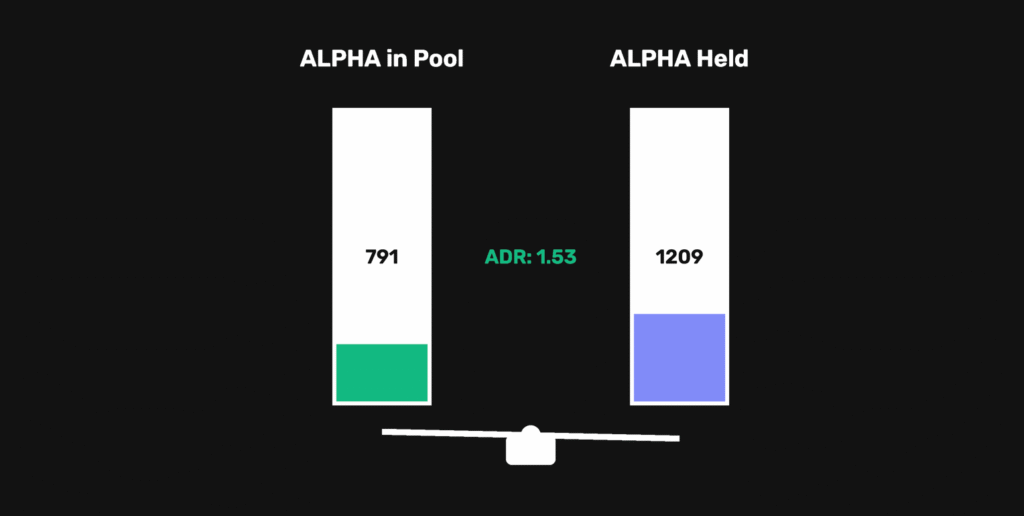
In equivalent terms, ADR can be expressed as alpha_out ÷ alpha_in, where alpha_out represents tokens distributed through emissions and alpha_in represents tokens injected into the pool.
Under standard protocol conditions, the network injects between 0 and 1 $ALPHA into the pool per block, with the ideal case matching the 1 $ALPHA distributed to participants. This produces an ADR of approximately 1 under balanced conditions.
At the protocol level, ADR tracks roughly 2^(k − n), where k represents the global $TAO halving index and n represents the subnet’s $ALPHA halving index.
The Three ADR States
ADR values fall into three primary ranges, each with distinct implications:
1. ADR Below 1: The pool holds more $ALPHA than is circulating in participant wallets. The protocol classifies this as a state of net $ALPHA accumulation, indicating that more tokens are returning to the pool through un-staking or selling than are being withdrawn through staking or buying.
2. ADR Equal to 1: The volume of $ALPHA in the pool matches the volume held by participants. This represents balanced alpha flow.
3. ADR Above 1: Participants hold more $ALPHA than the pool contains. The protocol classifies this as a state of net $ALPHA distribution, where tokens are leaving the pool faster than they are returning.
How to View Subnets ADR Index
There are several tools that can be used to view ADR of TAO Subnets.
On Taostats, users should:
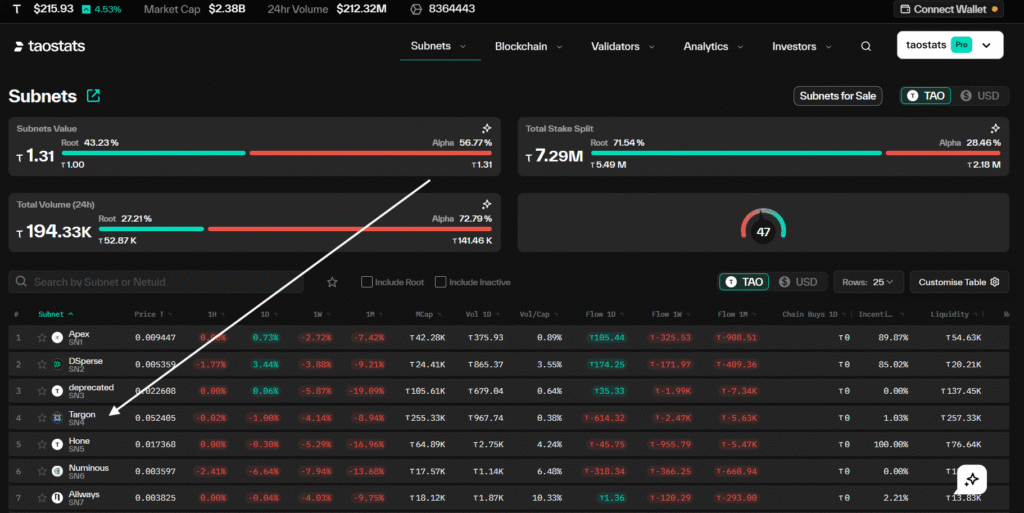
1. Visit Taostats’ Subnet Page and Choose a Subnet of Interest (Targon-SN4 is Used for This Simulation.)
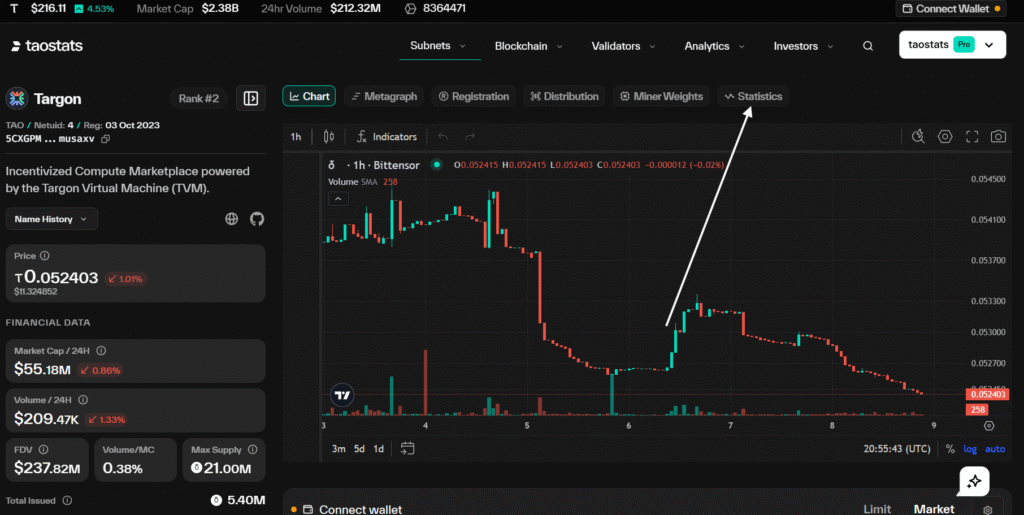
2. On the Subnet’s Page, Choose The Statistics Bar
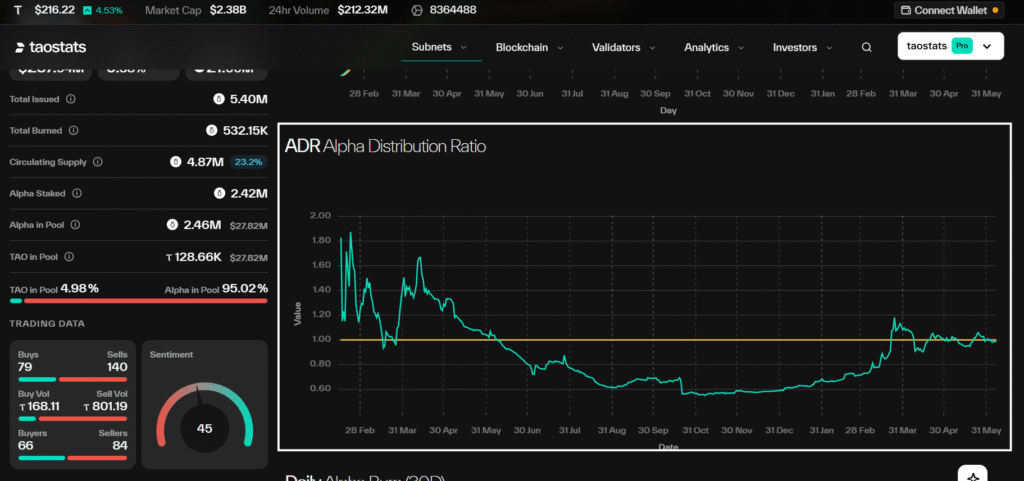
3. Scroll Till You Get to ADR Alpha Distribution Ratio Chart
On TaoMarketCap, users should:
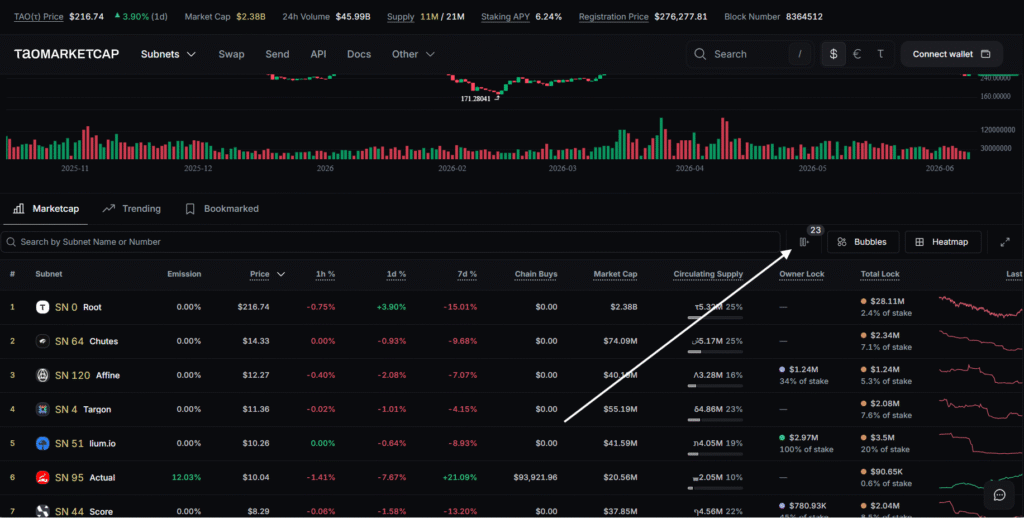
1. Visit TaoMarketCap and Click on the Hidden Column Icon to View Various Metrics Available
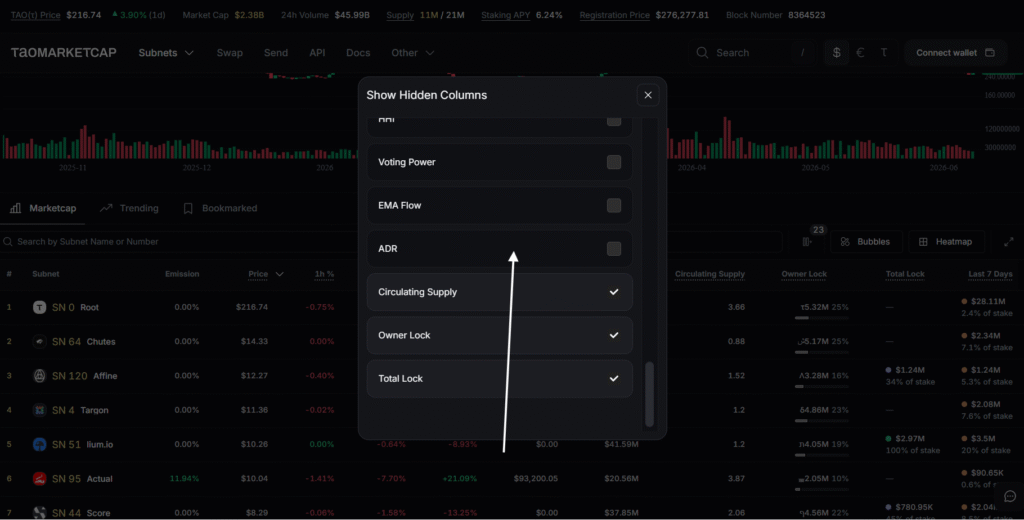
2. Scroll Till You See ADR, and Select It
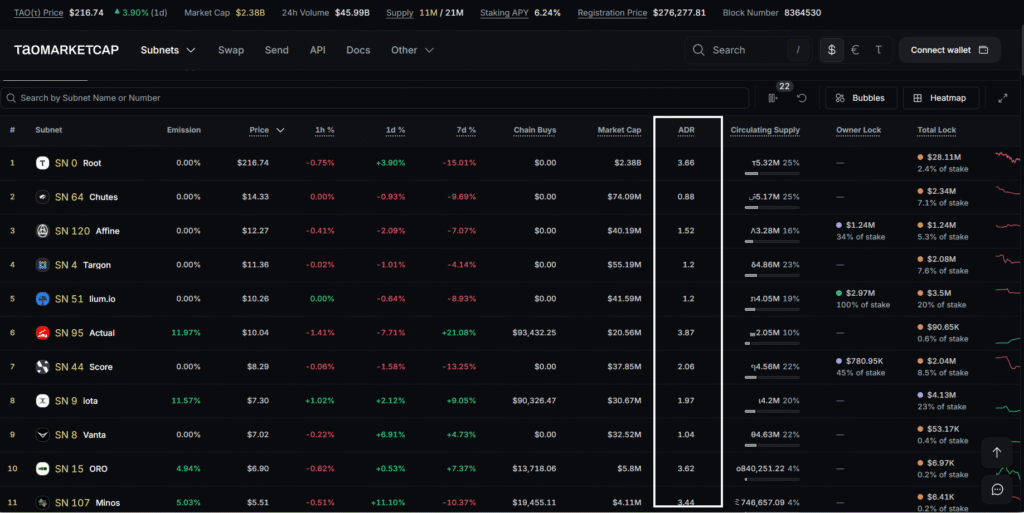
3. A Designated Column For ADR Comes Up, and Users Can Scroll to Subnet of Interest
How ADR Affects Deregistration
ADR has direct consequences during subnet deregistration. When a subnet is deregistered, the $TAO held in its pool is distributed proportionally across $ALPHA stakes.
The ratio determines what holders receive relative to the prevailing alpha price:
a. When ADR is Below 1: the pool holds more liquidity relative to circulating $ALPHA. During liquidation, holders receive more $TAO per $ALPHA than the current spot price would suggest.
b. When ADR is Above 1: the pool holds less liquidity relative to circulating $ALPHA. Liquidation occurs at a discount to spot price, and holders receive proportionally less $TAO.
Under the current protocol, only subnets with ADR below 1 are eligible for deregistration. The worst-performing subnets are subject to weekly withdrawal cycles.
Implications for Participants
For participants evaluating subnet positions, ADR provides information that should be considered alongside price performance and demand indicators:
a. Growth in $ALPHA price relative to $TAO across multiple timeframes confirms underlying demand.
b. ADR below 1 indicates the pool retains sufficient liquidity to support holder positions during a deregistration event.
c. ADR above 1 indicates a thinner liquidity cushion, with greater exposure to price impact during large sell flows and a steeper liquidation discount if the subnet is deregistered.
Participants staking $TAO into subnet positions should review the ADR alongside other metrics to assess both demand and exit conditions.
Summary
ADR is a structural metric that describes the relationship between circulating alpha supply and pool liquidity. It is not a demand signal in isolation, and it should not be interpreted as one.
The most accurate read of any subnet position requires evaluating ADR in combination with price performance, emission dynamics, and the protocol’s deregistration rules.
A complete understanding of ADR allows participants to assess both the upside and the structural risks of their positions with greater precision.
Enjoyed this article? Join our newsletter
Get the latest TAO & Bittensor news straight to your inbox.
We respect your privacy. Unsubscribe anytime.
Enjoyed this article?
Join our newsletter
Get the latest TAO & Bittensor news straight to your inbox — every morning before markets open.



No comments yet — be the first.