


Three Bittensor releases shipped between June 23 and June 25 are one coordinated upgrade rather than three separate ones, and the throughline is that the chain changed how it decides which subnets earn emissions. The old system rewarded subnets based on $TAO flowing in and out of them.
The new system rewards them based on the price of their subnet ‘$ALPHA’ token and whether they are running real mining. The upgrade affects subnet owners and active traders only, leaving regular $TAO and $ALPHA holders, wallets, and everyday interfaces untouched.
The Three Releases Across 48 Hours
The rollout happened in three steps, with the final production version landing two days after the initial push.
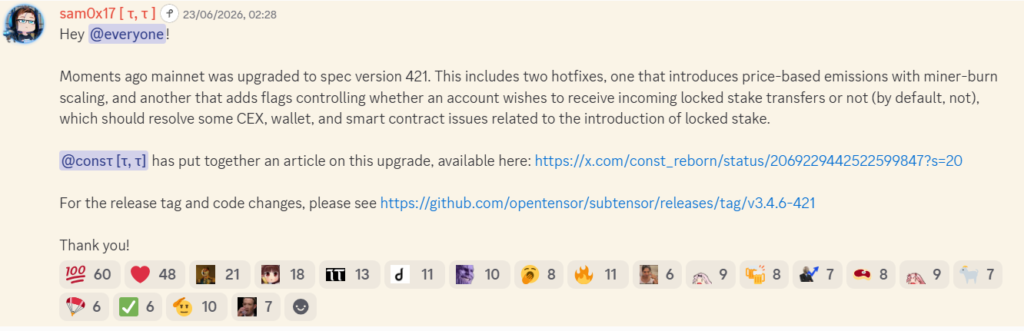
1. Release 421 on June 23: The fast push of the new emission model.
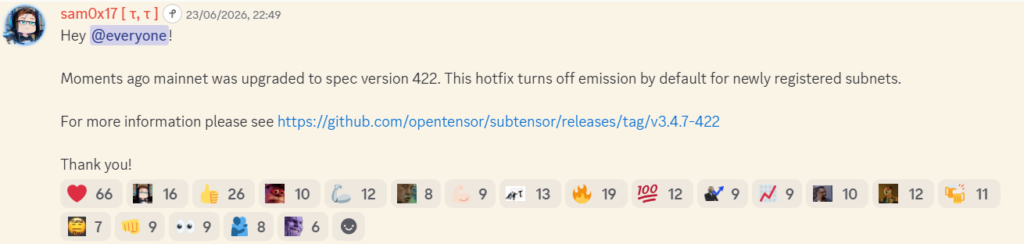
2. Release 422 later on June 23: New subnets now register with emission turned off by default.
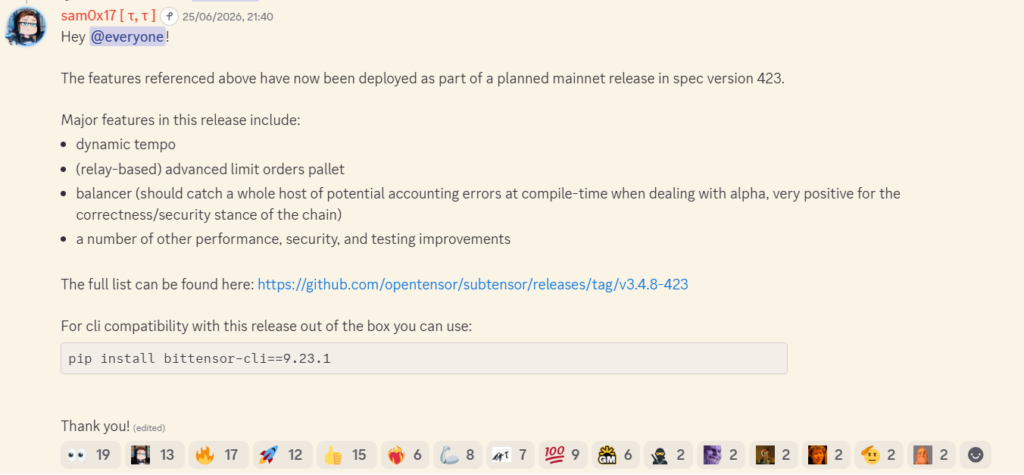
3. Release 423 on June 25: The big consolidated release of roughly 41 changes, containing the production version of the emission switch alongside governance updates, configurable tempo, limit orders, and several fixes.
The emission switch is the core change, with the consolidated release providing the production-grade version the chain runs on indefinitely.
How The New System Works
Three pieces combine to determine how much emission each subnet earns:
1. Price: Each $ALPHA price is the main driver, smoothed over time so short-term spikes do not move it. A higher price earns more.
2. Root Proportion: A factor tied to how much $TAO is being routed back to $TAO holders versus how much $ALPHA the subnet has issued. As a subnet matures and issues more $ALPHA, this factor decreases, giving newer subnets an on-ramp while requiring older ones to keep earning rather than coasting on size.
3. Active Mining Gate: A factor controlled by validators that decides whether a subnet’s mining is real. Burning miner rewards now costs the subnet chain emission as well. Real mining keeps full emission, and faked mining gets switched off.
Oversight tooling exists for cases where validators themselves are inactive on a fake-mining subnet, allowing emissions to be cut from above. The chain provides the lever. Validators and oversight provide the verdict.
Why TaoFlow Got Replaced
TaoFlow scored subnets on a moving average of net flow, and moving averages carry memory that fades. That created a clean arbitrage cycle for anyone who owned multiple subnets:
1. Buy one of your own subnets to trigger the emission boost,
2. Sell out once the boost is captured,
3. Rotate to the next subnet you owned, and
4. Come back to the first one once its memory had faded enough to restart the cycle.
Cycling emission between your own subnets was a viable strategy under the previous system. Price-based emission removes the cycle because the trading pools are symmetric in how they reflect buys and sells, so a purchase and a sale move the emission vector equally and oppositely regardless of timing. The active mining gate inherits the same property because it is recomputed fresh every tempo with no historical memory.
What 48 Hours Changed
The coordinated rollout across three releases is the most substantial protocol upgrade Bittensor has shipped at one go, and the throughline is that the chain now rewards subnets for delivering value back to $TAO holders rather than for gaming capital flow.
Subnet owners and active traders feel the change directly, while everyone else sees no difference. The mechanism gives newer subnets an easier on-ramp and forces incumbents to keep earning, with the active mining gate ensuring that subnets pretending to do work no longer get paid for it.
Enjoyed this article? Join our newsletter
Get the latest TAO & Bittensor news straight to your inbox.
We respect your privacy. Unsubscribe anytime.
Enjoyed this article?
Join our newsletter
Get the latest TAO & Bittensor news straight to your inbox — every morning before markets open.


No comments yet — be the first.