

A tech-heavy week for Bittensor, featuring model releases, infrastructure wins, and distribution moving in the right direction.
Here’s the rundown.
Subnet updates
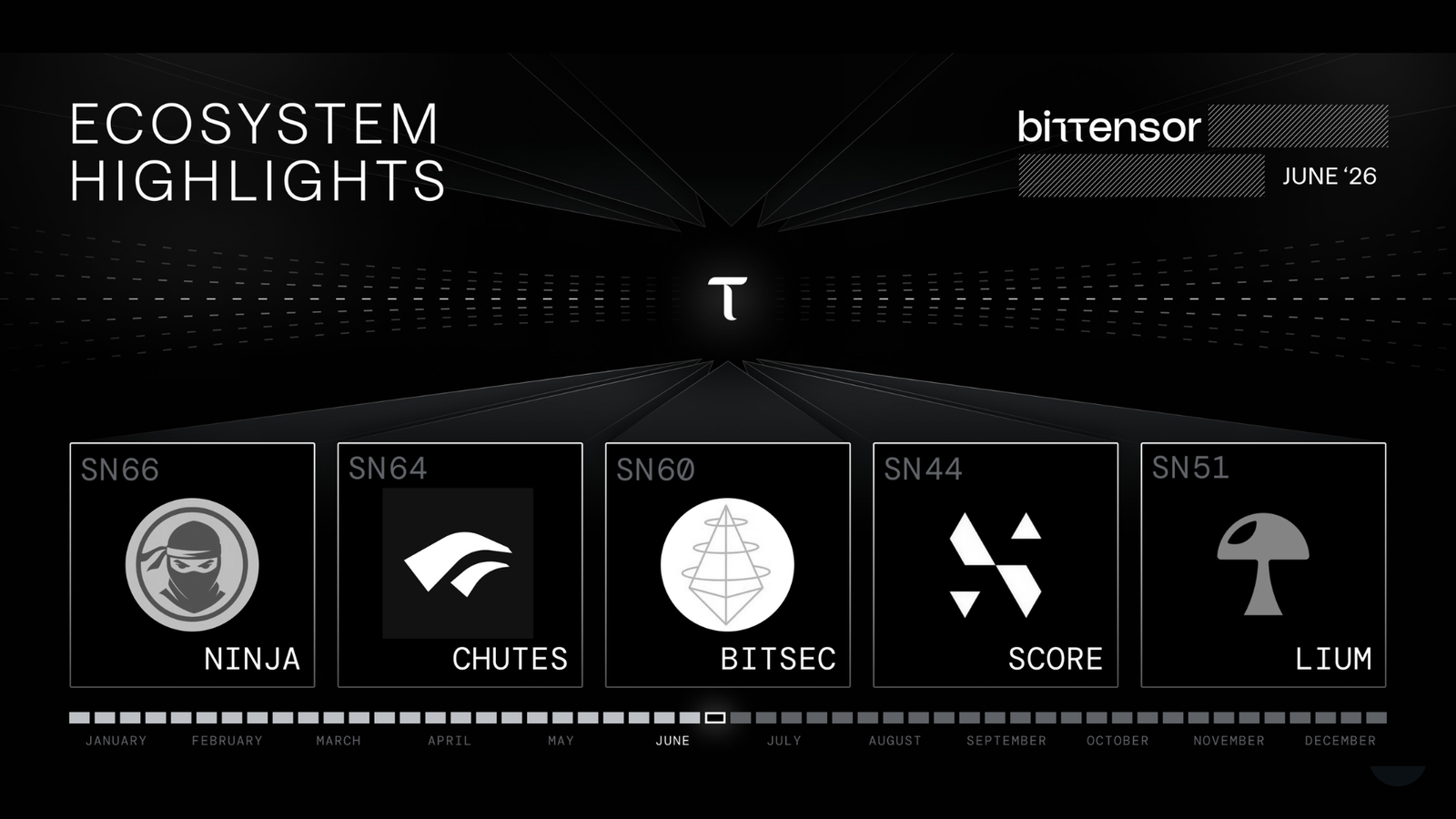
Chutes (SN64) had the busiest week. The team became a built-in provider in TypingMind and shipped a VS Code extension for running Chutes models as coding agents (source, source).
Jon Durbin also shared new Parallax details and a diffusion-draft pipeline showing 30–50% real-world decode performance gains on Gemma-4 31B and Qwen3-6-27B (source, source).
Ninja (SN66) launched Katana, an agentic IDE and Bittensor-native workspace for research, mining workflows, code shipping, and validator debugging (source).
Score (SN44) announced Satori 1.0, its first ~2B VLM — distilled from larger models to handle nine vision primitives — and shared plans to train future versions on SN44 using Teutonic SN3’s mechanism (source, source).
Bitsec (SN60) outperformed Fable 5 on a security audit, finding 160+ vulnerabilities — including five criticals and ten highs that Fable 5 missed (source).
Lium (SN51) completed a 2,500 TAO buyback and burn into SN51, funded entirely by revenue from GPU credit purchases (source).
Quasar (SN24) launched its 10T-token incentive mechanism, starting with a 5T-token target and support from Gradients on post-training and RL (source, source).
Minos (SN107) launched MinosVM 2.0 on Targon, with native AI assistant support for miners (source).
Affine (SN120) moved its base model to Qwen3.6-35B-A3B, with new champions pushing benchmark scores higher across Memory, NavWorld, SWE, and Terminal (source).
Ditto (SN118) launched its mobile app on Google Play and the Apple App Store (source).
Beam (SN105) successfully transferred 50GB in ~51 seconds across multiple sources and R2 destinations — roughly 5x the data of its earlier benchmark in similar time (source).
Apex (SN1) redesigned its website with dedicated agent profiles to showcase user contributions, peer activity, and status across SN1 (source).
Takeaway
Chutes’ diffusion-draft pipeline delivering 30–50% real-world decode gains is the kind of incremental performance win that compounds. Bitsec catching critical vulnerabilities a frontier-model audit missed is a pointed reminder that decentralized, specialized systems can outperform centralized generalists on the right problems. And Lium funding a 2,500 TAO buyback from organic revenue, alongside Quasar moving into its serious training phase, is more of the same pattern: subnets behaving like businesses, with the cash flow to back it up.
On to next week.
Enjoyed this article? Join our newsletter
Get the latest TAO & Bittensor news straight to your inbox.
We respect your privacy. Unsubscribe anytime.
Enjoyed this article?
Join our newsletter
Get the latest TAO & Bittensor news straight to your inbox — every morning before markets open.



No comments yet — be the first.