

Crypto has spent years building new blockchains, assets and financial tools. Allways (SN7) is working on the layer that could make them function as one connected market, allowing users to exchange native assets across networks without relying on wrapped tokens or traditional bridges.
In a conversation with Gordon Frayne, Grant El-Deir, co-founder of Ventura Labs and lead staff behind Allways, explains how the project has evolved from a permissionless solver network into a broader exchange platform.
He also discusses the lessons the team learned from its early approach to liquidity, its growing focus on user acquisition, and why he believes AI agents could become major users of cross-chain infrastructures.
From mining to building on Bittensor
Ventura Labs began in 2024, when Grant and a friend started mining Bittensor at a time when the network had only eight subnets. Their first involvement was with Subnet 8, which initially focused on Bitcoin price prediction before evolving into what became PTN (Proprietary Trading Network).
As the ecosystem grew, so did Ventura Labs’ involvement. The team moved beyond mining into validation, trading dynamic TAO markets, podcasting and eventually acquiring subnets. It now operates across several parts of the Bittensor ecosystem, including Allways (SN7) and Gittensor (SN74).
That experience also gave Grant a close view of how subnet incentives shape miner behaviour. In Bittensor’s earlier days, competition was limited, but the introduction of stronger economic incentives brought more miners and increasingly aggressive strategies.
Grant argued that many behaviours described as exploits were miners responding to the incentives they had been given, even when those actions did not match the subnet owner’s intentions.
Over time, subnet developers improved their code and incentive systems, making it easier to reward the behaviour they precisely wanted.
That experience with incentives and competition now informs how Ventura Labs approaches building and operating Allways.
Allways is a marketplace for native assets, not a bridge
Grant’s central idea is that people will continue using different blockchains. As tokenized stocks, stablecoins, subnet tokens and other digital assets expand, users will need to move between networks without losing access to the native assets those networks use.
This is where Allways comes in. It aims to facilitate exchanges from any asset to any other asset, including routes such as Bitcoin to Ethereum or a tokenised stock on Solana to a Bittensor subnet token.
Unlike traditional bridges, which commonly deliver wrapped representations of assets on another chain, Allways aims to deliver the actual native asset the user wants to receive.
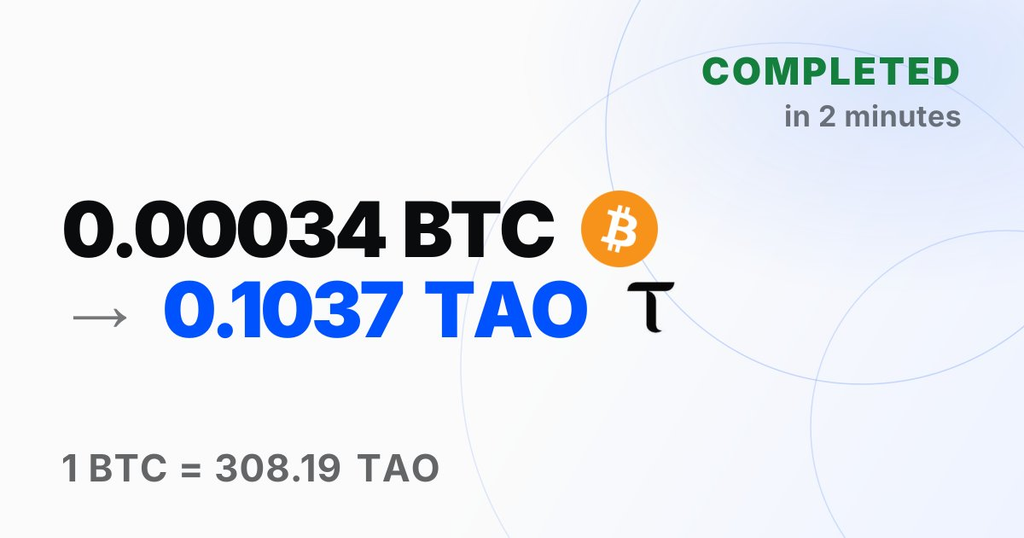
Its model is built around a direct exchange:
1) Choose the assets: The user selects the asset to send and the asset they want to receive.
2) Review the rate: Allways presents an available exchange route and the expected output.
3) Send the asset: Funds move from the user’s wallet to the selected provider.
4) Receive the asset: The provider delivers the requested native asset to the destination wallet.
Allways says it does not take custody of user funds, allowing users to either choose a walletless flow by entering the relevant addresses or connect wallets for a more streamlined experience.
During the conversation, Grant demonstrated a SOL-to-TAO swap and another exchange from TAO into tokenised Tesla stock on Solana, showing how a user could complete exchanges that would otherwise involve several separate steps across different networks.
The underlying system has evolved. Allways originally used its own permissionless solver network where miners posted collateral tied to the size of the transactions they could handle, quoted rates and fulfilled swaps with a financial incentive to complete the exchange alongside independent verification of the transaction legs and a mechanism for handling failed delivery.
The current version takes a different route by aggregating rates and execution from existing providers, including networks such as NEAR Intents, and presenting those options to users.
Grant said the team still wants to bring more permissionless competition into the backend once they build a product with enough demand to support it.
That is a practical change in priorities, since users want a reliable exchange and a competitive rate and are unlikely to choose a product simply because its backend is decentralised.
The lesson that changed Allways’ strategy
Allways initially believed that offering the best rates would be enough to attract users, as Grant said the team built competitive markets for assets such as USDC across eight blockchains and TAO, with rates he believed could beat those available on centralised exchanges, yet the platform struggled to get users.
The team realised that creating supply was easier than creating demand, since having miners ready to fulfil swaps meant little if people did not know the platform existed or had no reason to use it.
Allways has therefore shifted its mining incentives toward user acquisition, allowing participants to generate referral links and earn compensation when the people they bring to the platform use it.
This gives miners a more accessible way to contribute in the current phase, because they do not all need to set up complex infrastructure or compete to fulfil swaps when they can help bring real activity to the marketplace instead.
Grant sees this as a broader lesson for Bittensor projects that a strong technical product still needs distribution, given that building the service is only part of the work while finding the people who will use it is another challenge entirely.
Why Allways is preparing for AI agents
The project is also being designed for a future in which software agents handle more financial activity, as Grant expects agents to become a major source of transaction volume, which will require them to control wallets, exchange assets and interact with different blockchains without relying on a human to complete every step.
Because traditional centralised financial services often depend on identity checks and human account ownership that can create friction for autonomous agents operating their own wallets, Allways wants to provide the native-asset exchange infrastructure they would need.
To enable this, the project is developing agent-facing access through its public API, command-line tools and dedicated documentation, while Grant also discussed plans for MCP support, including integrations with tools such as Claude, so agents can request quotes, reserve swaps and settle transactions programmatically.
The same infrastructure remains useful to people making swaps today. The difference is that Allways is preparing its exchange layer for both human users and software that may eventually transact at a much larger scale.
One interface for a multi-chain future
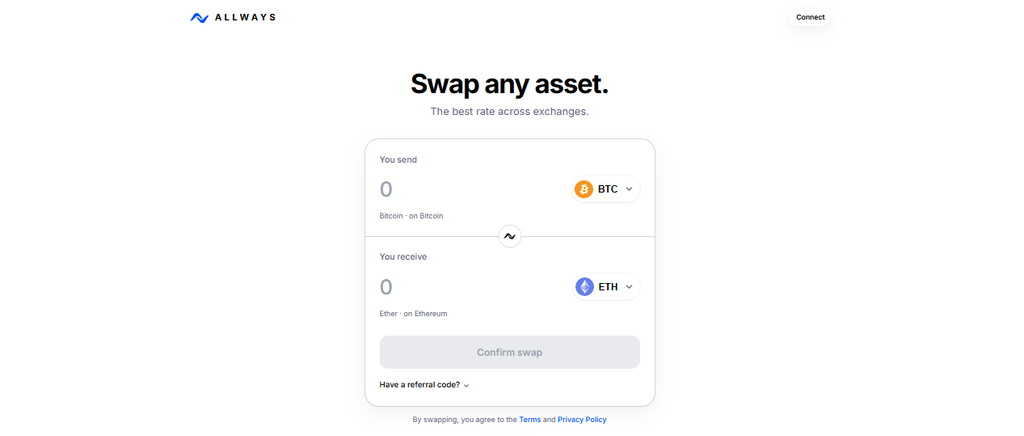
The immediate goal is to make crypto easier to navigate, as Grant wants users to stop worrying about which wallet holds an asset, which network requires gas, or how many steps are needed to exchange one token for another.
He said the team was working toward a unified platform that could bring multiple wallets and blockchains into one experience, with a launch expected around December 2026.
This supports a wider vision to make crypto more useful as a medium of exchange, since Grant sees Bitcoin as having established its role as a store of value while everyday use of digital assets still faces practical obstacles that Allways wants to close by making native assets easier to exchange and use across networks.
Although there is still work ahead as the project needs to attract more users, expand its provider network and continue developing the permissionless side of its marketplace, its direction remains clear as one place to exchange assets that live across many chains without asking users to become experts in how each network works.
≫ Read more about our earlier coverage on Allways (SN7) below:
Enjoyed this article? Join our newsletter
Get the latest TAO & Bittensor news straight to your inbox.
We respect your privacy. Unsubscribe anytime.
Enjoyed this article?
Join our newsletter
Get the latest TAO & Bittensor news straight to your inbox — every morning before markets open.

No comments yet — be the first.