


The Ventura Labs team came up during this Novelty Search’s media chat to walk through two very different subnets they are operating, and the thread connecting them is more interesting than either alone.
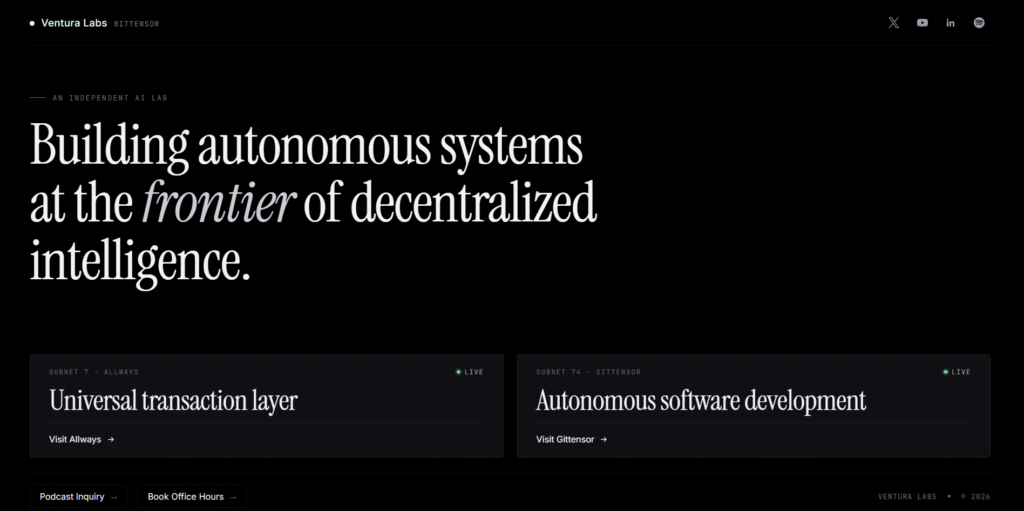
Gittensor (SN74) has evolved from a permissionless (Pull Request) PR-mining experiment into something that may absorb the need for many specialized optimization subnets. Allways (SN7) launched six days before the call and is proposing to do for transactions what Gittensor is doing for code.
Both share the thesis that Bittensor’s substrate is general enough that entire categories of subnet logic can be collapsed into single repos or single transaction flows.
Gittensor (SN74): From PR Bounties to a Meta-Platform
Gittensor started as a permissionless subnet rewarding miners for submitting merged pull requests. The early version pointed miners at roughly 4,000 repos, since narrowed to 10, with throughput accelerating after maintainer responsiveness was tightened on a few owned repositories.
What miners have actually shipped:
a. First and second place at the Sentient Hackathon, with no code written by the team itself.
b. ~50 merged PRs into OpenCloud from a single top miner.
c. Self-built upgrades to Gittensor itself, with issues posted and miners shipping implementations.
Quality is enforced through an 80% PR merge ratio for emission eligibility, which forces human-agent hybrid workflows since pure spam loses credibility fast.
The Vision: One Repo Could Replace an Entire Subnet
Per-repository hyperparameters now let each repo define its own reward function:
a. Most recent merged PR wins all emissions, ideal for benchmark-driven optimization repos.
b. Credibility thresholds tune per repo based on velocity versus social context.
c. Maintainer cuts reward whoever gates PRs, not just miners producing them.
d. Smart contract repository lists are being designed so alpha holders can direct emission toward specific repos.
The implication is that optimization subnets are sophisticated ways of deciding whether code should be merged.
If Gittensor hosts that decision logic at the repo level, a single repo structurally replaces what currently requires a full subnet. One repo of Gittensor becomes one subnet.
Allways (SN7): A Universal Transaction Layer With No Bridges
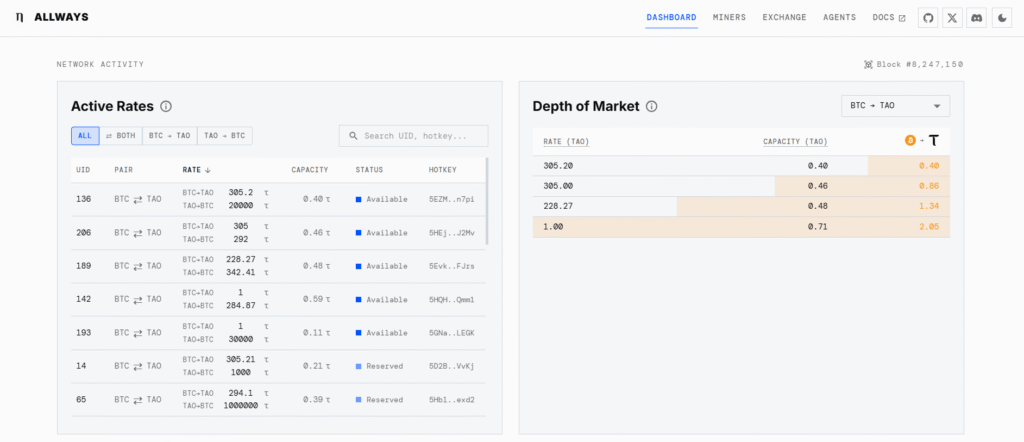
Allways launched on mainnet six days before the call, currently supporting $BTC and $TAO. The end goal is that miners can compete to fulfill any input-to-output asset transaction, with the user specifying the destination and the miner optimizing the path.
Miners are scored on three dimensions:
a. Credibility, the percentage of transactions completed.
b. Speed, how quickly they settle.
c. Best rate, since miners route through whichever exchange offers the most favorable conversion.
The trust mechanism:
a. Every transaction is over-collateralized through a smart contract.
b. Failed transactions get slashed and the user reimbursed automatically.
c. Slippage protection locks in the agreed rate to prevent mid-transaction attacks.
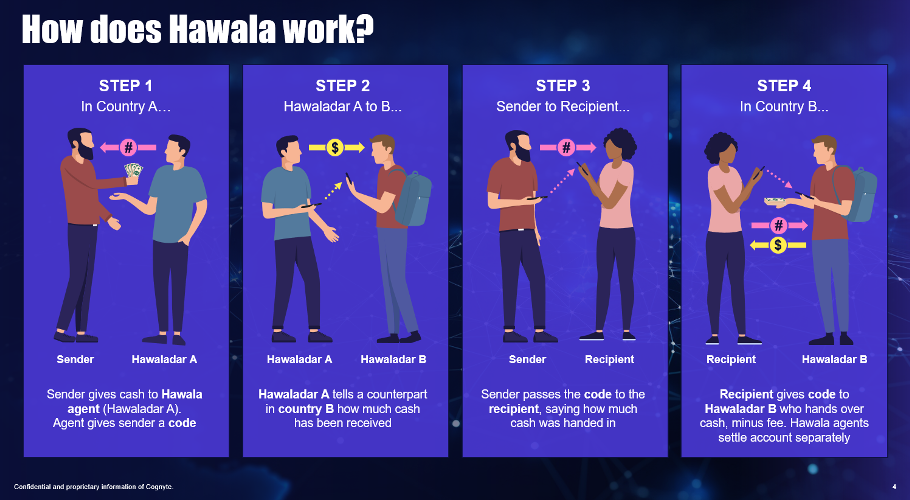
Underneath, this resembles a Hawala system. Miners maintain exchange accounts and stablecoin reserves across platforms, so a $TAO-to-$USDT-on-Tron transaction never requires an on-chain bridge.
The miner uses existing balance on the destination chain and pockets the difference.
Why Both Projects Point at the Same Thesis
The endgame for Allways is holding all wealth in $TAO and transacting against any asset, anywhere. The pain points it targets:
a. Banks can freeze accounts.
b. Centralized exchanges can block trades.
c. Payment processors can deny transactions.
d. Bridges introduce trust assumptions that defeat peer-to-peer transfer.
The structural connection:
a. Gittensor absorbs optimization subnets into individual repos.
b, Allways absorbs cross-chain transactions into miner-fulfilled trade flows.
However, it is important to note that both subnets rely on the assumption that a measurable reward function plus slashing is enough to let the market handle the rest.
What This Really Means
The most ambitious subnets are being built as substrates capable of hosting other people’s subnet logic, without requiring a new subnet for every optimization problem.
If either model proves out, the question for new builders shifts from “what mechanism should I design” to “which existing subnet can host my mechanism.”
The next few months will tell whether either project gets there, but the framing alone is worth tracking.
Read More on How: Ventura Labs Steps Into the Builder’s Arena, Acquires Two Bittensor Subnets
Enjoyed this article? Join our newsletter
Get the latest TAO & Bittensor news straight to your inbox.
We respect your privacy. Unsubscribe anytime.
Enjoyed this article?
Join our newsletter
Get the latest TAO & Bittensor news straight to your inbox — every morning before markets open.



[…] (SN7) from Ventura Labs closes that gap with a browser-based exchange that gives the Solana community a direct path to […]