

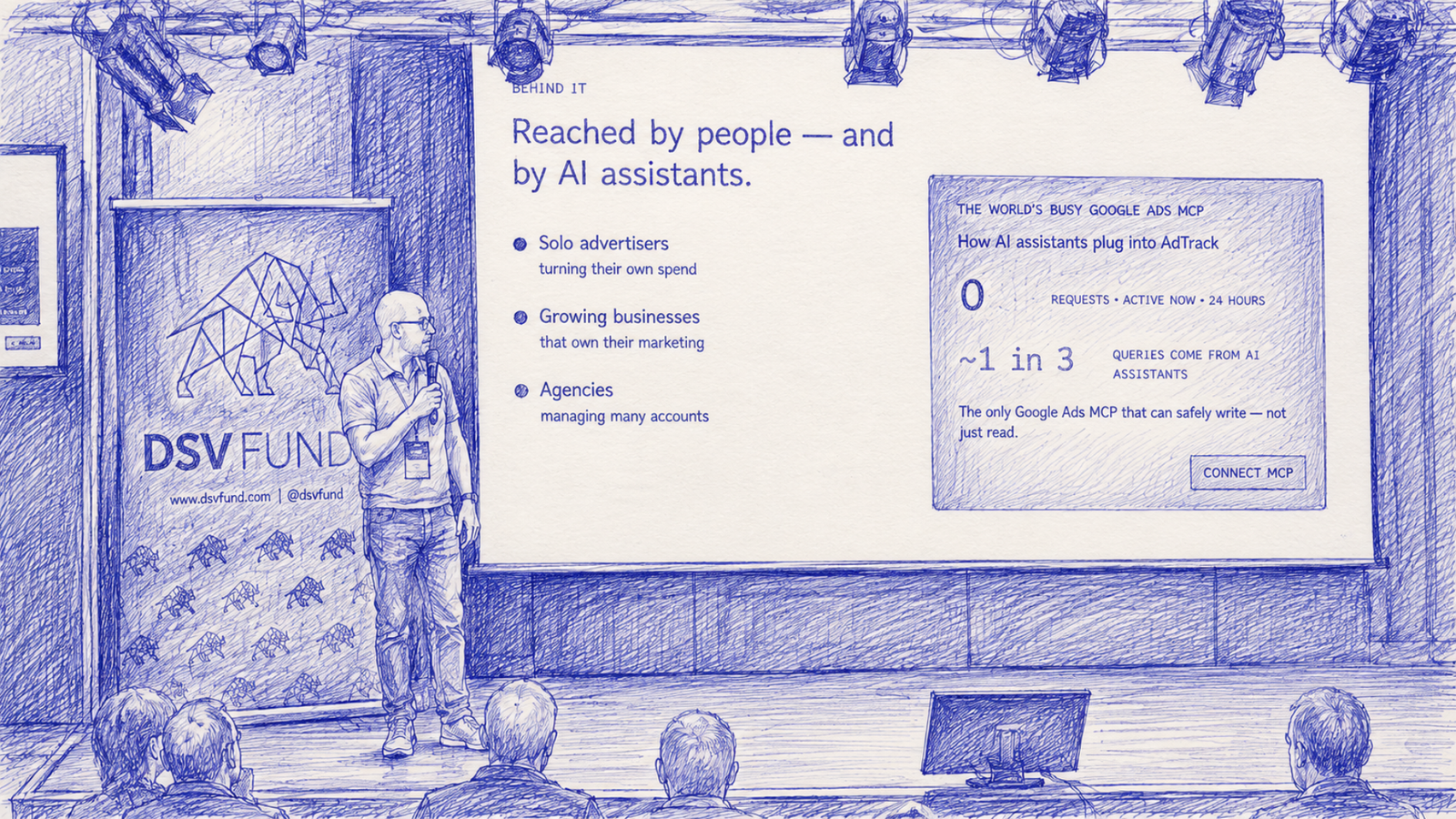
AdTAO (SN21) took the stage at Inside Bittensor (a Bittensor event organized by Siam Kidd’s DSV Fund) to explain why the $300 billion Google Ads market still runs on folklore and how the subnet’s prediction layer is being built to change that.
Google itself holds the data that could fix the market, but its casino-style model rewards keeping chairs filled and spending high rather than helping any advertiser actually win.
AdTAO entered Bittensor with an evidence layer already covering 20,000+ Google Ads accounts and three years of data, delivering roughly 20% uplift before miner competition even started. Five weeks in, the team has shipped five prediction models with on-chain results verification launching in August.
What the Session Covered
The presentation moved through the structural failure of the $300 billion Google Ads market, the evidence layer AdTAO brought into Bittensor, and the roadmap that turns the subnet into a prediction engine no incumbent can match.
1. Google Ads is a $300 billion market still operating as a wild west 20+ years in. The industry has never systematized despite the scale, with client accounts still run by generalists who have managed maybe ten accounts and call it experience. Google itself sits on $130 billion in cash reserves protecting the revenue stream.
2. The information asymmetry between Google and advertisers is structural. Google can run statistical tests in one corner of its ecosystem and have a valid answer by lunchtime. Practitioners running client accounts have data so fragmented that even skilled operators cannot draw statistically meaningful conclusions from it.
3. Google Ads runs on a casino model. The platform’s incentive is to keep chairs filled at the table and keep players spending as long as possible. Whether any individual advertiser wins or loses is irrelevant provided the overall take stays high, which puts the party with the most data in direct opposition to the party paying for the media.
4. AdTAO’s evidence layer predated Bittensor. The team built a proprietary data corpus covering 20,000+ live Google Ads accounts across three years, codified into a system that shows advertisers how they compare against competitors and where the fixes need to land.

5. The evidence layer alone delivers roughly 20% account performance uplift. For an advertiser spending $10K to $50K monthly, that difference determines whether a campaign is profitable or not, which is why the team already had a working business before entering Bittensor.
6. Bittensor was chosen specifically for prediction. The problem the team wanted to solve was knowing what any given change would do to an account before making it, and that required a decentralized ML network capable of running thousands of prediction experiments in parallel rather than a single academic collaboration.
7. Bittensor delivered in five weeks what academia would have taken 18 months to attempt. Five prediction models across five different aspects of Google Ads performance are already live, providing 7, 14, and 28-day change forecasts before any real spending happens.
8. Three revenue models sit on top of the technology. Subscription software with currently vetted access, a done-for-you service at roughly 80% margins (compared to 10% at a typical agency), and an embed model that replaces 75% of an agency’s staff while sharing upside with the owner.
9. The business is profitable with real commercial traction. $500K+ ARR, 87% margins, ten US franchise brands signed, and 50 internal beta testers running the tool. June revenue grew roughly 20% month-over-month, with monthly Alpha buybacks scaling as profits grow.
10. August 1st ships on-chain verifiable results unprecedented in marketing technology. Every AdTAO client outcome will be published as a before/after comparison verifiable on-chain, shifting the industry standard from unfalsifiable claims like “we averaged 20% better” to case-by-case proof.
The Standard AdTAO Is Setting
A subnet does not need to invent a new market to work on Bittensor. It needs to find a market where information asymmetry structurally punishes the participants paying the bills, then build a data and prediction layer the incumbent cannot or will not offer.
Google Ads is that market at $300 billion in scale, and AdTAO already had a profitable business demonstrating the thesis commercially before entering the network. The vision from the stage was direct: within a few years, running Google Ads without AdTAO data will be an act of negligence for anyone spending real money on campaigns.
For a subnet with $500K ARR, 87% margins, and on-chain verifiable client outcomes shipping in August, that ambition is closer to a roadmap than a marketing line.
Enjoyed this article? Join our newsletter
Get the latest TAO & Bittensor news straight to your inbox.
We respect your privacy. Unsubscribe anytime.
Enjoyed this article?
Join our newsletter
Get the latest TAO & Bittensor news straight to your inbox — every morning before markets open.


No comments yet — be the first.