

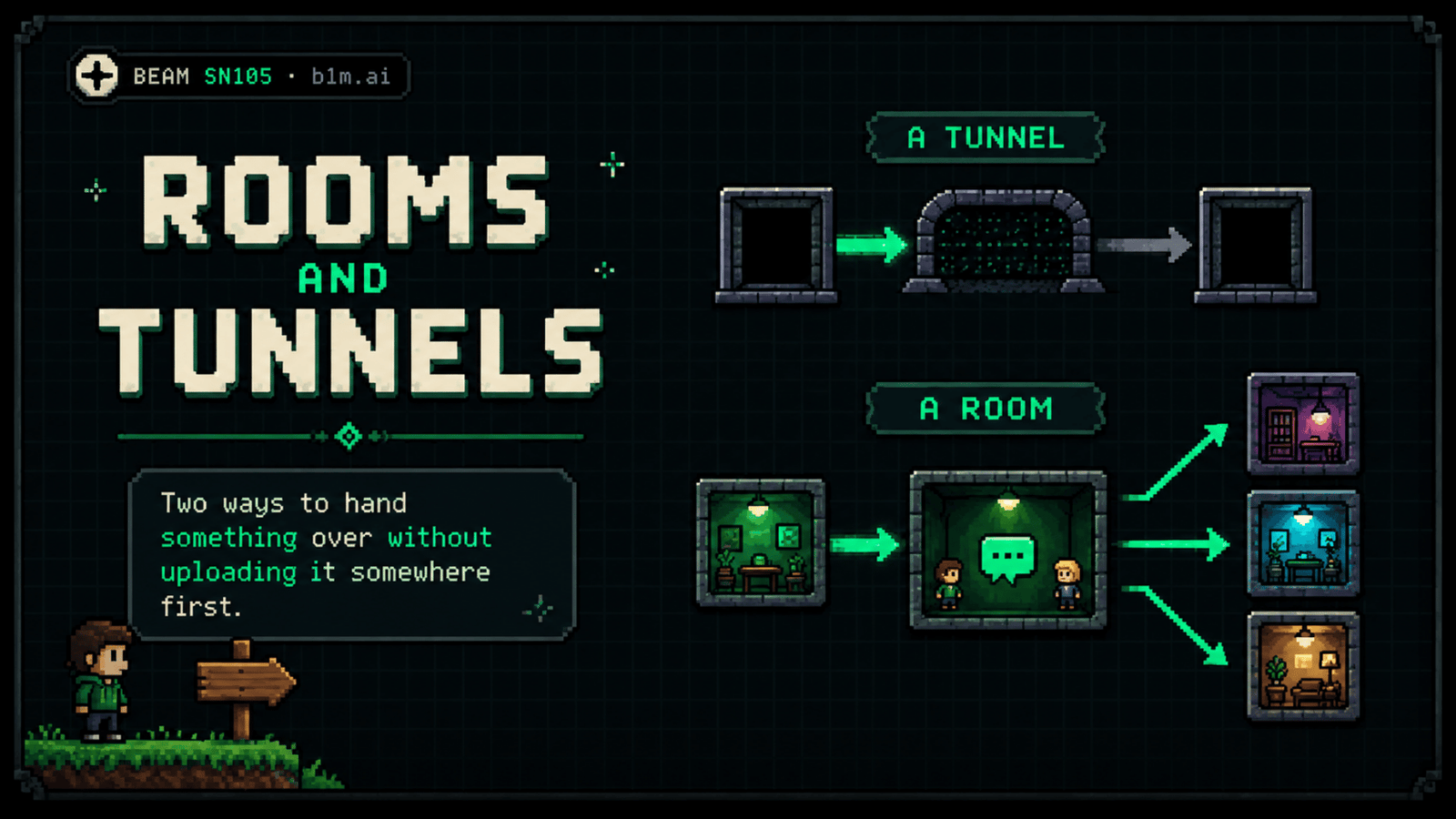
A file lives on your laptop, and someone else needs it. Sending it usually means uploading somewhere first, waiting through two transfers, and leaving a copy sitting on infrastructure nobody controls afterward.
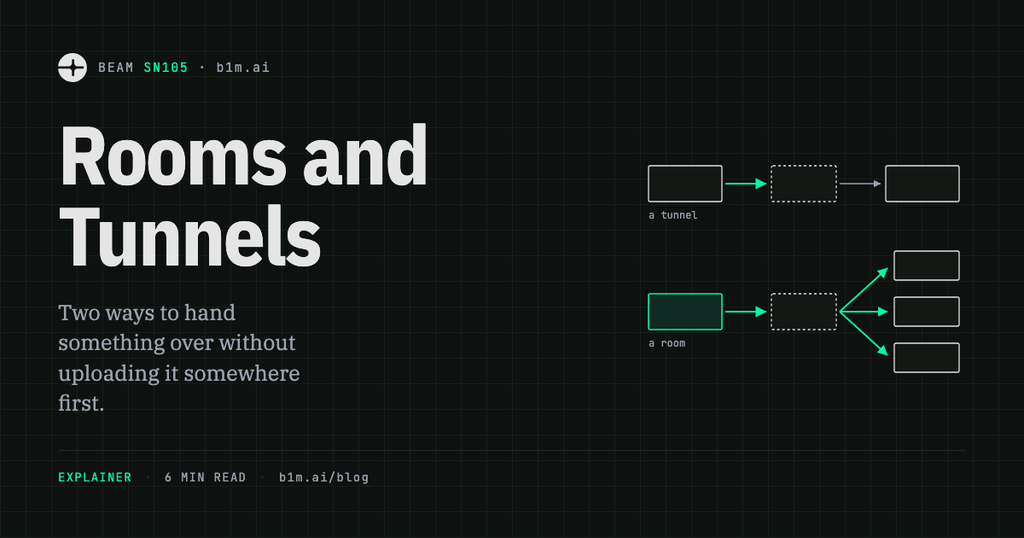
BEAM (SN105) removed that middle step with Rooms and Tunnels, a real-time transfer layer where data moves once between the machines that need it. Tunnels give one thing on your device a public web link, while Rooms create private groups where members send files directly to each other.
How Rooms Work
A room is a private group of machines whose members send files back and forth without any central storage layer holding copies in between.
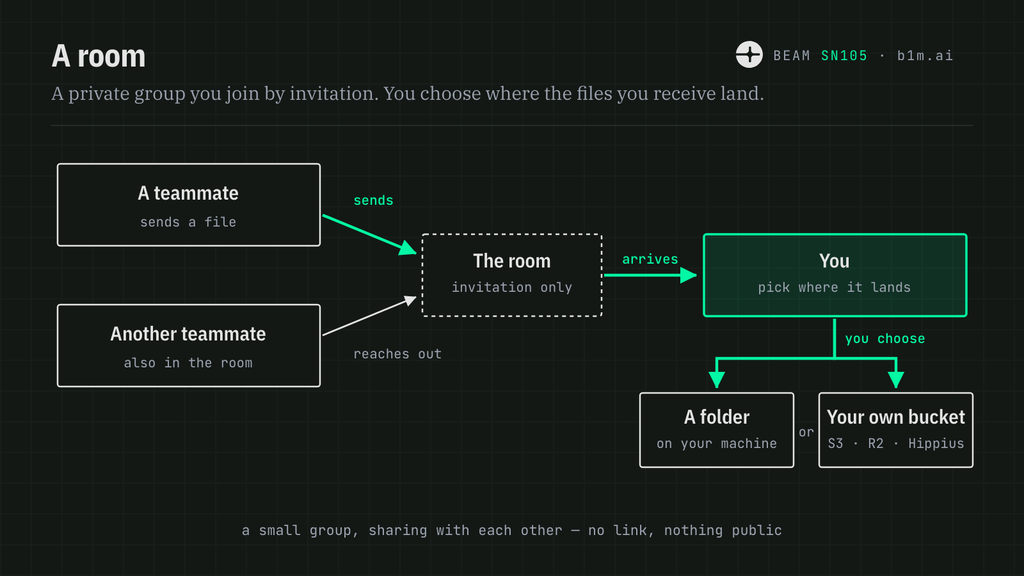
1. Someone creates the room and invites specific participants: Invitations are single-use and expire, so nobody joins just by knowing the room name.
2. Any member can send files to any combination of other members: Delivery runs any-to-any, as against one-publisher-to-many-subscribers as most sharing tools operate.
3. Broadcasting delivers the same payload to every participant simultaneously: Adding a fifth machine adds capacity by not making the four existing members wait longer.
4. Recipients choose where arriving files get stored: A local folder works, or the payload can flow straight into an S3 bucket, Cloudflare R2, or Hippius storage.
5. Servers, build machines, and AI agents can hold membership too: Rooms extend past human users into full fleets exchanging work without shared credentials floating around.
Rooms suit teams that keep trading work between the same set of machines rather than one-off exchanges.
How Tunnels Work
A tunnel exposes one specific thing on your computer through a web link anyone can open in a browser or script.
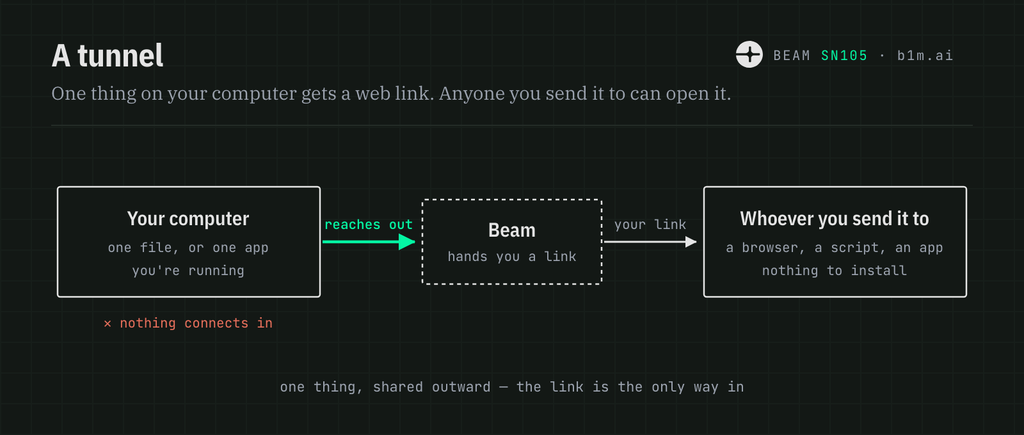
1. You pick the file, folder, or app to expose: Everything else on your device stays invisible from the outside with no browsing possible beyond what you named.
2. BEAM returns an ordinary web link back to you: The person receiving it needs no account, install, or BEAM credentials of their own to fetch.
3. Your computer reaches out to BEAM, instead of accepting incoming connections: No port to open, no firewall change required, no address handed to the outside world.
4. Whoever holds the link can pull what you shared: Treat the URL like a password since anyone with it gets access until you close the tunnel.
Tunnels fit one-time handoffs, quick demos of local work in progress, or letting another service pull data straight off your machine.
Tunnel Versus Room at a Glance
The two surfaces solve different problems, and picking between them starts with whether the transfer flows outward or stays inside a group.
| Dimension | Room | Tunnel |
| Who can access | Only invited members | Anyone with the link |
| Requirements | BEAM CLI or Studio plus an invitation | Browser, script, or HTTP client |
| Direction of flow | Everyone shares with everyone | You share one thing outward |
| Duration | Until you leave the room | Until you close it |
| Best use case | A group trading work continuously | One handoff to one person, once |
Match the surface to whether outward reach or ongoing collaboration is the priority.
Bandwidth as a Programmable Resource
BEAM (SN105) has been running scheduled terabyte-scale transfers since launch, and Rooms and Tunnels extend the same infrastructure into real-time and multi-party workloads.
The expansion arrives under one phrase: bandwidth is now programmable, meaning developers script how data moves rather than picking between rigid transfer products.
Orchestrators and workers across the network need a short adaptation period to prepare for the new workload patterns arriving. Scheduled transfers continue running at full pace during the transition and are ramping up alongside the new capabilities.
➛ Access BEAM (SN105)’s Waitlist Here.
Enjoyed this article? Join our newsletter
Get the latest TAO & Bittensor news straight to your inbox.
We respect your privacy. Unsubscribe anytime.
Enjoyed this article?
Join our newsletter
Get the latest TAO & Bittensor news straight to your inbox — every morning before markets open.



[…] live 100-gigabyte bucket transfer finished in 1:10 minutes during Beam (SN105)‘s Novelty Search appearance. The team said scaling that same job to 1 terabyte could finish […]
[…] BEAM (SN105)’s Rooms and Tunnels Open a New Way to Move Files Directly […]
[…] BEAM (SN105)’s Rooms and Tunnels Open a New Way to Move Files Directly […]
[…] BEAM (SN105)’s Rooms and Tunnels Open a New Way to Move Files Directly […]