


In February 2025, McKinsey published a study on engineering simulation highlighting an interesting gap in the adoption of artificial intelligence. While two-thirds of surveyed engineering organizations had used AI or machine learning for simulation, only 5% were using these technologies at scale.
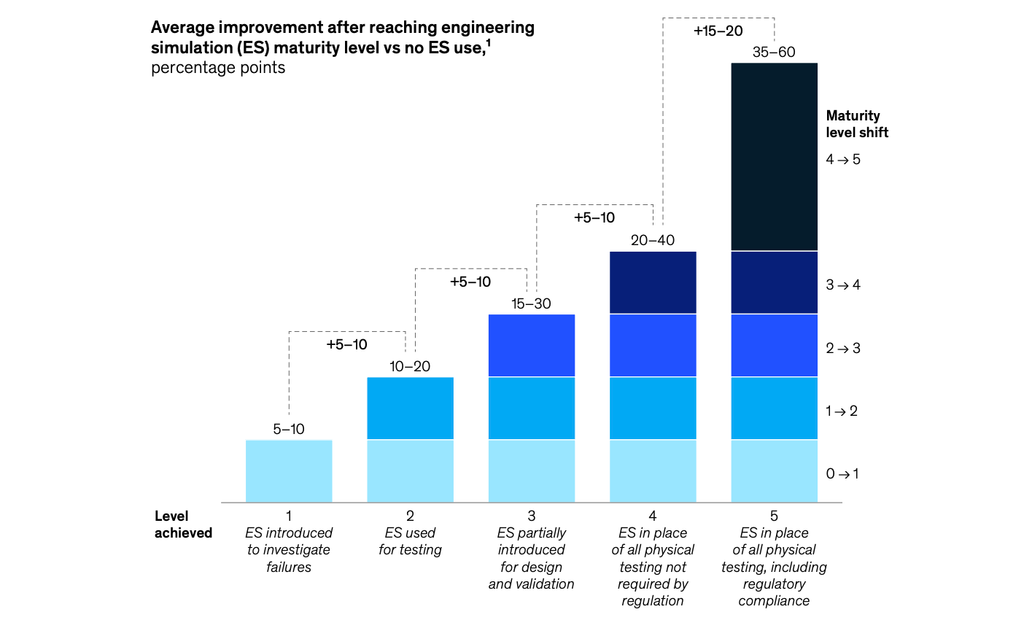
The opportunity is significant. AI models can help engineers simulate the behavior of physical products much faster than traditional methods, potentially reducing development costs and allowing companies to explore more designs. But getting these models into everyday engineering workflows remains a challenge.
Part of the problem is trust. An AI model might perform impressively in a research environment but struggle when tested against the specific operating conditions an engineer needs it to handle.
This is the problem Carbon, a Bittensor project operating on Subnet 116, is trying to solve.
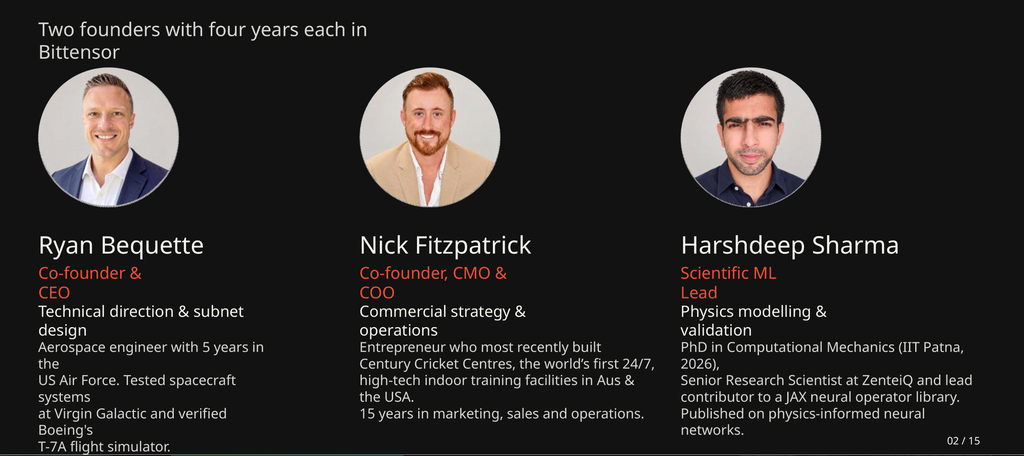
Carbon was co-founded by Ryan Bequette, a former engineer at the US Air Force, Virgin Galactic, and Boeing, and Nick Fitzpatrick, an entrepreneur with over 15 years of business experience. The team also includes Hiran Sen, who leads physics modelling and validation.
Carbon uses Bittensor miners to develop AI models for specific engineering problems, while validators independently test whether those models produce reliable results. Its initial commercial targets include motor design for robotics and cooling systems for AI chips.
The TAO Daily spoke with the Carbon team about how the subnet works, where it sees commercial opportunities, its plans to connect business revenue to subnet alpha, and what success should look like over the coming year.
The gap between faster simulations and reliable engineering
Before manufacturers build physical products, engineers typically run computer simulations to predict how different designs will behave. These simulations can take hours, making it expensive to evaluate hundreds or thousands of possible designs.
AI surrogate models offer an alternative. By learning to approximate the results of traditional physics simulations, they can produce predictions much faster.
Research published in Nature Reviews Physics in April 2024 examined how neural operators, a class of models used for scientific simulation, could dramatically accelerate computational tasks across applications including fluid dynamics, weather forecasting, and materials modeling.
But speed alone does not guarantee that a model is suitable for an engineering application.
Carbon sees two major obstacles to adoption: models that are too general for specific engineering problems, and insufficient evidence that their predictions can be trusted.
“A model can perform well in a research test and still fail under the conditions an engineer actually needs it for,” the team told The TAO Daily.
Carbon’s proposed solution separates model development from evaluation. Miners compete to create specialized models for particular engineering challenges, while validators independently test their performance against physics requirements, operating conditions, and scenarios designed to expose weaknesses.
The intention is to make AI models not only faster but useful enough for engineering companies to incorporate into their development processes.
How Carbon could help design a better robotic motor
To explain how this would work in practice, the team described a robotics company designing a motor for a robotic arm.
The motor needs enough strength to lift heavy objects while maintaining smooth movement at low speeds. Engineers must balance these requirements across different possible designs.
Detailed simulations could take hours for each design, limiting how many options the company can realistically explore.
Carbon would turn this into a competition. Working with the company, it would define the relevant design choices, operating conditions, and performance requirements.
Miners would develop AI models to predict motor performance, and validators would test those predictions against trusted simulations using hidden test cases.
A successful model could help engineers evaluate considerably more designs, identify promising candidates, and narrow the selection before conducting traditional simulations and physical testing.
“The value is giving engineers more room to explore,” the team said. “They could discover a better motor that their original time and computing budget would never have allowed them to find, while reducing the cost of getting there.”
This distinction matters. Carbon is not proposing that engineers abandon established methods of verifying physical products. Its models would help them explore more possibilities before committing resources to expensive testing.
Why Bittensor is central to the approach
Carbon could have pursued this opportunity as a conventional AI research company. Instead, it chose to build on Bittensor.
“Bittensor is the engine for the exact product Carbon needs,” the team explained.
The reasoning centers on competition. A traditional research organization is generally limited by the researchers it employs and the approaches they choose to pursue.
Bittensor allows Carbon to open that process to independent contributors around the world, providing incentives for miners to continuously develop better solutions.
Validators then evaluate those solutions against the requirements of the engineering task.
Carbon’s role is to define commercially relevant problems and design evaluation mechanisms that reward improvements customers can use.
“A traditional research company is largely limited to the team it hires and the approaches that team pursues,” the team said. “Bittensor lets us open that competition to contributors around the world, with ongoing incentives for improvements that stand up to independent testing.”
The challenge is ensuring that competition produces genuinely useful engineering models, not simply higher scores on a benchmark.
That is also how Carbon believes the subnet should be evaluated.
When we asked what the Bittensor community should watch over the coming months, the team identified three measures: whether its challenges reflect real engineering needs, whether models demonstrate independently tested improvements in accuracy, speed, and cost, and whether engineers begin using those models in real projects.
“We’re here to turn exciting research into serious value. Judge us on that.”
Finding commercial opportunities in robotics and AI computing
Carbon has identified several possible applications, including battery charging, electric motors, photonics, and AI-chip cooling.
However, the team is particularly interested in two near-term opportunities: motor design and cooling plate optimization.
In robotics, improved motor designs could enable stronger, smoother, and more energy-efficient movement.
For AI chips, better cooling plates could improve heat management while reducing the energy needed to circulate coolant.
Both applications involve balancing competing physical requirements, making them suitable for exploring many design possibilities.
“Motor design and cooling plate optimization are the two we’re most excited about in the near term because they address important engineering needs behind robotics and AI computing, with clear ways to measure whether a better design creates value,” the team said.
Carbon intends to focus on demonstrating results in these applications before expanding into other engineering problems.
The team also sees room to compete with established Physics AI companies such as PhysicsX, Neural Concept, and Siemens.
The team believes their decentralized research approach could make developing specialized models faster, more flexible, and more transparent. Its evaluation process is intended to give customers visibility into how models were built, where they perform well, and where their limitations lie.
Carbon could also complement existing engineering platforms by supplying specialized models or independently evaluating models already used by customers.
The challenge of winning engineering customers
Despite its ambitions, Carbon has not yet begun commercial engagements.
“We haven’t started commercial work yet,” the team confirmed.
However, the team isn’t approaching the market without industry experience. Founder Ryan Bequette has worked with potential customers in the engineering industry for over a decade, giving Carbon an existing understanding of the companies it hopes to serve, the problems they face, and the evidence they need before adopting new technologies.
The team believes its biggest obstacle will be earning customer confidence. Engineering companies need to know that a model can reliably handle their requirements and generate enough value to justify changing an established workflow.
Carbon is considering a freemium approach, where it would first develop something useful for a potential customer within a defined scope. The customer could evaluate the results before paying for further development.
The longer-term commercial opportunity lies in repeat business.
As the team explained, engineering companies typically have numerous problems they need to solve. Successfully addressing one could open the door to additional projects across the same company.
Connecting commercial revenue to subnet alpha
Beyond its engineering applications, Carbon intends to connect future commercial revenue to its subnet economy.
The team plans to allocate a portion of revenue toward purchasing SN116 alpha tokens.
The reasoning is that miners and validators are responsible for producing the models Carbon hopes to sell. Supporting the subnet’s token economy could therefore strengthen the incentives available to the contributors building those products.
“Our intention is to allocate a portion of commercial revenue to purchasing subnet alpha,” the team said. “That will connect demand for Carbon’s engineering products with demand for the subnet’s token.”
Carbon has not yet specified how much revenue would be allocated to purchases or when the mechanism would begin.
What the next twelve months should reveal
Over the next six to twelve months, Carbon wants to demonstrate that its competitive research process can consistently produce engineering models with practical value.
The first milestone is developing models that meet the accuracy requirements of specific engineering tasks while improving speed or cost compared with existing simulation tools.
The second is discovering novel model architectures through miner competition.
The third is building an intelligence product alongside each model, giving engineers useful information about where a model performs well, where it fails, and what trade-offs they should expect.
As the subnet tackles more engineering problems, it hopes to identify patterns in which model architectures perform best under different conditions. Over time, this knowledge could support APIs and SDKs that help engineers access suitable models without launching a new competition for every request.
Commercially, the team is targeting partnerships, initial customer projects, and eventually repeat business.
How an experiment on another subnet led to Carbon
Toward the end of our conversation, we asked Carbon founder Ryan Bequette what had originally prompted him to pursue this opportunity.
Given his background in systems engineering, including work at the US Air Force, Virgin Galactic, and Boeing, we expected the idea to have emerged from a particular experience in aerospace or hardware development.
Instead, it began while he was trying to develop an autonomous miner for another Bittensor subnet.
“Funny enough, it was actually while I was trying to build myself an agentic miner for another subnet that I discovered these surrogate models,” Ryan said.
His system needed to evaluate its results before continuing its work, but the evaluation process was slow and expensive.
That led him to investigate surrogate models and their potential to accelerate complex calculations.
“I fell down that rabbit hole and couldn’t believe no one was building this on Bittensor,” he recalled.
The discovery connected with his engineering background, where designing, integrating, and testing physical systems against specific requirements was already familiar work.
Carbon is now applying that same thinking to AI models: define the requirements, encourage competing solutions, independently test the results, and identify what works.
➛ Read more about Carbon (SN116):
Enjoyed this article? Join our newsletter
Get the latest TAO & Bittensor news straight to your inbox.
We respect your privacy. Unsubscribe anytime.
Enjoyed this article?
Join our newsletter
Get the latest TAO & Bittensor news straight to your inbox — every morning before markets open.


No comments yet — be the first.