


Affine has launched a new AI video-generation studio and mining competition on SN120. The initiative combines a public studio powered by the open-weights MiniMax-H3 model with a competition focused on reducing video-generation costs.
Affine (SN120) is focused on improving AI models through decentralized training and competitive optimization. The studio launch was announced via a sample AI-generated video. The development expands Affine’s work beyond language-model training into video generation.
Inside Affine’s AI Video Studio
Affine Video allows users to generate AI videos with audio in approximately 5, 10, or 15 seconds. It supports multiple aspect ratios, with output at 24 frames per second.
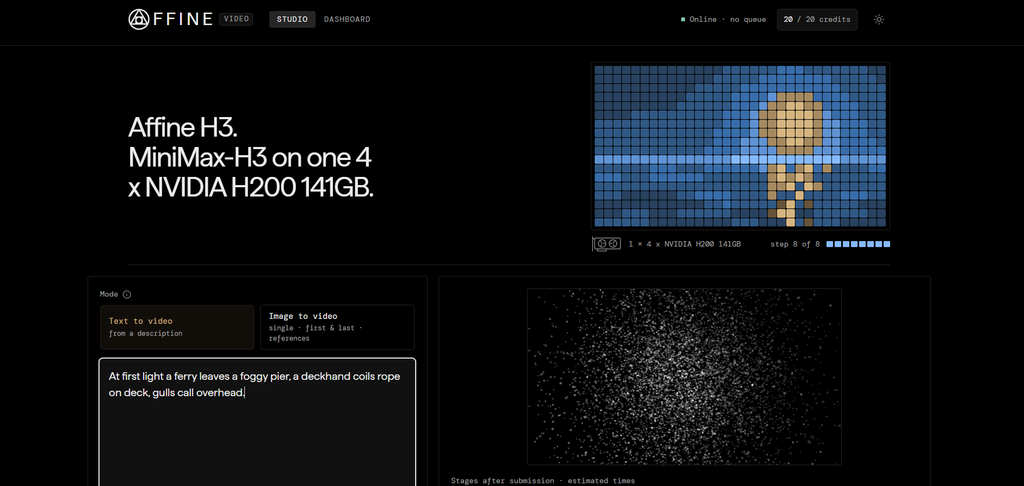
Users receive 20 free credits daily, while generations cost one to three credits. The studio also offers automatic prompt creation and a Pro mode for advanced users.
Generation runs on a single NVIDIA RTX 5090 GPU, taking approximately 80 seconds to four minutes depending on video length.
How Sparse Attention Reduces Computing Costs
AI video generation requires significant computing power to process relationships between objects and movements across frames. Affine’s competition uses sparse attention, a technique that reduces processing requirements by focusing on the most important connections.
Miners train a component called a selector to identify these connections without modifying the underlying video model.
The approach builds on Veda, a research method that previously demonstrated comparable video quality at 90% attention sparsity and a 5.1× speedup in a separate experiment. These results have not yet been reproduced in Affine’s competition.
How Miners Compete on SN120
Miners submit trained selector weights through public Hugging Face repositories without needing to operate video-generation servers.
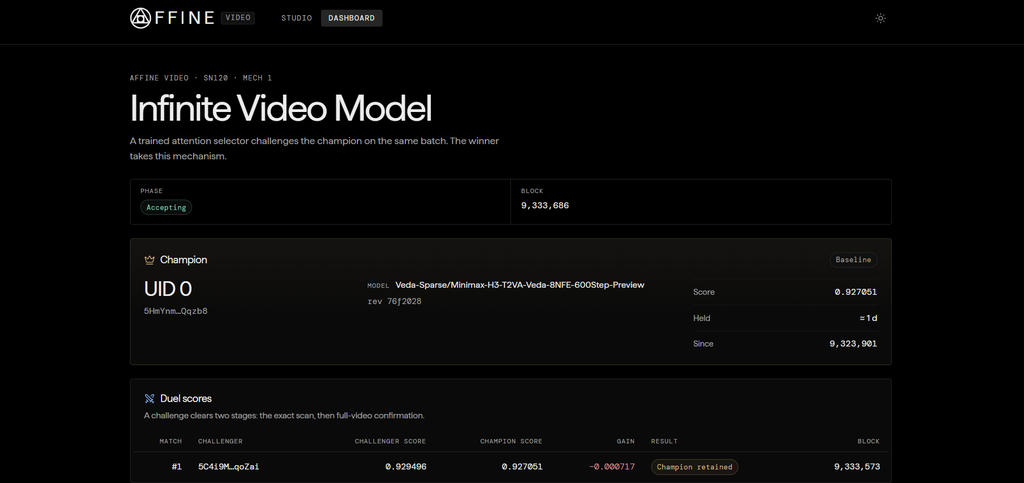
Affine’s Infinite Video Model Dashboard
Each eligible hotkey receives one submission opportunity. Candidates undergo two evaluation stages measuring attention efficiency, computational cost, and final video quality.
To become champion, a miner must demonstrate statistically significant improvements over the current leader in both stages. The winner receives the full reward weight allocated to mechanism 1 on SN120.
Early Results and What Comes Next
At the time of initial reporting, one challenger had been evaluated. UID 472 narrowly outscored the reference champion but failed to meet the required statistical confidence threshold, leaving UID 0 as champion.

Affine’s Submission History
The competition runs alongside Affine’s MiMo GRPO language-model training track. The initiative will test whether Bittensor miners can make AI video generation faster and less expensive while maintaining output quality.
➛ Generate Videos on Affine Video Studio Here.
Enjoyed this article? Join our newsletter
Get the latest TAO & Bittensor news straight to your inbox.
We respect your privacy. Unsubscribe anytime.
Enjoyed this article?
Join our newsletter
Get the latest TAO & Bittensor news straight to your inbox — every morning before markets open.


No comments yet — be the first.