


Beam (SN105) is preparing to launch Beam Data Mesh, a decentralized layer that lets data flow across Cloudflare R2, Amazon S3, Hippius (SN75), and any other supported provider without being trapped inside a single ecosystem.
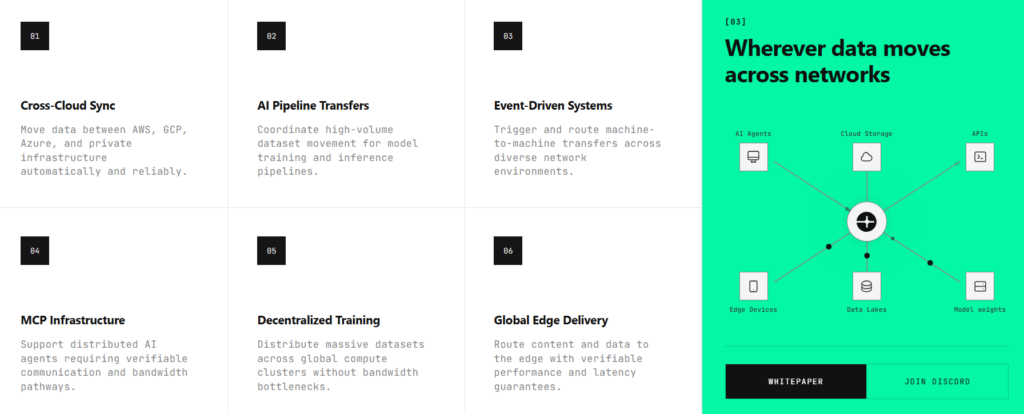
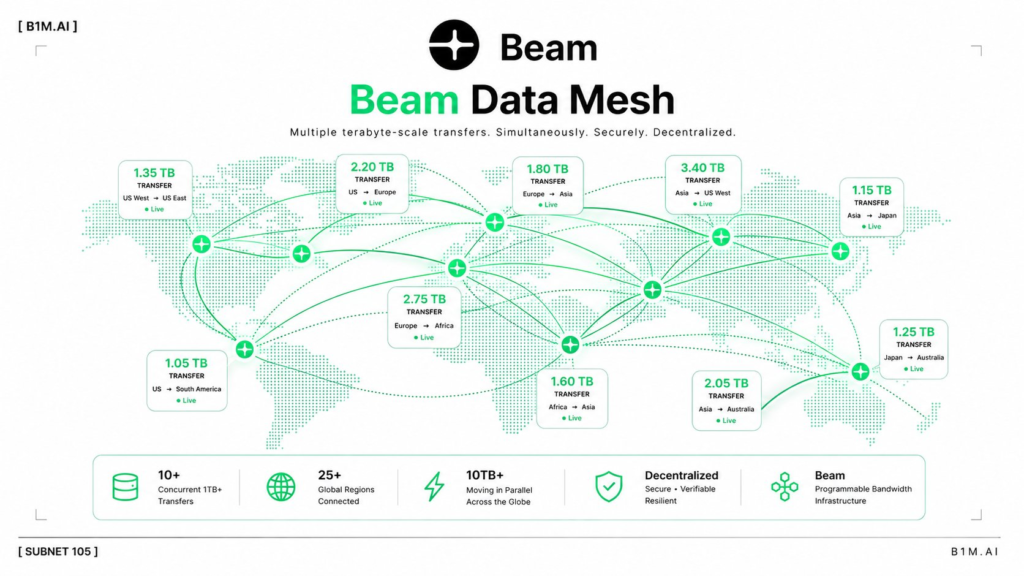
The system already handles ten or more concurrent terabyte-scale transfers across 25+ global regions, moving over 10TB in parallel with decentralized security and verifiable resilience.
Beam (SN105) is turning bandwidth itself into programmable infrastructure, closing the gap between storage networks that historically could not talk to each other at enterprise scale.
What Beam Data Mesh Enables
The Mesh solves the specific problem that has kept enterprise data workflows anchored to single cloud providers: moving terabytes between ecosystems has always been slow, expensive, or both.
1. Multi-provider support: Cloudflare R2, Amazon S3, Hippius (SN75), and additional networks in the pipeline.
2. 10+ concurrent 1TB+ transfers: Enterprise-scale volume moving simultaneously rather than sequentially.
3. 25+ connected global regions: US West to US East, US to Europe, Europe to Asia, Asia to Australia, and every combination in between.
4. 10TB+ moving in parallel: Real global throughput rather than single-lane bandwidth.
5. Decentralized security: Secure, verifiable, and resilient by design rather than dependent on a single operator.
6. Programmable bandwidth as infrastructure: Every transfer is composable, not manual.
Enterprises and AI workloads that previously had to pick one cloud and stay there now have a decentralized path between all of them, with the transfer layer handling the coordination.
Where This Fits Beam’s Broader Roadmap
Beam has spent recent months compounding its transfer benchmarks, moving from 107 GB in 2:16 minutes to 1.12 TB in 3:40 minutes, and the Data Mesh is the productized version of what those benchmarks were proving.
10x times the transfer volume in comparable time is what an enterprise buyer needs to see before betting on decentralized infrastructure. For a subnet building toward being the interoperability layer for AI and enterprise data, this is the moment where programmable bandwidth stops being a demo and starts being infrastructure the market can actually plug into.
The era of moving terabytes between ecosystems is here, and Beam (SN105) is the layer making it possible.
Enjoyed this article? Join our newsletter
Get the latest TAO & Bittensor news straight to your inbox.
We respect your privacy. Unsubscribe anytime.
Enjoyed this article?
Join our newsletter
Get the latest TAO & Bittensor news straight to your inbox — every morning before markets open.



Be the first to comment