

VIDAIO (SN85) commissioned an independent benchmark comparing video encoding efficiency across major cloud providers, and the results put it first on compression efficiency in both AV1 and H.265.
The benchmark tested 30 real-world clips across e-commerce, user-generated content, archives, and security and surveillance, with each clip encoded against three defined VMAF (Video Multi-Method Assessment Fusion) quality targets.
The bigger finding sits underneath the compression numbers: every other configurable provider needed three to five encodes to reach the target, while VIDAIO reached it in one.
At 1,000 hours of video per year, the estimated encoding cost gap was roughly $4,000 versus as much as $145,000 at the top end of the tested alternatives.
Inside the Benchmark
The test compared five providers across 30 clips, two codecs, and three VMAF quality targets. The lineup: VIDAIO, AWS MediaConvert, Bitmovin, Brightcove Zencoder, and a self-hosted FFmpeg reference.
The objective was to find the smallest file at matched visual quality, then calculate the real operational cost of getting there:
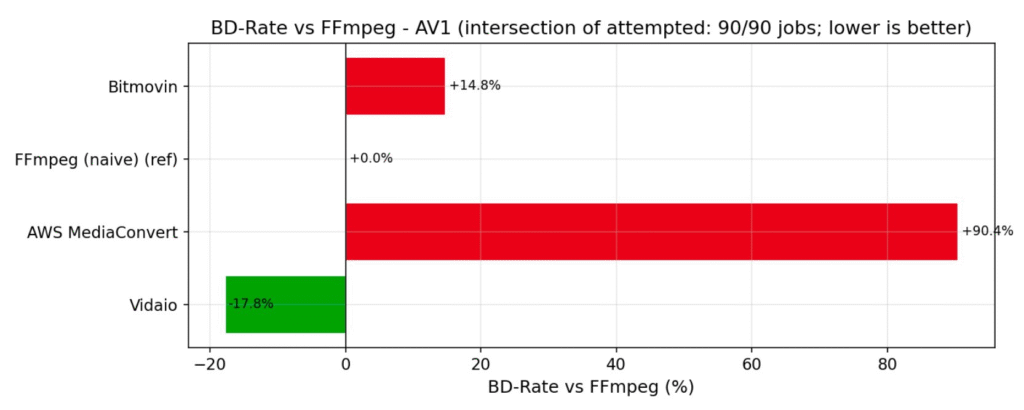
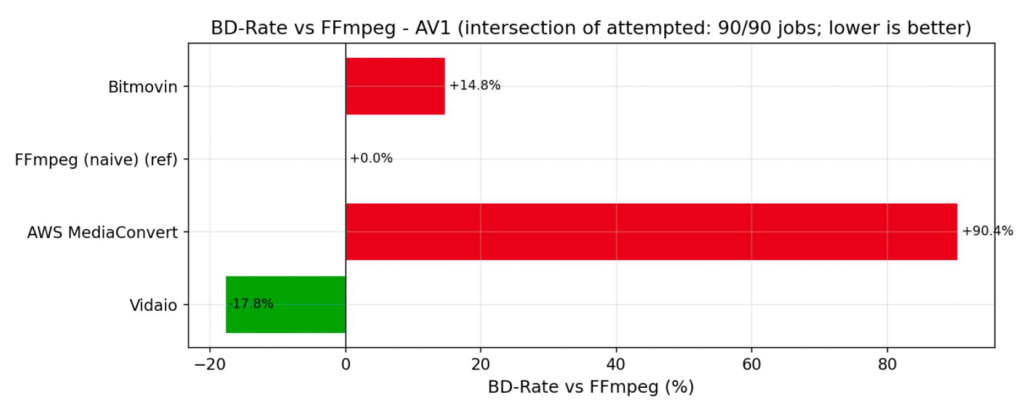
1. VIDAIO ranked first on compression efficiency in both codecs. Against the self-hosted FFmpeg baseline, VIDAIO required approximately 7.8% fewer bits in AV1 and 9.7% fewer bits in H.265 at matched visual quality. The gaps were larger against the managed cloud providers.
2. The single-encode workflow is the core finding. Most platforms require the user to tune parameters (bitrate, CRF, preset, rate control) and re-encode until the quality target is hit. Configurable providers in the test needed three to five encodes per target. VIDAIO accepts the quality target as a direct API input and returns a single output.
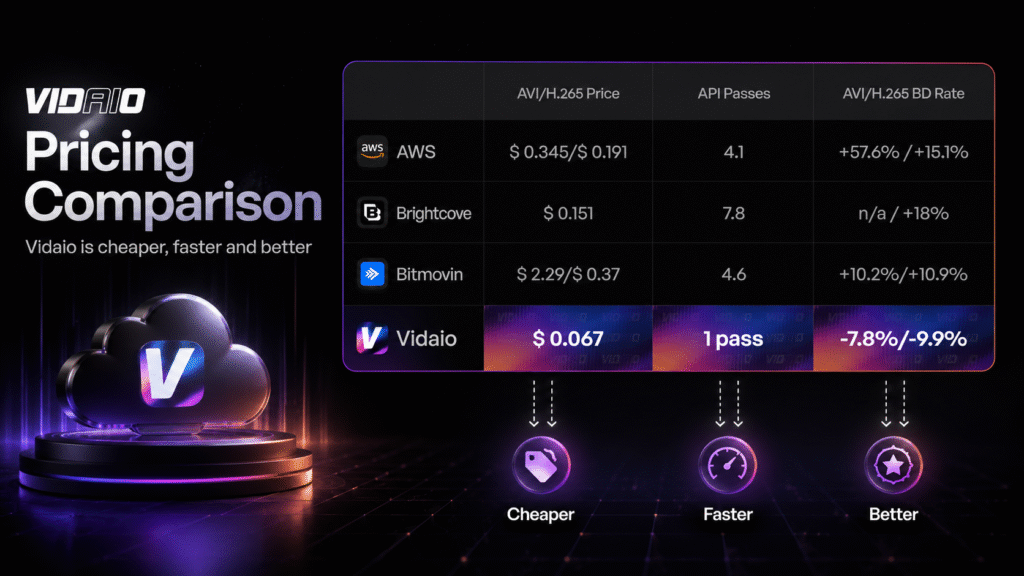
3. The cost gap at scale is substantial. VIDAIO was estimated at approximately $0.067 per delivered minute. At the top end of the tested managed workflows, the cost reached approximately $2.42 per delivered minute. At 1,000 hours per year, that translated to $4,000 with VIDAIO versus up to $145,000 with the alternatives.
4. Archive footage produced the most striking result. On grainy archive clips with targets of 85 VMAF and above, managed cloud providers scored between 19 and 59, with an average around 36. Only VIDAIO and self-hosted FFmpeg reached the target range.
5. Surveillance content compressed efficiently across providers. Low-motion scenes compress well by default, so the providers grouped more closely here. The opportunity comes from volume, since surveillance systems run continuously across cameras, buildings, and transport networks.
6. VIDAIO’s accuracy was high but not strictly above target. The system hit the target in 68% of jobs, landed within one VMAF point in 95% of jobs, and remained within 1.5 points in every job. Other providers were permitted to re-encode and select the closest attempt. VIDAIO generated one result per job, which is where the cost savings come from.
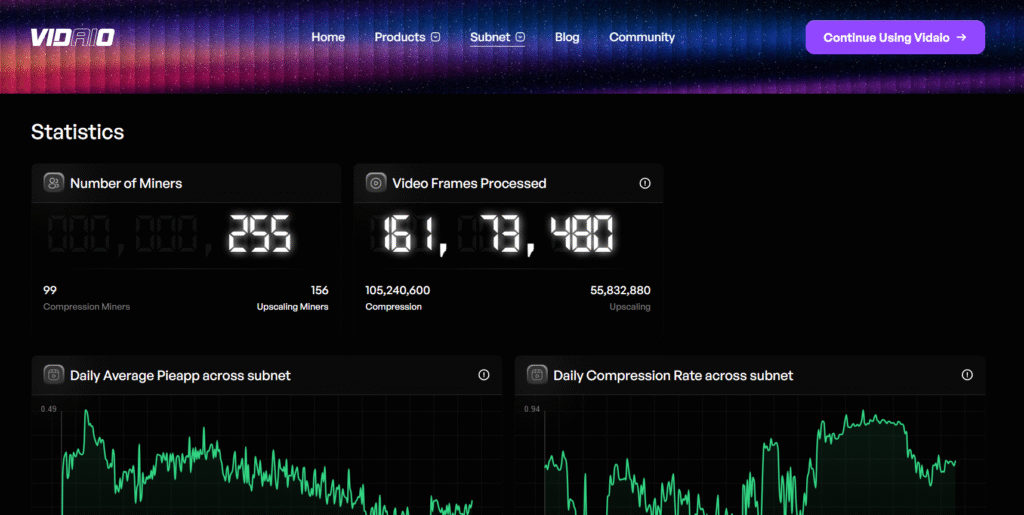
The benchmark’s broader argument is that price per encoded minute is the wrong commercial metric. The right one is cost per successfully delivered minute at the requested quality. A provider charging a low rate but needing four attempts costs four times the advertised figure before any engineering overhead is added.
The Workflow Argument
VIDAIO’s compression efficiency lead is meaningful on its own, but the workflow advantage is what changes the economics of video encoding at scale.
A centralized provider that needs four attempts to hit a target effectively charges four times the rate card rate before any engineering or storage costs are added.
A single-encode workflow eliminates that waste, and the bitrate advantage compounds across thousands of hours of stored, transferred, and delivered video.
For any business with petabytes of video that need encoding once and delivering many times, the gap between $4,000 and $145,000 per 1,000 hours is the difference between video being a manageable line item and an infrastructure problem.
Enjoyed this article? Join our newsletter
Get the latest TAO & Bittensor news straight to your inbox.
We respect your privacy. Unsubscribe anytime.
Enjoyed this article?
Join our newsletter
Get the latest TAO & Bittensor news straight to your inbox — every morning before markets open.

No comments yet — be the first.