

A new wave of crypto-native investing is emerging where AI agents execute entire strategies end-to-end. In this video, Lewis Jackson demonstrates how he built a fully automated investment system around Bittensor using AI tools, real-time data feeds, and programmatic execution.
He claims the system generates consistent daily returns and can be deployed in minutes. In this video, we walk through the whole process. Remember, none of the content of this article serves as financial advice.
The Core Idea: Outsourcing Strategy to AI
Rather than manually analyzing subnets or market conditions, the creator builds his strategy by leveraging AI, specifically Claude, to do the heavy lifting.
Instead of becoming a domain expert in Bittensor, he:
- Aggregates expert knowledge (via transcripts)
- Feeds it into AI
- Extracts a structured investment strategy
The expert he models is Mark Jeffrey, whose views and portfolio allocations are reconstructed by scraping and analyzing his podcast appearances.
This effectively turns AI into a “synthetic fund manager,” replicating the thinking of a seasoned investor.
Portfolio Structure: Balancing Stability and Upside
The resulting strategy divides capital into two main components:
1. Core Position (50%) — Root Staking
Half of the portfolio is allocated to holding and staking $TAO directly.
- Lower risk profile
- Generates steady emissions (yield)
- Comparable to holding an index like the S&P 500
2. Alpha Positions (50%) — Subnet Tokens
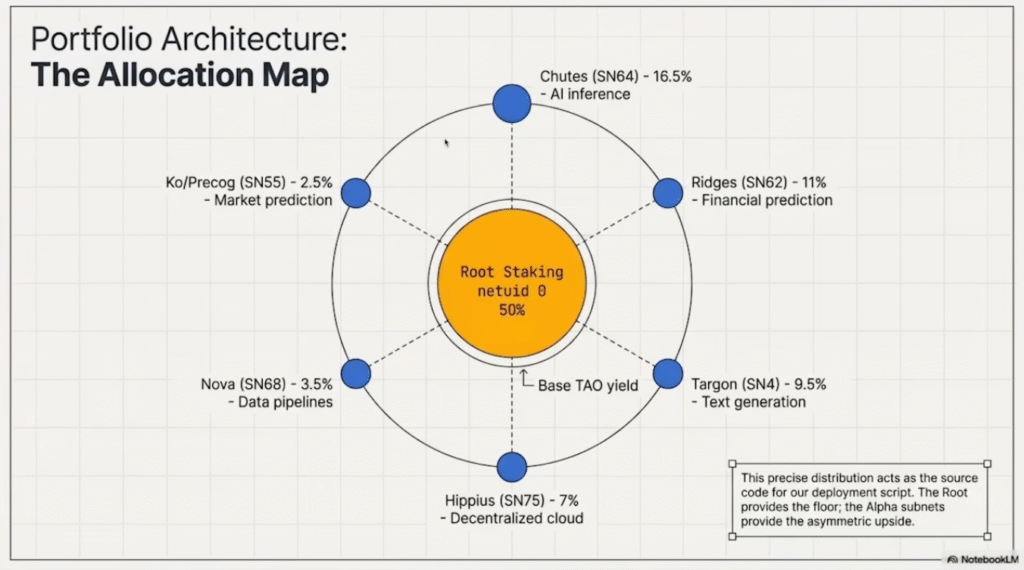
The remaining capital is distributed across high-upside Bittensor subnets, including:
- SN64 (Chutes)
- SN62 (Ridges)
- SN4 (Targon)
- SN75 (Hippius)
- SN68 (Nova)
- SN55 (NIOME)
Each subnet receives a percentage allocation based on inferred conviction levels from the AI analysis.
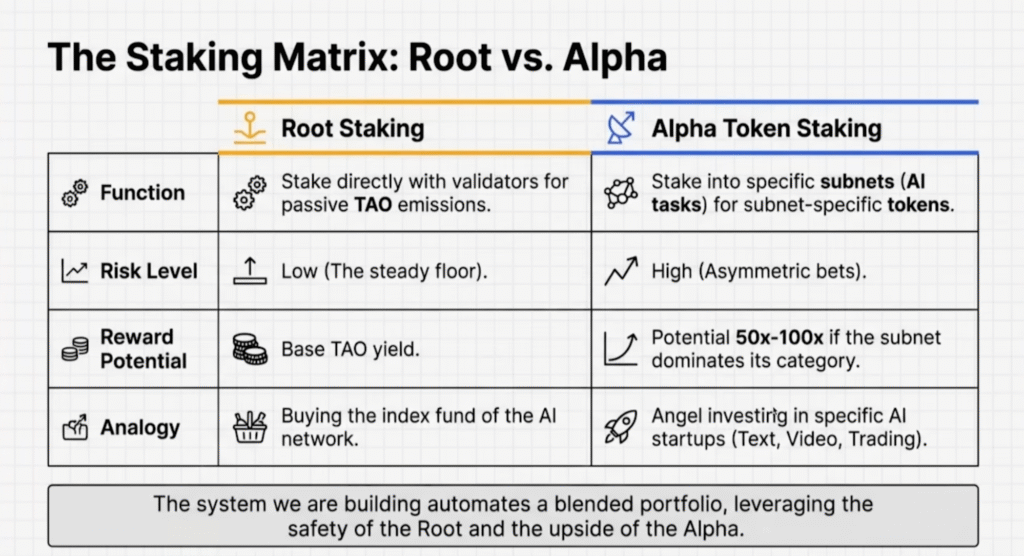
This mirrors a classic portfolio structure:
- Core asset (TAO) = stability
- Subnets = venture-style bets
The Automation Layer: AI + CLI + Python
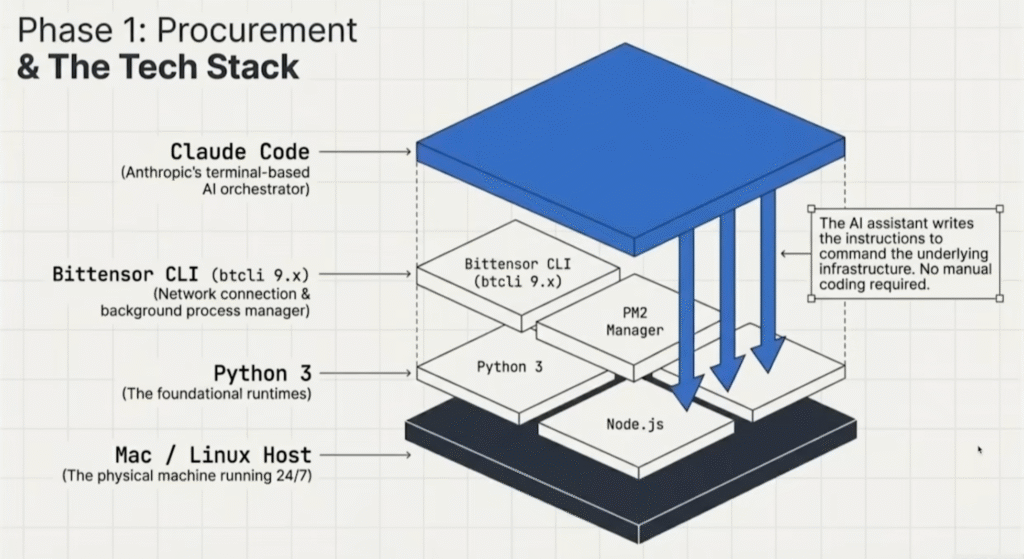
What makes this system unique isn’t just the strategy, it’s the execution.
The full stack looks like this:
- AI Layer: Claude interprets strategy and makes decisions
- Execution Layer: Bittensor CLI (Command Line Interface)
- Logic Layer: Python scripts automate actions
- Data Layer: CoinGecko API for real-time pricing
This allows the system to:
- Monitor market conditions continuously
- Execute trades automatically
- Stake and rebalance positions
- Run without manual intervention
All actions are triggered by predefined rules derived from AI analysis.
Trading Logic: Rules-Based Execution
The system follows a structured set of rules:
Entry Strategy
- If $TAO drops by a certain percentage (e.g., 3% daily), the system buys
- Capital is deployed in multiple tranches (e.g., 5 entry points)
Exit Strategy
- If a subnet token rises significantly:
- Sell partial positions (e.g., 10% on 10% daily gains or 100% overall gains)
- Profits are rotated back into $TAO
Long-Term Hold
- A fixed portion (e.g., 10%) is never sold
- Reserved for long-term “generational” upside
This creates a hybrid system combining:
- Dollar-cost averaging
- Momentum trading
- Profit-taking discipline
Real-Time Monitoring and Alerts
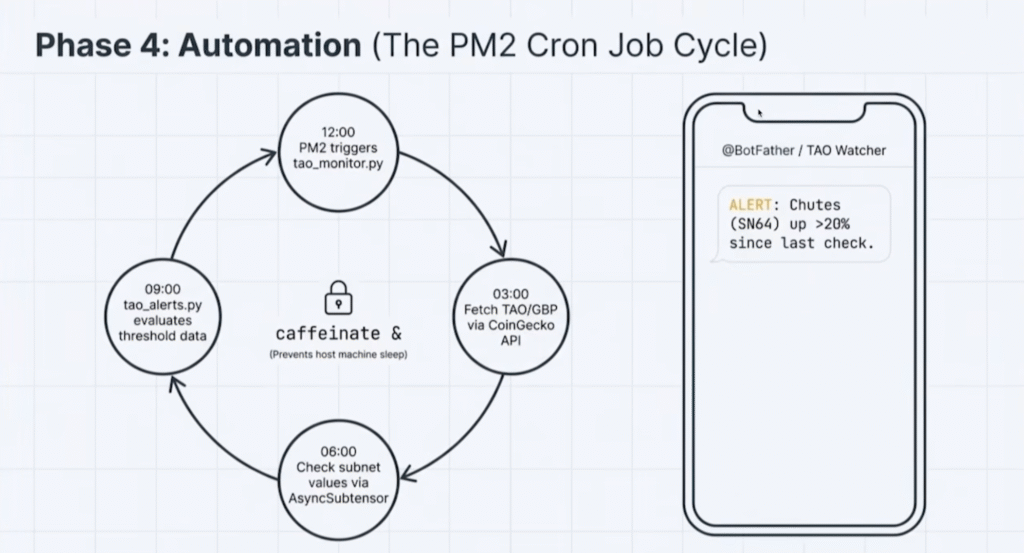
To stay informed without constant oversight, the system integrates with Telegram.
Users receive alerts when:
- Trades are executed
- Prices hit key thresholds
- Portfolio changes occur
This turns the system into a semi-autonomous agent with human visibility but no need for manual input.
Catalyst Tracking: Beyond Price Signals
The system doesn’t rely only on price movements. It also monitors broader ecosystem signals, such as:
- Exchange listings of subnet tokens
- Institutional activity (e.g., fund raises)
- Key figures like Barry Silbert
- Revenue performance of subnets
- Infrastructure expansions (e.g., integrations with other chains)
These catalysts inform when to:
- Take profits
- Increase exposure
- Adjust allocations
Setup Process: From Zero to Running in Minutes
While the video walks through a manual setup (terminal, wallet creation, API keys, etc.), the creator also provides a shortcut:
- A prebuilt script that sets up:
- Folder structure
- Wallet configuration
- Trading logic
- Automation scripts
Access the full prebuilt script here.
Users can:
- Copy and paste the script into Claude
- Answer a few prompts
- Deploy a working system in under 10 minutes
Resources to Get Started
Here are resources to help you get started with your automated trading system:
- Download the 10 Minute Set Up document for free.
- Build your AI trading setup with Lewis Jackson.
- The 10X Challenge Dashboard.
Watch the full video on YouTube:
Enjoyed this article? Join our newsletter
Get the latest TAO & Bittensor news straight to your inbox.
We respect your privacy. Unsubscribe anytime.
Enjoyed this article?
Join our newsletter
Get the latest TAO & Bittensor news straight to your inbox — every morning before markets open.



No comments yet — be the first.