


For those tracking subnet ‘$ALPHA’ tokens on Bittensor and have been trying to make sense of its price movements, the real question is not where it trades today, but whether the underlying mechanics justify sustained attention.
In crypto, price often moves ahead of fundamentals, or lags behind them entirely. The only way to cut through that noise is to examine the structure beneath the token: What drives demand, how value flows, and whether the system is designed to compound over time.
0xMarkets does not attempt to reinvent token economics from scratch. Instead, it anchors itself directly within the architecture of Bittensor, inheriting a model that is already aligned around production, incentives, and measurable output. That decision alone defines how its token behaves.
The Foundation: $ALPHA Within the Bittensor Subnet Model
To understand subnet tokens, you first need to understand the environment it operates in. Bittensor is structured as a network of subnets, each focused on a specific domain of useful work. Every subnet has its own token, known as $ALPHA, which is launched through an automated bonding curve rather than traditional distribution mechanisms.
This has several implications:
a. No presales or private allocations,
b. No delayed unlock schedules that introduce structural sell pressure, and
c. Market-driven price discovery from inception
0xMarkets operates on Subnet 35 within this framework. The subnet emits:
a. 7,200 $SN35 tokens daily, distributed to miners and validators, and
b. A share of 3,600 daily $TAO emissions, allocated based on subnet performance
$ALPHA is not an isolated asset, it is embedded in a competitive system where emissions are tied to contribution, not narrative.
$SN35’s Role: Governance, Yield, and Protocol Alignment
$SN35 functions as the core coordination layer of 0xMarkets. It governs how value flows through the system, how decisions are made, and how participants capture upside from protocol activity.
$SN35 enables three things:
a. Participation in governance,
b. Access to protocol-generated yield, and
c. Alignment with long-term platform growth.
These functions are expressed through a staking mechanism that transforms $SN35 into a more active asset.
veAlpha: Staking as Economic Positioning
When $SN35 is staked, it converts into veAlpha, a non-transferable representation of both economic and governance weight within the protocol.
This design introduces two simultaneous effects.
1. Yield Accrual
veAlpha holders receive a share of exchange revenue, specifically up to 40% of all trading fees.
Participants can choose how rewards are distributed, either:
a. $USDC for stable income, or
b. $SN35 for exposure and compounding.
When $SN35 is selected, the protocol sources it from the open market before distribution. This introduces continuous buy-side pressure tied directly to platform activity rather than speculative demand.
Additionally, rewards can be auto-staked, allowing positions to grow without manual intervention.
2. Governance Influence
veAlpha is also a voting instrument, and its holders influence fee distribution parameters, allocation of protocol revenue, and future configuration of the exchange.
This creates a system where economic exposure and decision-making power are directly linked.
Revenue Flows: How Value Moves Through the Protocol
0xMarkets generates revenue primarily through trading activity, and that revenue is systematically distributed.
1. Trading Fees
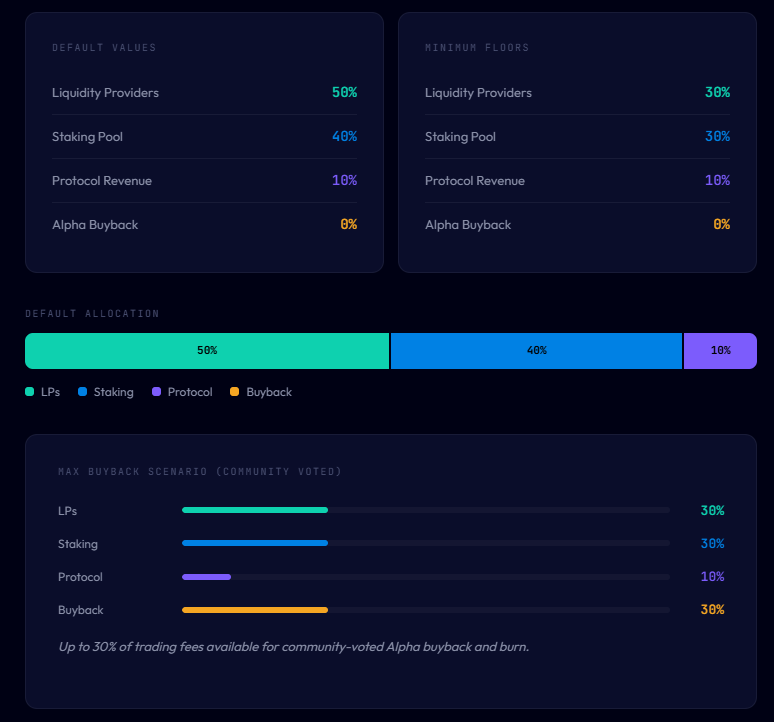
Trading fees are divided into multiple allocation buckets, which can be adjusted through governance. These allocations determine:
a. Staker rewards,
b. Buyback and burn intensity, and
c. Treasury or operational funding.
The key point is that fee distribution is not static. It is an actively managed variable controlled by participants.
2. Liquidation Fees
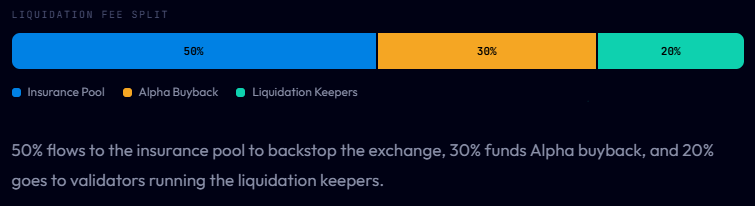
Liquidations introduce an additional revenue stream, separate from standard trading fees. These are distributed across:
a. Protocol incentives,
b. Market stabilization mechanisms, and
c. Community-aligned allocations.
Together, these flows ensure that value is consistently generated and routed through the system, rather than relying on emissions alone.
Demand Drivers: Why $SN35 Is Not a Passive Governance Token
Most governance tokens rely on a single narrative, which is voting rights. $SN35 introduces multiple demand vectors that operate simultaneously.
1. Yield-Driven Demand
a. Stakers earn a portion of real trading revenue,
b. Choosing $SN35 rewards triggers market buybacks, and
c. Compounding increases both yield and governance power.
This ties demand directly to exchange usage.
2. Governance-Driven Demand
a. veAlpha holders influence how aggressively the protocol buys back its own token, and
b. Participants can vote to increase or decrease buy pressure.
This creates a feedback loop between ownership and policy.
3. Access-Driven Demand
Future products and features are expected to be gated or enhanced through $SN35, thereby introducing an additional utility layer beyond finance.
Each channel operates independently, but reinforces the others.
The Flywheel: Where Mechanics Become Momentum
The most important aspect of $SN35’s design is not any single feature, but how they interact. The system forms a self-reinforcing loop where:
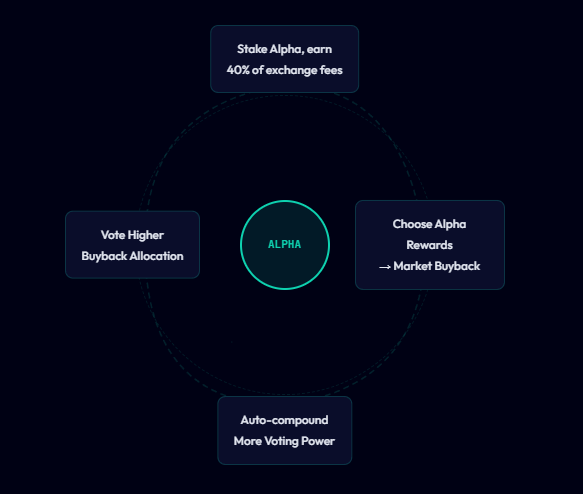
a. Stakers choose $SN35 rewards,
b. The protocol buys $SN35 from the market,
c. Staked positions grow through compounding,
d. Governance power increases,
e. Participants vote for stronger buyback allocations, and
f. Additional buy pressure is introduced.
This cycle does not depend on external incentives or temporary liquidity programs, it is sustained by real trading activity, continuous revenue generation, and active governance participation.
As long as the exchange produces volume, the flywheel remains in motion.
Structural Advantage: Built on Production, Not Narrative
By integrating directly into Bittensor, 0xMarkets avoids many of the pitfalls seen in standalone token launches. As such, there is no need to manufacture scarcity or engineer artificial demand.
Instead:
a. Emissions are tied to network contribution,
b. Value accrues through real usage, and
c. Governance controls how that value is distributed.
This creates a system where fundamentals are not an afterthought, but the primary driver of token behavior.
Conclusion: Evaluating $ALPHA on Its Own Terms
$ALPHA is not designed to be a passive asset that derives value from speculation alone. It is a coordination mechanism embedded within a revenue-generating system, where:
a. Activity drives income,
b. Income drives buy pressure, and
c. Buy pressure reinforces governance incentives.
The question for participants is not whether the token will move in the short-term. It is whether this structure, built on production, distribution, and compounding incentives, is strong enough to sustain attention over time.
Because in the long-run, token economies are not judged by their narratives, they are by whether their mechanics hold under pressure.
Enjoyed this article? Join our newsletter
Get the latest TAO & Bittensor news straight to your inbox.
We respect your privacy. Unsubscribe anytime.
Enjoyed this article?
Join our newsletter
Get the latest TAO & Bittensor news straight to your inbox — every morning before markets open.


No comments yet — be the first.