


Bittensor has attracted serious ML talent, but the network has yet to produce a widely used open-source LLM or an equivalent frontier deliverable. Brian McCrindle, the Macrocosmos engineer behind IOTA (SN9), Data Universe (SN25), and the mechanisms powering Bitstarter sat down with the Bitstarter team to explain why.
Infrastructure is the bottleneck rather than talent, and dTAO (dynamic $TAO) has ended the phase where subnets could subsist on emissions alone. Research alone is not investable without a market attached, and the biggest mistake first-time subnet founders make is treating subnet ‘$ALPHA’ token price like a scoreboard for their own worth.
The Bottleneck Is Infrastructure, Not Talent
Serious machine learning is already happening across Bittensor, with subnets like BitMind (SN34) and Zeus (SN18) producing genuine research output. What the ecosystem has not yet produced is a widely used open-source LLM, and the reason is not a shortage of ambition.
1. Compute subnets need deeper capacity: Without abundant compute at competitive prices, frontier training runs are structurally impossible.
2. Storage infrastructure has to keep pace: Training generates massive checkpoint and dataset requirements that decentralized storage has to service reliably.
3. Distributed pretraining is maturing but not solved: Non-blocking synchronization has been demonstrated, but scaling it to production frontier runs is ongoing work.
4. Custom RL environments are missing: Reinforcement learning depends on task-specific environments no single subnet has fully built out.
The foundations are being laid, but the timeline is set by how fast the right talent and coordination arrive.
What dTAO Ended For Builders
The move to dTAO enforced a discipline the earlier phase of Bittensor did not require.
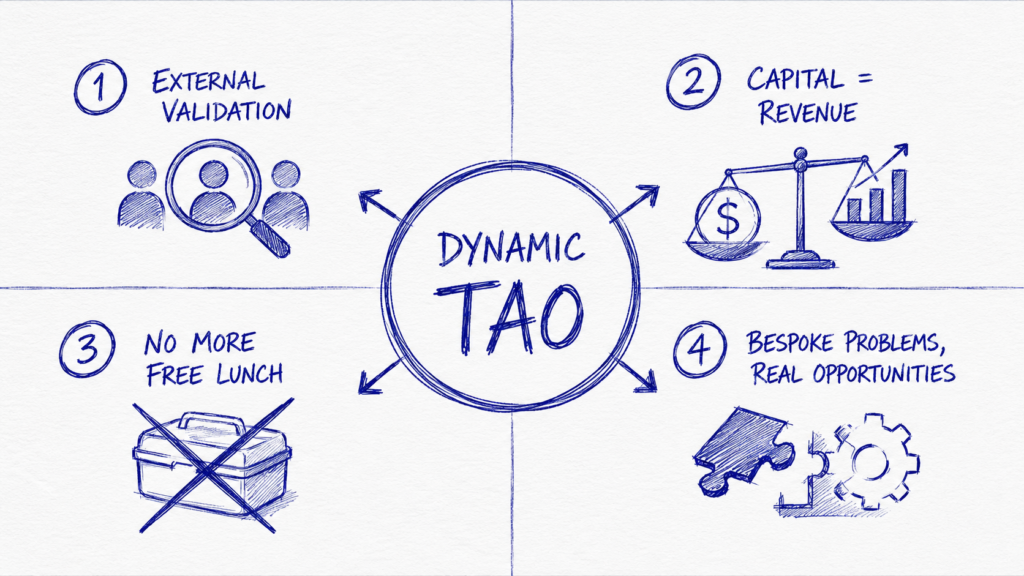
1. External validation moved to the center: Builders now spend serious time gathering conviction from investors across the size spectrum.
2. Capital and revenue became the same conversation: $ALPHA price behavior maps to how much capital a subnet attracts and how much runway it earns.
3. The ‘free lunch’ ended: Every product must be desired, even if only by other Bittensor teams at first.
4. Bespoke Bittensor problems became commercial opportunities: The network has its own specific technical needs, and building for those needs is a legitimate market entry point.
What Fits Bittensor
Bittensor is currently the world’s best solution to decentralized AI, but not every ML project fits the network. Identifying the right target is a matter of mapping the AI stack and finding the gaps decentralization can plausibly fill.
1. Start with the entire AI stack: Identify what teams are doing and where the holes sit.
2. Fill holes only decentralization can plug: Those are the ones worth attacking.
3. Call the teams already building: Early product-market fit conversations shape the specification.
4. Synthetic data generation is one clear fit: The market needs it, and Bittensor’s structure can produce it at scale.
5. Auto-researcher style subnets are another: Systems that surface findings and open their solutions have room to grow.
Research alone is not investable because research cycles in and out of fashion. A research-led subnet has to be backed by a market or by convincing evidence that the research matters, and teams focused purely on research often find it more productive to partner with an existing subnet than to launch independently.
Where First-Time Founders Get Burned
The most common failure mode is emotional overreaction to short-term market signals.
1. Prices, social media, and hype cycles will burn founders who do not believe in their foundation: Emotional trading of your own $ALPHA is a leading indicator of failure.
2. Bittensor’s community structure differs fundamentally from VC: The open community of builders wants each other to succeed.
3. VC-backed builders remain beholden to ROI (Return on Investment) timelines: Bittensor builders remain accountable to the ecosystem instead.
4. Building on Bittensor is faster and produces more robust products: The community backing accelerates iteration in ways closed cap tables cannot match.
Bitstarter’s ML Track
The interview is part of an ongoing Bitstarter series speaking with leading ML engineers, researchers, and founders about what Bittensor needs to enable more ambitious machine learning, and what strong teams need to build successfully on the network.
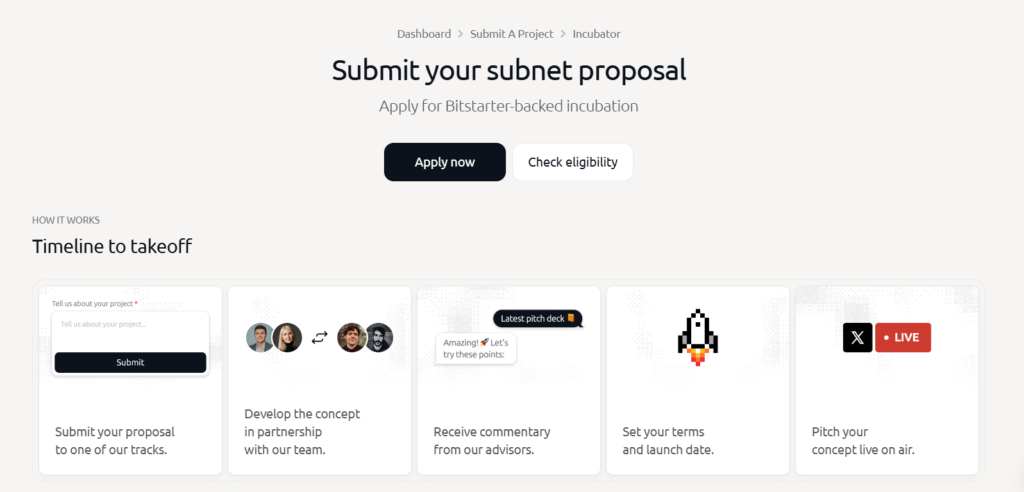
The ML Track itself is the operational answer to that question, structured to hand selected teams subnet ownership from day one alongside compute access, technical review, engineering support, launch distribution, and investor and community relations backing.
Faster and More Robust
Bittensor’s ML story is not being held back by talent or ambition, but by the depth of infrastructure required to make decentralized frontier work possible. dTAO has ended the phase where subnets could subsist on emissions alone. Research needs a market attached or a subnet partnership to accelerate it, and founders who treat their alpha price like a report card will lose their nerve when the cycle turns against them.
What Bittensor offers in return is a community of builders that wants each other to succeed and a compounding output that ships faster and holds up better than what a VC-funded team building in isolation can produce.
➛ To Know More and Apply for Bitstarter’s ML Track, Click Here
Enjoyed this article? Join our newsletter
Get the latest TAO & Bittensor news straight to your inbox.
We respect your privacy. Unsubscribe anytime.
Enjoyed this article?
Join our newsletter
Get the latest TAO & Bittensor news straight to your inbox — every morning before markets open.


No comments yet — be the first.