

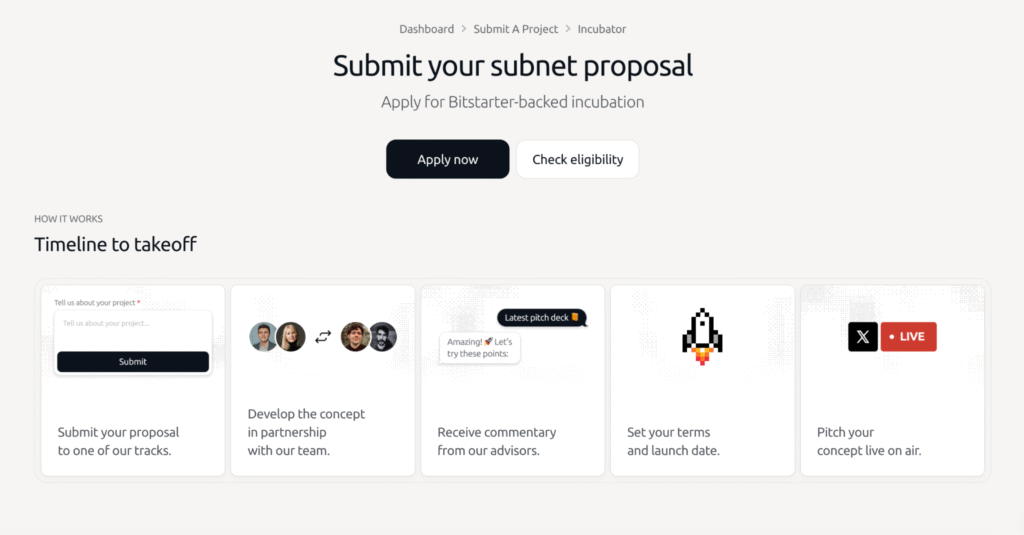
Bitstarter has opened submissions for a new machine learning incubator aimed exclusively at machine learning teams looking to launch subnets on Bittensor. The programme is backed by Const (Jacob Steeves) and runs as a more specialised offshoot of the platform’s existing crowdfund model.
This ML track was built with the intention that researchers with strong whitepapers or early-stage experiments shouldn’t have to choose between joining a closed lab and giving up their IP. The programme is built as a third path: enabling researchers to retain ownership, build on open infrastructure, and have their work evaluated continuously through live benchmarks, incentives, and open competition.
What teams get
Accepted teams launch with a freshly-registered subnet slot, full ownership rights (including cold key holding), alpha from day one, alongside support that includes:
- A100- and H100-class compute resources through Targon
- Technical feasibility reviews from Const, the advisory panel, and the Bitstarter team
- Partnerships with specialist ML development agencies and blockchain engineers to build and scale subnet architecture
- Editorial coverage, launch campaigns, livestreams, and distribution through Tensor Media Group
- Investor introductions and validator-side relationship building from the earliest stages
Bitstarter is positioning the track as infrastructure for systematically discovering and accelerating frontier machine learning on Bittensor. The goal is to identify promising research, pressure-test it against Bittensor fit, and help the strongest ideas evolve into durable Bittensor subnets.
That’s why the incubator is designed around the failure modes that repeatedly prevent strong subnet ideas from succeeding: infrastructure constraints, validator alignment, incentive design, positioning, distribution, and market timing.
The track record
Bitstarter’s existing crowdfund model has already helped launch teams exploring long-context language modelling, intelligence asymmetry markets, agent-first payments, and advertising intelligence.
One of the most notable examples is Quasar, whose attention model research reportedly reduced pre-training costs for long-context LLMs by roughly 99.5%, bringing training costs for a 20B-parameter MoE system below $50k.
The incubator also builds on the broader track record of Const-backed teams within the Bittensor ecosystem. Macrocosmos and Targon have contributed to some of the largest decentralised model training efforts to date, including collaborations involving Intel. Macrocosmos’s ResBM (Residual Bottleneck Models) work demonstrated up to 128x activation compression with minimal convergence loss, helping make distributed training viable across normal internet connections.
These breakthroughs are not isolated events, but early signals of what decentralised machine learning systems are capable of producing.
Who they want
One of Bittensor’s core strengths is its ability to explore machine learning problem spaces openly, using incentives and benchmarking to rapidly validate what works. That makes it particularly well suited to foundational research, where breakthroughs emerge through continuous experimentation and optimisation.
As a result, the programme explicitly favours novel training methods, optimisation approaches, and intelligence evaluation systems over narrow task-specific applications. Applications are judged on three criteria:
- Technical fit for decentralised infrastructure, and likely to stay relevant as the field develops
- Standards set by the advisory panel
- Output (a model, benchmark, or training method) that adds genuine value to the open-source AI ecosystem
“Big breakthroughs in machine learning start as whitepapers or technical experiments – in universities, at small start-ups, or in independent labs. The problem is that turning that research into something sustainable usually means joining a large organisation, or giving up the intellectual property. We’re trying to build a third path.”
— Chris Zacharia, Bitstarter founder
How to apply
The submissions portal is live. The first full cohort closes in late June, with the inaugural team expected to be announced this month.
Apply: app.bitstarter.ai/submit-a-project/incubator
Enjoyed this article? Join our newsletter
Get the latest TAO & Bittensor news straight to your inbox.
We respect your privacy. Unsubscribe anytime.
Enjoyed this article?
Join our newsletter
Get the latest TAO & Bittensor news straight to your inbox — every morning before markets open.



[…] has provided compute credits to Cascade (Bittensor subnet 91), the first team from Bitstarter’s ML track, to support the launch and research of the […]